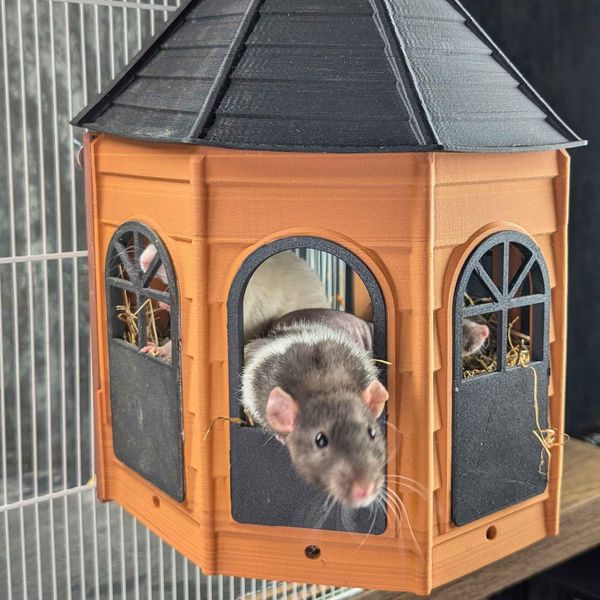
Hides and houses
 Shelves and ledges
 Foraging and toys
 Cage accessories
 Kits and bundles
 Fairy forest
 Spooky mischief
 Sweetie stash
 Game mode
 Forest floor
 Castles and cathedrals

Rat cage accessories by theme: quick answer
For themed rat cage accessories in the UK or anywhere else, start with the job the cage needs: a hide for cover, shelves for climbing, cups for foraging and bowls for feeding. Gothic and fairy rat cage accessories work best when the theme still gives rats real places to hide, perch and explore.
- Spooky and gothic rat cage accessories: dark themed hides, shelves and set-up pieces. Our gothic rat cage accessories guide shows how to use them.
- Fairy forest rat accessories: mushroom and woodland-style cage pieces.
- Rat hides and houses: start with cover, then add climbing and foraging.
Not sure your cage is big enough? Try our rat cage size and fit calculator first.
Rat hideouts, mats and accessories
For rat hideouts, choose a covered space that feels secure, has enough room for the rats using it, and can be cleaned properly. The RSPCA asks for a safe, dark hiding place for every rat, ideally one more than there are rats, each with more than one exit.
If you are building a cage from scratch, choose the essentials first: a hide, water, a food bowl, a climbing shelf or ledge, and something that makes feeding more active.
Our rat cage accessories
- Our full range of rat cage accessories, when you want to compare hides, shelves, bowls and enrichment pieces together.
- The Fairy Mushroom Rat Cage Accessory Kit, the fuller set-up option with several coordinated pieces.
- The Teapot Rat Hide and Teacup Shelves, a smaller hide-and-perch option.
- Our guide to what a rat cage should have in it, to read before choosing decorative pieces, especially for chewing, cleaning and supervision.
What are the best rat cage accessories?
The best rat cage accessories are the pieces that add a clear job to the cage. Start with cover, climbing, food interest and easy cleaning before decoration.
| Job | What it gives the rats | Examples |
|---|---|---|
| Hide | A covered place to rest, retreat and sleep | Houses, floor hides, hanging hides |
| Climb | Shelves, ledges or perches that use height safely | Corner shelves, ledges, natural-fibre ropes |
| Forage | Food spots and cups that make feeding more active | Hanging cups, puzzle feeders, digging boxes |
| Rest up high | A soft, shared bed off the floor | Hammocks, hanging beds |
| Decorate | Themed pieces that still give a practical benefit | Novelty hides, matching shelf sets |
If you are building a first set-up, use the complete rat cage setup guide. If your rats are bored, compare our rat cage enrichment ideas.
Decorative accessories work well when they are stable, easy to inspect, easy to clean and useful for the rats. If a piece only looks good in a photo and does nothing for the cage layout, keep it outside the cage.
Which rat accessory should you add first?
Choose rat accessories by the job missing from the cage. A hide gives rest, a shelf or ledge adds movement, a food point makes feeding cleaner, and a foraging toy keeps busy rats working for treats.
- Rat hides are the first stop when the cage needs a proper sleeping corner.
- Our guide to rat toys that keep rats busy helps when the set-up needs more foraging and problem solving.
- The full rat accessories range is the place to compare pieces by job.
Choose the right rat cage accessory
Don't start with the most decorative piece. Start with the part of the cage that needs help: sleep, movement, feeding, foraging, or a calmer first set-up.
- Houses and cabins are the first stop when the cage needs a covered rest spot.
- Shelves and climbing ledges fill long empty drops and give routes across the cage.
- Foraging and training toys help when busy rats need a food-based job.
- The rat cage setup guide is the better starting point if you are still planning the layout.
Build enrichment into the cage choice
Start with the path your rats use every day. A good set-up gives them a covered place to settle, a climbing path, a food-searching job and enough open space to move without crowding. The RSPCA also asks owners to rotate toys regularly and replace chewed ropes, which keeps the cage new without buying more.
- For a first set-up, use the rat cage setup guide before buying extra accessories.
- For food-based enrichment, compare foraging toys and place them away from the main sleeping spot.
- For calmer rest, choose from hides and houses before adding more decorative pieces.
- For a digging job, our rat digging box guide shows a simple, supervised set-up; the RSPCA suggests a box of clean sand or compost.
- For wider planning, use the rat enrichment toys guide to match each item to a real cage job.
These are the pieces we'd look at first, by the job they do. Check the measurements against your cage layout on each product page.
| Piece | Cage job | Good when |
|---|---|---|
| Fairy Mushroom Rat Cage Accessory Kit | Hide, climbing and foraging in one | One hide, two shelves and three hanging foraging cups, with fittings for standard wire cage bars |
| Teapot Rat Hide and Teacup Shelves | Hide and perch | You want a smaller hide-and-shelf choice for a themed cage |
| Fairy Mushroom Rat Hide | Hide | You need a focused hide, not the full kit |
| Dragon Rat Shelf Set | Climbing | The cage needs height and movement |
| Personalised Rat Diner Feeder | Feeding | You want food presentation and daily cage interest |
| Rat Picnic Bench Food Bowl | Feeding | You want a raised feeding point for fresh food, treats and simple mealtime enrichment |
| Botanical Rat Cage Bundle | Full themed set | You want eight matching pieces in one go |
| Space Rat Cage Bundle | Full themed set | Seven pieces: helmet and Saturn hides, three planet perches and two moon foraging cups |
Pet rat supplies: the full list
| Supply | What to look for | Read more |
|---|---|---|
| Cage | At least 80 × 50 × 80 cm (31 × 20 × 31 in) with 1 cm (0.4 in) bars for up to four rats (Wood Green); solid floors | Best rat cages |
| Bedding (substrate) | Paper, card or dust-extracted bedding; no sawdust, scented bedding, pine or cedar | Best bedding for rats |
| Hides | One more than the number of rats, dark, with two exits where possible | Our hides and houses |
| Hammocks | Two or more, washable, hung at different heights | Rat hammock guide |
| Shelves and ledges | Break up drops; cover any wire | Our shelves and ledges |
| Food bowl | Heavy, open ceramic | Rat food chart |
| Water bottles | At least two so all rats can drink at once; check daily for leaks and blockages | Rat drinking water |
| Rat food | A complete pellet or nugget made for rats, not rabbit or hamster food | What can rats eat? |
| Foraging toys | Cups, puzzles and a digging box | Our foraging toys |
| Wheel (optional) | Solid running surface, big enough that the back stays straight | Rat wheels |
| Carrier | Hard-sided, ventilated, for vet trips | Rat carriers |
| Litter tray | A corner tray with unscented paper pellets (Wood Green) | Rat cage cleaning |
| Digital kitchen scales | For weighing rats regularly, as the RSPCA advises | Rat health monitoring |
For costs, see our guide to how much a pet rat costs to buy and keep, and for the full shopping list in one place, our pet rat supplies page.
What to buy first
- Hide. Give the rats a covered place to sleep or settle, one per rat plus one.
- Shelf or ledge. Add a route through the cage's height and break up long drops.
- Feeding point. Keep food easy to find and easy to clean around.
- Foraging piece. Make food more interesting and give the rats a job to do.
- Theme piece. Add the style once the useful layout is already covered.
Before you choose a rat cage accessory
- It fits your cage space and doesn't block normal movement.
- You know how it mounts, stands or sits in the cage.
- You can remove it, inspect it and clean it.
- It has a real cage use: hiding, climbing, perching, feeding or foraging.
- It has no small loose parts, rough edges or peeling finish.
- You will inspect it regularly for chew wear or damage.
Don't use exercise balls. The RSPCA says they restrict exploration and cause rats high stress. Give supervised free-range time or a playpen instead.
Rat bed, rat hide, shelf or cage calculator?
People looking for rat cage accessories often mean quite different jobs. Use the choice that matches what the cage needs now, then choose the style.
- Rat bed or rat hide: browse rat hides and houses when the cage needs a covered sleeping or resting space. Our rat hide guide explains what makes a hide work.
- Rat cage shelf or climbing path: browse rat shelves and ledges, such as the Dragon Rat Shelf Set, when the cage needs safer paths through height.
- Foraging or feeding: read the rat diet guide, then choose the Rat Diner, the Rat Picnic Bench Food Bowl or our foraging and training toys when you want food to take more work than a plain bowl.
- Checking cage size first: use the rat cage size calculator if you are still deciding whether the cage has enough usable space.
Rat feeding schedule and feeding accessories
Feed rats twice a day, in the morning and the evening. The RSPCA says rats feed mainly at dawn and dusk, and asks owners to remove uneaten food and adjust portions so rats finish what they are given and stay a healthy weight.
| When | What | Accessory |
|---|---|---|
| Morning | Half the day's rat food; check and refill water | Heavy ceramic bowl; two bottles |
| Evening | The rest of the rat food plus a small portion of fresh veg | Bowl, or scatter in the bedding |
| A few times a week | Cooked egg, pulses or a little lean meat as treats (PDSA) | Foraging cups or a puzzle feeder |
| Daily | Remove uneaten fresh food; check bottles for blockages and leaks |
Wood Green suggests about 15 g (half an ounce) of dry food per rat per day, about two tablespoons, though the PDSA says to weigh it out by the packet's guide. Fresh food comes out of the daily allowance, not on top of it. The RSPCA also suggests scatter feeding and hiding food in bedding, tubes and digging trays, which is where foraging cups earn their place. For which foods are safe, see our safe food list for rats.
Choose accessories for the space you have
The best accessories make the cage easier to use, not just fuller. Build from comfort and movement before adding decorative pieces.
- Hide first. Give the rats a reliable resting place before choosing extra pieces around it.
- Path second. Add shelves or ledges that make the cage easier to cross without long empty drops.
- Food point third. Put bowls, cups or puzzles where the rats can reach them easily, away from the sleeping spot and the toilet corner.
- Theme last. Once the essentials work, choose the pieces that make the cage feel like one planned world.
Leave open floor. The RSPCA asks for room to run, stretch up on the back legs and climb, so stop adding pieces when the rats start squeezing between them.
Build the cage by job
For a simpler choice, use our guide to what a rat cage should have in it and choose one piece for each cage zone: sleeping, climbing, eating, toileting and play. If you are buying for a new set-up, start with our first 30 days with pet rats plan and its supplies checklist, then come back here to choose the cage pieces.
Cardboard hides
A cardboard box makes a good temporary hide and something to shred, forage through and rearrange, but it is throwaway. Keep it dry, clean and stable, take off tape, staples and loose pieces, and replace it when it gets wet, heavily soiled, collapsed or damaged. For a hide that lasts, choose one you can inspect and clean by its own care instructions. Our safe rat shredding toys guide covers paper and card checks, and our pet rat care hub links every other guide.
Rat cage accessory questions
What rat accessories should I buy first?
Start with a hide for every rat plus one, a shelf or ledge for climbing, a heavy ceramic food bowl, two water bottles and something for foraging. Those cover shelter, movement, food and daily interest. Add a hammock and themed pieces once the cage works, not before.
What rat feeding accessories are useful?
Useful feeding accessories make food easy to find, easy to clean around, or part of enrichment. Start with one heavy ceramic bowl, which the RSPCA prefers to metal, and at least two bottles so rats can drink at once. Then add foraging cups or a feeder, and use our rat food chart to plan fresh foods and treats.
Are decorative rat cage accessories safe?
They can be, when they are stable, easy to clean, sized for the cage and useful for the rats. Avoid loose ornaments, tiny parts that could be swallowed, unknown coatings, rough edges, and anything that blocks movement or cleaning. Check every piece for chew damage at each weekly clean.
What is a good rat cage accessory kit?
A good kit includes pieces that do different jobs rather than several of the same thing. Our Fairy Mushroom Rat Cage Accessory Kit is the clearest starter choice in our range because it combines a hide, two shelves, three hanging foraging cups and fittings for standard wire cage bars.
I want a rat bed or rat hide. Where should I start?
Start with our rat hides and houses collection. Choose a covered space that fits the cage, can be lifted out for checking and cleaning, and gives the rats a real place to rest. Aim for one more hide than you have rats, and add a hammock as an extra bed up high.
Should I check cage size before buying accessories?
Yes, if you are unsure the cage is big enough. Every accessory takes up room, and an overfilled small cage is worse than a sparse big one. Wood Green recommends at least 80 x 50 x 80 cm (31 x 20 x 31 in) for up to four rats. Our rat cage size calculator checks your measurements.
Where should first-time rat owners start?
Start with a practical cage layout before choosing a theme: a big enough cage, solid floors, paper bedding, hides, a climbing route, food and water. Our first 30 days with pet rats plan walks through the first week, and this page helps you choose the pieces that go in.
Can a rat cage be themed and still practical?
Yes. Choose useful pieces first, then pick a theme for them. Fairy mushroom, gothic and gaming pieces work best when each one still gives shelter, height, feeding or foraging value. A theme made of ornaments that do nothing just takes space from the rats.
What is a good rat feeding schedule?
Feed twice a day, morning and evening, because the RSPCA says rats feed mainly at dawn and dusk. Wood Green suggests about 15 g (half an ounce) of dry rat food per rat per day, roughly two tablespoons, plus small amounts of fresh vegetables. Check and refill water morning and evening too.