Hides and houses
 Shelves and ledges
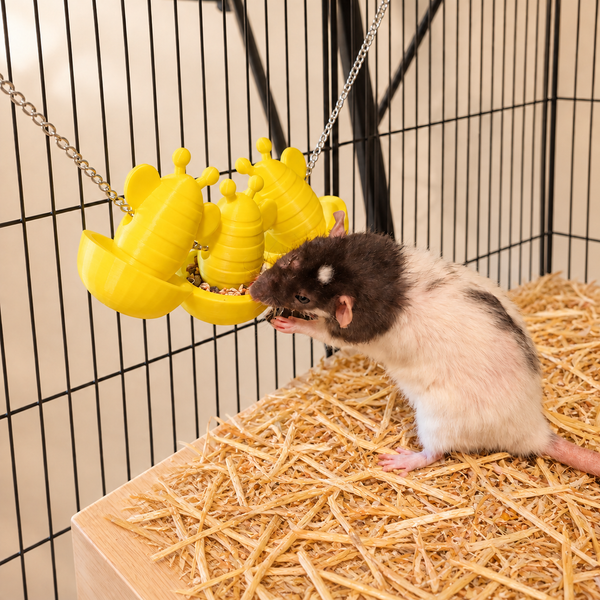
 Foraging and toys
 Cage accessories
 Kits and bundles
 Fairy forest
 Spooky mischief
 Sweetie stash
 Game mode
 Forest floor
 Castles and cathedrals

What to feed a rat: the short version
Pet rats need a complete food made for rats, with small amounts of suitable fresh food as part of their daily allowance. Provide fresh water at all times and use some of their food for foraging. The RSPCA says rats are omnivores and can have small amounts of fruit, veg, cooked egg, grains and seeds, counted within the daily allowance. Keep treats small, monitor weight, and avoid grapes and raisins in line with RSPCA advice.
How much to feed depends on the rats, their weight and what they leave behind. Woodgreen gives an example allowance of about 15 g of dried food per rat per day, but it is not a universal portion. Ask a rat-savvy vet about a suitable amount if weight or appetite changes. To check a single food fast, use our rat food checker or the full what can rats eat list.
Rat food chart
"Every day" means suitable in a small, varied fresh-food rotation, not every food every day. Where sources disagree, this chart follows the UK RSPCA avoid list, including grapes, raisins, citrus and walnuts. Other sources' lists are not adopted wholesale.
| Food | Safe? | How much and how often | Why | Source |
|---|---|---|---|---|
| Complete rat pellets or nuggets | Every day | Follow the packet, about 15 g (0.5 oz) per rat; morning and evening feeds | Main balanced diet; extras stay within the allowance | RSPCA; PDSA; Woodgreen |
| Carrot | Every day | Small varied portions in rotation, not all at once | Fresh variety alongside the staple | FOUR PAWS; Burgess |
| Broccoli | Every day | Small varied portions in rotation | Fresh variety alongside the staple | FOUR PAWS; Burgess |
| Courgette (zucchini) | Every day | Small varied portions in rotation | Fresh variety alongside the staple | FOUR PAWS; Burgess |
| Cucumber | Every day | Small varied portions in rotation | Fresh variety alongside the staple | FOUR PAWS; Burgess |
| Chicory | Every day | Small varied portions in rotation | Fresh variety alongside the staple | FOUR PAWS; Burgess |
| Fennel | Every day | Small varied portions in rotation | Fresh variety alongside the staple | FOUR PAWS |
| Parsnip | Every day | Small varied portions in rotation | Fresh variety alongside the staple | FOUR PAWS |
| Sweet pepper (bell pepper) | Every day | Small varied portions in rotation | Fresh variety alongside the staple | FOUR PAWS; Burgess |
| Sweetcorn (corn) | Every day | Small varied portions in rotation | Fresh variety alongside the staple | FOUR PAWS |
| Endive | Every day | Small varied portions in rotation | Fresh variety alongside the staple | FOUR PAWS; RSPCA NSW |
| Chard | Every day | Small varied portions in rotation | Fresh variety alongside the staple | FOUR PAWS |
| Beetroot (beet) | Every day | Small varied portions in rotation | Fresh variety alongside the staple | FOUR PAWS |
| Swede (rutabaga) | Every day | Small varied portions in rotation | Fresh variety alongside the staple | FOUR PAWS |
| Turnip | Every day | Small varied portions in rotation | Fresh variety alongside the staple | FOUR PAWS |
| Celery | Every day | Small fresh portions in rotation; remove leftovers | Fresh variety within the usual allowance | Woodgreen |
| Kale | Every day | Small fresh portions in rotation; remove leftovers | Fresh variety within the usual allowance | Woodgreen |
| Peas | Every day | Small fresh portions in rotation; remove leftovers | Fresh variety within the usual allowance | Woodgreen; Burgess |
| Apple, pips removed | Sometimes | Tiny occasional portion | Fruit adds sugar; pips contain a cyanide-type compound | FOUR PAWS; Burgess |
| Ripe banana | Sometimes | Tiny occasional portion | Fruit adds sugar; green bananas are on the RSPCA NSW avoid list | Burgess; RSPCA NSW |
| Strawberry | Sometimes | Tiny occasional portion | Fruit adds sugar; not the main meal | FOUR PAWS; Burgess |
| Blueberries | Sometimes | One or two, occasionally | Fruit adds sugar; not the main meal | FOUR PAWS |
| Peach, stone removed | Sometimes | Tiny occasional portion | Fruit adds sugar; not the main meal | FOUR PAWS; Burgess |
| Melon | Sometimes | Tiny occasional portion | Fruit adds sugar; not the main meal | FOUR PAWS; Burgess |
| Pear | Sometimes | Tiny occasional portion; remove the core | Fruit extra, not a staple | Woodgreen; Burgess |
| Cooked egg | Sometimes | Small plain cooked portion occasionally | Protein treat within the allowance | PDSA; RSPCA |
| Cooked lean chicken | Sometimes | Small plain cooked portion occasionally | Protein treat within the allowance | PDSA; Woodgreen |
| Cooked lentils | Sometimes | Small plain cooked portion occasionally | Protein treat within the allowance | PDSA |
| Cooked beans | Sometimes | Small plain cooked portion occasionally; never raw dry beans | Protein treat within the allowance | PDSA; RSPCA NSW |
| Cooked chickpeas (garbanzo beans) | Sometimes | Small plain cooked portion occasionally | Protein treat within the allowance | PDSA |
| Plain cooked rice | Sometimes | Tiny plain portion occasionally | Moderate treat, not the main diet | Woodgreen |
| Plain cooked pasta | Sometimes | Tiny plain portion occasionally | Moderate treat, not the main diet | Woodgreen |
| Dry bread | Sometimes | Tiny plain portion occasionally | Moderate treat, not the main diet | Woodgreen |
| Low-sugar wholegrain cereal | Sometimes | Tiny plain portion; under 5% sugar | Moderate treat, not the main diet | Woodgreen |
| Sunflower seeds | Sometimes | A few occasionally; not with peanuts the same day | Fat-rich foraging treat | RSPCA; Woodgreen |
| Peanuts | Sometimes | A few occasionally, plain and roasted, ideally in the shell | Fat-rich foraging treat; never raw | RSPCA; RSPCA NSW |
| Onion | Never | Do not offer | RSPCA avoid list | RSPCA |
| Garlic | Never | Do not offer | Burgess harmful list | Burgess |
| Citrus fruit | Never | Do not offer | RSPCA avoid list; cautious advice wins where sources differ | RSPCA |
| Walnuts | Never | Do not offer | RSPCA avoid list; cautious advice wins where sources differ | RSPCA |
| Rhubarb | Never | Do not offer | RSPCA avoid list | RSPCA |
| Grapes | Never | Do not offer | RSPCA avoid list; cautious advice wins where sources differ | RSPCA; Burgess |
| Raisins | Never | Do not offer | RSPCA avoid list; sticky and sugary too | RSPCA; Burgess |
| Chocolate | Never | Do not offer | RSPCA avoid list | RSPCA |
| Avocado | Never | Do not offer | On welfare avoid lists | RSPCA NSW; Burgess |
| Blue cheese | Never | Do not offer | On welfare avoid lists | RSPCA NSW; Burgess |
You are welcome to copy this chart into your own care sheet, forum post, school project or club page. Please credit Bruxlings with a link back to this page.
Can rats eat…? The rat food chart
Pellets first, fresh bits second, and the never list always. Fresh food comes out of the daily allowance, not on top of it. Pop it on the fridge.
| Every day (small portions) | Sometimes (tiny treats) | Never (leave these out) |
|---|---|---|
| Complete rat pellets or nuggets (the main meal) | Apple (no pips) | Chocolate |
| Fresh water, always | Pear | Onion |
| Carrot | Banana (ripe) | Garlic |
| Peas | Strawberry | Citrus fruit |
| Broccoli | Melon | Grapes |
| Cauliflower | Peach | Raisins |
| Cabbage (white or green) | Cooked egg | Rhubarb |
| Kale | Cooked lean meat, such as chicken | Walnuts |
| Celery | Plain cooked rice or pasta | Avocado |
| Cucumber | Cooked lentils or chickpeas | Blue cheese |
| Courgette (zucchini) | Sunflower seeds or peanuts (fatty, so just a few) | Raw dry beans |
| Sweet pepper (bell pepper) | Dairy or sugary treats, rarely | Sticky sweets |
| Herbs: basil, parsley, coriander (cilantro) |
Fresh veg in small, varied portions, and take away anything left before it spoils. Fruit is sugary and seeds are fatty, so keep them tiny. Not as the main food: rabbit, guinea pig or hamster food, which is made for other animals. Not sure about a food? Leave it out and ask a vet who treats rats. Sources differ on a few single foods, such as grapes; this chart follows the more cautious advice.
Test yourself: play Safe or Not?, our rat food game, and sort 12 foods into every day, sometimes or never.
How much does a rat eat per day?
A pet rat eats about 15 g (half an ounce) of dried food a day, roughly two level tablespoons, according to Woodgreen Pets Charity. That is a starting point, not a rule. Follow the feeding guide on your nugget packet, and the PDSA advises measuring the food out daily because rats gain weight easily. The National Fancy Rat Society gives adult males as around 500 g (1.1 lb) and adult females around 300 g (10.5 oz), so a big buck may need more than a small doe.
There is no single spoonful that suits every rat, age and food. Start with the manufacturer's allowance and discuss body condition with an exotics vet. Watch individuals at feeding time, especially one that is quieter or slower than its companions. Weigh weekly and record it, so a trend is easier to spot. Unplanned weight loss, difficulty holding food or a sudden change in appetite needs a vet, not just a different flavour. Our guide to rat teeth care covers eating changes caused by teeth.
| Part of the day's food | Roughly how much per rat |
|---|---|
| Complete nuggets | About 15 g (0.5 oz), split morning and evening, part of it scattered |
| Fresh veg | A few small pieces, each about the size of the rat's ear |
| Fruit | One piece the size of the rat's ear, a few times a week (Woodgreen, Burgess) |
| Protein treat | A pea-sized bit of cooked egg or lean meat, or one mealworm (PDSA), occasionally |
| Seeds or nuts | One or two sunflower seeds or a peanut, occasionally |
Young rats under about 10 weeks need more protein and fat for growth, says the National Fancy Rat Society, and Oxbow makes a separate young rat food for the same reason. Pregnant, nursing, elderly or underweight rats need different amounts too, so ask your vet rather than guessing.
Best food for rats: pellets or seed mix?
Complete pellets (also called nuggets, blocks or lab blocks) are the best food for most rats, because every piece is the same blend of protein, fat, fibre, vitamins and minerals, so it doesn't matter which piece a rat picks up first.
Seed mixes look appealing, but they allow selective feeding: rats pick out the tastier, fattier parts and leave the rest. That is why welfare guidance puts a complete rat food at the centre of the diet. A colourful mix is not balanced once a rat has picked out its favourite pieces. A seed mix can still be useful as scatter feed for enrichment, sprinkled around the cage or hidden in a foraging toy, as long as the complete food stays the main meal.
What is the best staple rat food?
Choose a complete food labelled for pet rats and follow its feeding guide, adjusting with your vet's advice for the individual. RSPCA NSW suggests aiming for a food with at least 16% protein and around 4% fat. Two examples of uniform complete rat foods are Burgess Excel Rat Nuggets in the UK, which add linseed and prebiotics, and Oxbow Essentials Adult Rat Food in the US, with at least 15% protein and 4% fat and a uniform nugget designed to stop selective eating. Both companies' care pages say to feed alongside a little fresh veg.
- Labelled complete for rats, not for rabbits, guinea pigs or hamsters
- Uniform nuggets or pellets rather than a loose mix
- A clear feeding guide on the packet
- No added sugar coatings or coloured pieces
- Keep the packet so you can identify the food and its ingredients later
- Change foods gradually, mixing old and new over a week or two, rather than swapping a familiar staple overnight
Keep track of what is actually eaten, not just what disappears into a bed: rats stash food, and the NZ Fancy Rat Society sees stashing as a personal habit, not a sign of under- or overfeeding.
Homemade mixes: where sources disagree
Woodgreen Pets Charity also gives a homemade mix based on the Shunamite diet: 10 scoops of a base mix, 5 of processed grains, 2 of a protein source, 2 of dried herbs and veg and 1 of healthy seeds, fed at about 15 g per rat a day and used within three months. Its suggested bases include some rabbit mixes, which sits awkwardly with the RSPCA's advice that rabbit food does not meet a rat's needs. For most owners we would follow the RSPCA and use complete rat nuggets as the base. If you want to build a mix, follow one tried recipe exactly and ask a rat-savvy vet to check it.
Fresh foods to offer
Fresh food adds variety and gives rats something to work at. Offer small amounts that will be eaten within a few hours, and remove anything left before it spoils. Introduce new foods one at a time so you can spot anything that doesn't agree with them. Burgess suggests portions such as a slender slice or a small cube.
Vegetables
- Broccoli (small amounts)
- Kale and pak choi (bok choy)
- Peas, fresh or thawed
- Cucumber
- Cooked sweet potato (never raw)
- Carrot
- Sweet pepper (bell pepper)
- Cooked butternut squash
- Spring greens and romaine (cos) lettuce
- Cauliflower and white cabbage
- Cress, and herbs such as basil, sage, parsley and coriander (cilantro)
Fruit, as a smaller extra
- Banana, ripe, in small pieces
- Blueberries
- Apple, with the pips removed
- Strawberry
- Melon
- Pear, cored
- Peach, stone removed
For single foods, see can rats eat broccoli, can rats eat bananas and can rats eat eggs.
Foods to avoid
Take a cautious approach with disputed foods. UK welfare guidance conflicts on grapes: the RSPCA advises avoiding grapes and raisins, while Woodgreen and FOUR PAWS list grapes as a small treat. This guide follows the more cautious advice, so leave out grapes and raisins unless your exotics vet specifically says otherwise.
The RSPCA's avoid list is onion, citrus fruit, walnuts, rhubarb, grapes, raisins and chocolate, plus sugary and high-fat foods such as dairy except as rare treats. Burgess adds garlic, blue cheese and avocado. Also avoid raw dry beans, alcohol, caffeine and sticky sweets. RSPCA NSW adds green bananas, green potato skins, liquorice, raw artichokes, raw Brussels sprouts, raw red cabbage, raw sweet potato, seaweed, and sticky foods such as dried fruit, peanut butter and some sweets (candy). FOUR PAWS warns to cook potatoes and avoid ornamental pumpkins. See can rats eat grapes, can rats eat raisins, can rats eat chocolate and can rats eat avocado for the detail.
| Avoid | Who lists it |
|---|---|
| Onion, citrus, walnuts, rhubarb, grapes, raisins, chocolate | RSPCA (UK) |
| Garlic, blue cheese, avocado | Burgess; RSPCA NSW |
| Raw dry beans and raw peanuts, raw sweet potato, raw Brussels sprouts, raw red cabbage, raw artichokes | RSPCA NSW |
| Green bananas, green potato skins, liquorice, seaweed | RSPCA NSW |
| Sticky foods: dried fruit, peanut butter, sticky sweets | RSPCA NSW |
| Alcohol, caffeine, sugary and very fatty food | RSPCA; general vet advice |
Can rats eat raisins?
No. Raisins are dried grapes, both are on the RSPCA and Burgess lists, and raisins are sticky and sugary too. If your rat has already eaten one or two, don't panic: remove the rest and watch over the next day or two for eating less, lethargy, hunching or changes in droppings or urine. The RSPCA says to contact your vet straight away if you think a rat has eaten something harmful, so ring for advice and tell them roughly how much.
Treats and training
Rats are very food-motivated, which makes training easy. Use tiny, pea-sized pieces so a whole session adds up to very little food. Treats are for bonding, training and variety, not a replacement for the main diet, and count them in the daily allowance. Sugary shop-bought treats such as yoghurt drops are best kept occasional. A peanut or sunflower seed in its shell makes a good treat because the rat has to work at it. Our guide to training pet rats uses this method.
What do pet rats like to eat?
Most rats love cooked egg, peas, sweetcorn (corn), banana and seeds or nuts in the shell. The RSPCA notes rats develop individual food preferences, and even share food, giving the hungriest rat the largest share. Find each rat's favourite and save it for training and recall.
How often to feed
Feed twice a day, morning and evening: the RSPCA says rats feed mainly at dawn and dusk. Take away uneaten fresh food and adjust the amount so they finish it and stay a healthy weight. Burgess suggests removing leftovers every morning.
How can I make feeding more interesting?
Keep back part of the normal dry-food allowance for simple searching games. The RSPCA suggests mixing food into fresh bedding, scattering it, hiding it in sand trays or cardboard tubes, and offering whole foods such as a cooled, unpeeled boiled egg to work at. Burgess adds a rolled-up old sock, a paper bag or a pine cone.
- Start easy. Scatter part of the morning nuggets across the cage floor so every rat finds some quickly.
- Make it a little harder. Once all your rats join in, hide food in paper parcels, tubes or a dig tray.
- Use several places. Spread the food so one rat cannot guard the only reward.
- Check afterwards. Clear hidden fresh leftovers and look for wear on toys.
- Keep an easy option. A rat with reduced mobility should always have a bowl it can reach, not only puzzles.
Water
Fresh water must be available at all times. The RSPCA recommends bottles rather than bowls, because bowls collect bedding and droppings. Give a group several bottles so every rat can drink at once and there is a backup if one blocks; Woodgreen suggests one at each end of the cage. Check each bottle morning and evening for blockages and leaks, refill twice a day and clean regularly to stop algae. Check the flow, not just the level: tap the spout to make sure water comes out. Our guide to rat drinking water covers bottles, bowls and daily checks.
Signs the diet needs a look
- Pellets left untouched while treats vanish: cut back the extras until the main food is being eaten
- Weight gain, trouble grooming or a waddling walk: review portions and treats, and add more ways to move and forage
- Dull, thinning or greasy coat or soft droppings: think about what changed recently, and see a vet if it continues
- Weight loss or eating less: check teeth and see a vet
Weighing your rats regularly makes changes easier to spot; the RSPCA suggests doing it during cage cleaning. Any sudden change in weight or appetite is a reason to see a rat-savvy vet. Weight matters more than it looks: the MSD Veterinary Manual links high-calorie diets with pituitary tumours, which are common in pet rats, especially females, and links protein and calorie intake with kidney disease. Our rat health checks guide shows what else to look for.
Rats eat some of their own fresh droppings, usually straight from the bottom. The RSPCA says this is natural and helps them absorb nutrients, so don't try to stop it.
Can rats eat common human foods?
Use common human foods as tiny extras, not the main diet. A complete rat food stays the base, with small fresh-food portions for variety and enrichment. Burgess's rule is simple: if in doubt, leave human food out.
- Avoid avocado, grapes, raisins, onion, garlic, chocolate, alcohol, caffeine and sticky sweets
- Fruit such as peach should be a small occasional treat, not a daily staple. We skip mango, which some rat food makers list as a food to avoid: see can rats eat mango
- Peas, rice and leafy greens can be offered in small amounts when prepared plainly, but variety matters more than one single food
- Plain cooked chicken, boiled egg, dry bread and low-sugar cereal are fine in small amounts (Woodgreen)
- Rabbit, guinea pig or hamster food is not a proper staple for rats: the RSPCA says these foods will not give rats the nutrients they need. See can rats eat hamster food and can rats eat guinea pig food
- If a rat is unwell, very young, elderly, pregnant or has breathing or weight problems, ask an exotics vet before changing its diet
Quick comparison
| Option or observation | Purpose or meaning | What to check |
|---|---|---|
| Complete rat food | Main diet | Packet guidance and individual advice |
| Checked fresh foods | Small additions | Introduce one at a time; remove leftovers |
| Treats | Occasional rewards | Count them in the food allowance |
| Water | Always available | Check flow, not just the bottle level |
Further reading
For feeding at different ages, read caring for rats at every age. If you are new to rats, start with the complete first-time rat owner guide, your first 30 days with pet rats and our pet rat supplies guide. Everything else is on the pet rat care hub. This guide is general pet care information, updated November 2026 from RSPCA, Woodgreen and other welfare guidance, and is not a substitute for advice from a vet.
Frequently asked questions
What do rats eat?
Rats are omnivores: in the wild they eat grains, seeds, plants, fruit and insects. Pet rats do best on a complete rat food as the base, with small amounts of suitable fresh veg, a little fruit and the odd bit of cooked egg or lean meat. Fresh water must be available at all times.
What do pet rats eat every day?
Every day, pet rats need a measured portion of complete rat nuggets, split between morning and evening, a few small pieces of fresh veg, and fresh water from a bottle. Fruit, seeds, nuts and cooked protein are occasional extras that come out of the daily allowance, not on top of it.
What is the best food for rats?
The best everyday food is a complete nugget or pellet made specifically for rats, where every piece is the same, so a rat cannot pick out the fatty bits. Burgess Excel Rat Nuggets in the UK and Oxbow Essentials Adult Rat Food in the US are two examples. Food made for rabbits, guinea pigs or hamsters is not a proper staple.
Can rats eat raisins?
No. The RSPCA advises against raisins and grapes for rats, and so does Burgess. Raisins are also sticky and sugary. Leave them out. If your rat has already eaten some, watch for eating less, lethargy or changes in droppings or urine, and ring your vet for advice, as the RSPCA advises for anything harmful.
How much does a rat eat per day?
Woodgreen Pets Charity suggests about 15 g (half an ounce) of dried food per rat per day, roughly two tablespoons. Follow your nugget packet's guide, weigh your rats weekly and adjust: less if they gain weight or leave food, more for young, pregnant or underweight rats on a vet's advice.
How often do rats need to eat?
Rats feed mainly at dawn and dusk, so the RSPCA recommends feeding twice a day, morning and evening. Split the daily allowance between the two meals, use part of it for scatter feeding, and take away uneaten fresh food the next morning.
Can rats eat guinea pig, rabbit or hamster food?
Not as their staple. The RSPCA says pellets made for rabbits, guinea pigs, hamsters or other herbivores do not give rats the nutrients they need. A mouthful stolen from another pet's bowl will not hurt, but always use a complete food made for rats as the main diet.
What do pet rats like to eat most?
Most rats go wild for cooked egg, peas, sweetcorn (corn), banana, a sunflower seed or a peanut in its shell. Those are the treats to save for training and foraging. Rats develop their own favourites, so use what each rat loves best as its reward, in pea-sized pieces, inside the daily allowance.
Can rats eat hamster food?
It is not a good staple. Hamster food is made for a different animal and often comes as a mix rats can pick through. Use a complete food made for rats as the main diet, and treat a few hamster-mix pieces as scatter-feed only.
How often can I give treats?
Small treats every day are fine when they are tiny and the complete food is still the main diet. Count treats as part of the daily allowance, use pea-sized pieces for training, and keep sugary or fatty treats, such as yoghurt drops or seeds, to a few times a week.
Bottle or bowl for water?
Bottles. The RSPCA recommends bottles because bowls fill with bedding and droppings, and several bottles mean a group never goes without if one valve sticks. Check them morning and evening, refill twice a day and clean them regularly. If you use a bowl as well, choose heavy ceramic.
Sources
- RSPCA: what to feed pet rats
- Woodgreen Pets Charity: what do pet rats eat?
- Woodgreen Pets Charity: caring for rats as pets
- Burgess Pet Care: what should I feed my pet rats?
- PDSA: rats as pets
- FOUR PAWS: appropriate nutrition for pet rats
- RSPCA NSW: how to care for your rat
- Oxbow Animal Health: Essentials Adult Rat Food
- National Fancy Rat Society: keeping rats as pets
- MSD Veterinary Manual (pet owner version): disorders and diseases of rats
- NZ Fancy Rat Society: rat behaviour