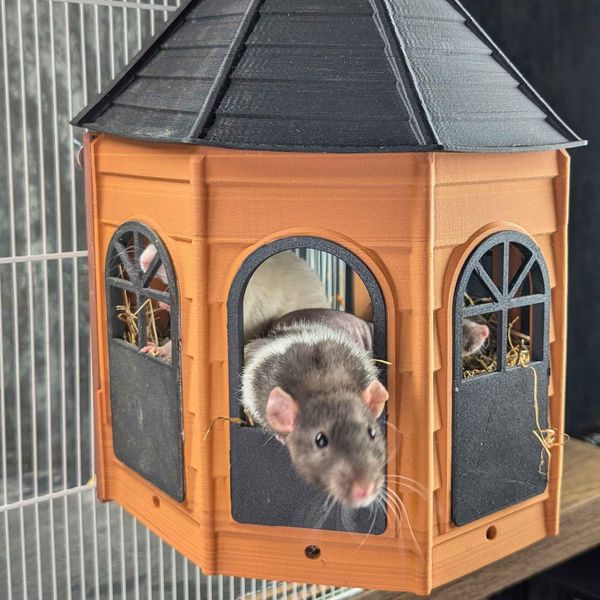
Hides and houses
 Shelves and ledges
 Foraging and toys
 Cage accessories
 Kits and bundles
 Fairy forest
 Spooky mischief
 Sweetie stash
 Game mode
 Forest floor
 Castles and cathedrals

For the wider setup, start with our pet rat care guide, which links every rat guide we have, or see the pet rat supplies guide.
Quick decisions at a glance
| Situation | Useful action | What to remember |
|---|---|---|
| Bottle looks full | Check delivery at the spout, not just the water line | A blockage can hide behind a full reservoir |
| Wet bedding below bottle | Check the seal and replace damp bedding | A leak can empty the bottle without a rat drinking |
| Green tint or film inside | Empty, scrub and move the bottle out of direct sun | The RSPCA says clean regularly to stop algae and bacteria |
| Rat cannot reach spout | Provide an accessible drinking position | Watch the individual rat rather than guessing |
| New drinking pattern | Record the change and contact a vet | Do not use an online daily target to rule out illness |
Does a rat drink water?
Yes. Rats drink every day and must have fresh, clean water available all the time. The RSPCA, RSPCA Australia, PetMD and the National Fancy Rat Society all say the same: a continuous supply of fresh water, from a bottle. Fresh vegetables and fruit add a little moisture to the diet, but a rat on a normal diet of dry rat food cannot rely on food for its water.
Rats are most active at night, dawn and dusk, so much of their drinking happens while you are asleep. That is why the evening water check matters as much as the morning one.
Should rats have a water bottle or a bowl?
Bottles. The RSPCA's UK advice favours bottles for routine drinking, to avoid contamination, and RSPCA Australia explains why: bedding and droppings end up in bowls and soil the water. The RSPCA also recommends several bottles, so all your rats can drink at the same time, and RSPCA Australia advises more than one bottle in case one fails. That is a more useful starting point than choosing the prettiest container.
Put each bottle where you can inspect it and where your rats can reach it without an awkward stretch. A cage layout that works for a climbing youngster may not work for an older companion. Watch each rat use the actual setup. If a rat is not drinking, do not assume they will work it out eventually: check the equipment and ask your vet for help. A decorative food cup is not automatically a suitable drinking vessel.
A bowl has one place: as an extra for a rat that struggles with a spout, such as an older, arthritic or unwell rat, and only with your vet's advice. If you use one, choose a heavy, shallow dish that cannot tip, raise it off the bedding on a shelf, and refresh it at every check. Keep the bottles in place too.
What makes a good rat water bottle?
A good rat water bottle is chew-resistant, easy to clean and easy to check. PetMD recommends a chew-resistant bottle, and the RSPCA says bottles must be cleaned regularly, so pick ones you can scrub inside. We don't sell water bottles, so this is what we'd look for in any shop.
| Feature | What to look for | Why |
|---|---|---|
| Body | Glass, or thick plastic kept outside the bars | Rats chew plastic they can reach |
| Spout | Metal, with a ball bearing that moves freely | Chew-resistant and drips less |
| Opening | Wide neck that a bottle brush fits | Lets you scrub out algae and residue |
| Fixing | A firm clip, bracket or spring that holds without tilting | A loose bottle tilts and leaks or lifts the spout out of reach |
| Size | Big enough not to run low between your morning and evening checks | Bigger groups and hot weather use more water |
| Spares | At least one extra, ready filled | So a failed bottle can be swapped at once |
What should a daily water check include?
Work around the cage in the same order so a second bottle does not get forgotten. RSPCA guidance calls for checks in the morning and evening, refilling twice a day, and checking every day for leaks and blockages. RSPCA Australia adds that you should test bottles regularly and change the water daily.
- Water level in every bottle
- Bottle firmly attached and upright
- Spout at a height each rat can reach
- Water comes out when you tap or press the ball
- No steady drip and no wet bedding underneath
- No green tint, film or cloudy water inside
- Fresh, clean water put in today
- Each rat seen drinking or behaving normally
When someone else looks after your rats, show them the particular fastening and spout. A written note saying "water topped up" cannot establish whether water came out. Ask them to check function as well as quantity.
How to clean a rat water bottle
Clean bottles regularly, as the RSPCA advises, to stop algae and bacteria building up. Washing at the weekly cage clean, plus a rinse at each daily change, suits most homes; clean more often in warm weather or if you see any film.
- Swap in a spare. Fit a clean, filled bottle before you take the old one away, so the rats are never without water.
- Empty and take apart. Pour out the old water and remove the cap and spout.
- Scrub the inside. Use hot water and a bottle brush, reaching the bottom and the shoulders where film collects.
- Clean the spout. Run hot water through it and push a pipe cleaner or thin brush through to clear residue, then check the ball moves freely.
- Rinse well. Rinse several times so no cleaning product or smell is left. If you used a pet-safe disinfectant, follow its label for rinsing.
- Refill and test. Fill with fresh, clean water, refit and tap the spout to check water comes out and does not drip steadily.
Keep bottles out of direct sunlight, which warms the water and helps algae grow; the RSPCA advises keeping the whole cage out of direct sun. Our rat cage cleaning guide fits bottle cleaning into the weekly routine.
How much water do rats drink a day?
There is no single number every rat must reach, and the welfare and vet care guides we checked (RSPCA UK, RSPCA Australia, PetMD and the National Fancy Rat Society) give none. Intake changes with the rat's size, diet, activity and the room temperature, and it is difficult to tell who drank what from a shared bottle. A falling level can also reflect a leak.
Use your knowledge of the individual alongside appetite, activity and their normal routine. Make a brief note if drinking looks different: which rat, what you saw, whether the bottle worked and whether the bedding was wet. This helps a vet interpret the problem without pretending a household bottle measurement is a diagnosis.
Hot rooms raise water needs and are risky for rats in their own right. The RSPCA gives 19 to 23°C (66 to 73°F) as ideal; our rat temperature guide covers what to do in a heatwave. Our guide to rat health problems and when to call a vet covers other signs to record.
Water, food and wet foods
Water sits alongside a good diet, not instead of it. Watery vegetables such as cucumber add moisture as part of the daily fresh food, but they do not replace the bottle. Our guide to what to feed a rat covers the daily diet, our list of what rats can eat covers fresh foods, and our page on whether rats can eat cucumber covers one of the most watery options.
Choosing accessories around the care routine
Keep food, drinking water and the routes your rats already use easy to reach. A successful arrangement is one you can inspect and maintain, not simply one that fills every gap. Our guide to the complete rat cage setup covers where bottles, shelves and hides go.
Frequently asked questions
Do rats need water at night?
Yes. Drinking water must be available continuously, not only when you are awake to offer it. Rats are most active at night, dawn and dusk, so night is when much of their eating and drinking happens. Check the bottles in the evening before you go to bed.
Can a bottle be blocked when it is full?
Yes. A stuck ball bearing, an airlock or a kinked or chewed spout can stop water reaching the tip even when the bottle looks full. Check that water reaches the spout every morning and evening; the level alone does not prove that a rat can drink.
Is a teacup shelf a water bowl?
No such use is claimed here. Decorative cups and shelves are cage accessories, not recommended drinking equipment. The RSPCA favours bottles for rats' routine drinking water because bowls collect bedding and droppings.
Should I measure every rat against one daily amount?
No. Do not use a single online number to dismiss or diagnose a change. The welfare and vet care guides we checked give no daily amount for pet rats, and a shared bottle cannot show who drank what. Observe the individual and ask a vet about concerns.
What if my rat stops drinking?
Check the water supply immediately: tap the spout, look for an airlock and offer a second working bottle. Then contact a vet promptly, especially if your rat also seems unwell. The RSPCA lists not drinking at all, or drinking a lot, as signs to call a vet.
Can I put a water bowl in a rat cage?
A bowl is not the RSPCA's choice for routine drinking because bedding and droppings soil it. If a rat struggles with a spout, for example an older or unwell rat, ask your vet; a heavy, shallow dish set off the floor and refreshed at every check can be used alongside bottles.
How long can a rat go without water?
Not long, and you should never test it. Welfare charities say rats need a continuous supply of fresh water. If a bottle has failed and a rat may have been without water, offer water straight away and ring a vet for advice if the rat seems dull, weak or is not eating.
Can I give my rat tap water?
Yes. Welfare guides ask for fresh, clean water, and clean drinking tap water meets that for most homes. Change it daily. Do not add vitamins, sugar, flavourings or medicines to shared water unless your vet gives an individual plan.
Advice here is general; speak to a rat-experienced vet about an individual health or mobility concern. Source guidance checked November 2026.