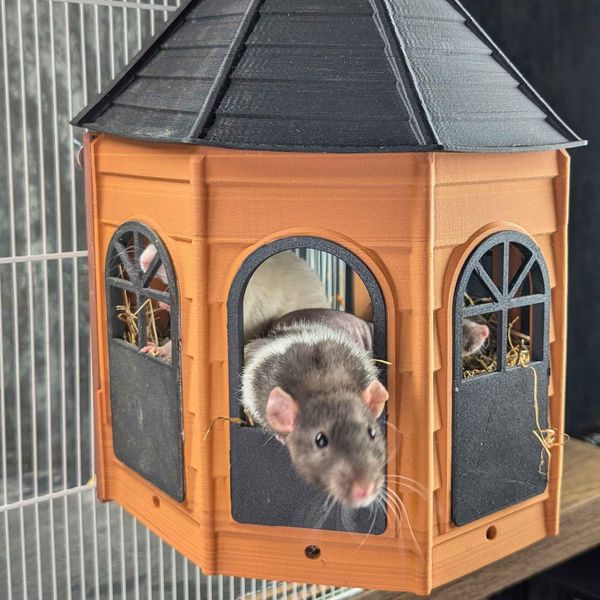
Hides and houses
 Shelves and ledges
 Foraging and toys
 Cage accessories
 Kits and bundles
 Fairy forest
 Spooky mischief
 Sweetie stash
 Game mode
 Forest floor
 Castles and cathedrals

Rat health problems: how soon to see a vet
Breathing difficulty means an emergency vet now; most other new signs mean a call to your vet the same day or promptly. This chart was checked on 7 November 2026 against PDSA, RSPCA and Burgess advice.
| Sign | What it can mean | How soon | Source |
|---|---|---|---|
| Laboured breathing or gasping | Serious respiratory illness is possible | Now: call an emergency vet, not later today | PDSA |
| Wheezing, snuffling, runny eyes or nose | Possible respiratory disease | Same day: PDSA says see a vet as soon as possible, as infections can worsen quickly | PDSA |
| Head tilt with respiratory signs | Respiratory or ear disease may be involved | Same day: contact your vet promptly for triage | PDSA |
| Weight loss with noisy breathing | Respiratory illness or another problem | Same day: contact your vet promptly | PDSA |
| New lump or swelling | A tumour, abscess or other cause | Ask your exotics vet how soon; do not assume a harmless lump | PDSA |
| New scratching, scabs or patchy fur | Skin irritation or parasites are possible | Ask your exotics vet; no universal waiting interval is given | PDSA |
| Changed appetite, behaviour or appearance | Illness or discomfort may be involved | Ask your exotics vet promptly; describe the change | PDSA |
| An eye stays bulging and does not return to normal | A tumour, abscess, stress or eye disease may be involved | Same day: seek veterinary advice | RSPCA, Burgess |
| Teeth grinding with hunching or other pain signs | Pain or distress rather than relaxed bruxing | Ask your exotics vet promptly; assess the whole rat | RSPCA |
No generic within-48-hours or watch-and-wait cut-offs are supplied: the sources do not give a safe universal interval. Ask your exotics vet about the individual rat. Our is my rat sick symptom checker helps you organise observations, not delay calling your vet.
If a rat is struggling to breathe, gasping, collapsing, having a seizure or bleeding heavily, call an emergency vet immediately. Do not finish a checklist or wait for a time or weight threshold before seeking help.
A familiar routine makes changes easier to notice. Watch how each rat eats, moves, breathes and interacts when normally awake, and keep a short record when something changes. A home check can help you describe a concern; it cannot diagnose illness or rule it out.
Common rat health problems
These are the problems rat-care guides mention most. Each one is a reason to call a vet who treats rats, not something to diagnose at home.
- Breathing problems: sneezing, wheezing, noisy or laboured breathing, or a runny nose or eyes. Burgess calls respiratory infection the most common illness in rats. More in our rat respiratory infection guide.
- Red staining around the eyes or nose: a little can follow stress; more than usual, or sneezing blood, needs a vet.
- Lumps and bumps: such as tumours or abscesses. Any new lump needs a vet check.
- Skin and coat problems: itching, bald patches, scabs or small bumps, which can come from mites or other parasites, an allergy or over-grooming.
- Weight changes and obesity: losing weight, gaining it fast, or becoming less active.
- Teeth: rats' front teeth keep growing, so ask your vet to check they are growing correctly, especially if eating changes.
The table below goes into each one in more detail, with the signs to look for and what vets commonly do.
| Problem | Signs | What to know |
|---|---|---|
| Respiratory disease | Sneezing, snuffling, wheezing, clicking, red staining, head tilt, weight loss | Usually linked to Mycoplasma pulmonis, which nearly all pet rats carry (Rat Guide). Dust, ammonia and stress trigger flare-ups. Vets usually prescribe antibiotics. |
| Mammary tumours | A soft, movable lump under the skin of the belly, chest, armpit or groin | The MSD Veterinary Manual calls them the most common tumours in rats; most are not cancerous. Wood Green says they can appear from a year old. Early surgery is easier, though new ones often appear. |
| Fast-growing lumps | A lump that grows quickly or feels firm and fixed | Wood Green says aggressive lumps can double in size "in a matter of weeks". Ring the vet promptly. |
| Abscesses and cysts | A swelling, often on the head, neck or face, that may burst | Wood Green says these are common in males and those on the head need prompt treatment. |
| Pituitary tumour | Weak or stiff front paws, difficulty holding food, head tilt, circling, sudden low mood | Rat Guide says these are most often seen in females aged 13 to 24 months. Vets can offer medicine to ease signs; surgery is not possible. |
| Zymbal's gland tumour | A lump at the base of the ear | The PDSA says these can be serious and painful. |
| Mites and lice | Scratching, scabs on the neck and shoulders, white specks in the fur | The MSD Veterinary Manual says mites flare when a rat is stressed. A vet prescribes a treatment; clean the cage after. |
| Barbering | Neat patches of short or missing fur, often on the face or back | A cagemate over-grooming. The RSPCA also links bald patches to boredom and over-grooming. |
| Ringworm (a fungus) | Round, scaly bald patches | Uncommon, but MSD notes it can spread to people and other pets. |
| Bumblefoot | Red, swollen or scabbed pads on the soles of the feet | The RSPCA links wire-mesh floors to foot problems. Solid floors, clean bedding and a healthy weight help. |
| Dental problems | Eating less, dropping food, drooling, weight loss, lumps along the lower jaw | Healthy incisors are orange-yellow (Wood Green). Never clip teeth yourself; see our rat teeth care guide. |
| Kidney disease | Drinking and weeing more, weight loss, low energy | MSD says it is common in older rats and more severe in males. There is no cure, but vets can ease signs. |
| Hind leg weakness | Wobbling, dragging or splaying back legs | Wood Green says hind leg degeneration is more likely with age and particularly common in males. |
| Diarrhoea | Soft, wet or smelly droppings, a dirty bottom | The RSPCA lists it as a reason to contact your vet. A rat cannot afford to lose fluids for long. |
| Obesity | No visible waist, struggling to groom or climb | Burgess blames too little exercise and too much or the wrong food; a complete nugget beats a seed mix. |
Sources for this section: RSPCA rat health and welfare, the Burgess rat health guide, Wood Green, the PDSA, Rat Guide and the MSD Veterinary Manual, all linked below.
Sick rat symptoms: how to tell if a rat is sick
A sick rat usually eats less, moves less and looks scruffier than usual, often before any obvious symptom. The RSPCA's list of signs to contact your vet about is the most complete we have found.
- Not eating or drinking, or refusing foods they used to like
- Drinking much more than usual, or not at all
- Losing weight, or gaining it quickly
- Diarrhoea
- Sunken or dull-looking eyes
- Discharge from the eyes or nose
- Sneezing, wheezing or breathing strangely
- A "starry" coat: oily, clumped, matted or unkempt, or not grooming
- Less active, or sleeping more during their usual active hours
- Avoiding cagemates or you
- Hunched, stiff posture, walking strangely, poor balance or guarding one area of the body
These signs look the same in every variety. A sick dumbo rat shows the same symptoms as any other rat: dumbos differ only in where their ears sit (see our dumbo rat guide). Hairless rats feel the cold more and can look thin, so know your own rat's normal.
Rats cannot vomit. The RSPCA warns that even a small amount of something harmful can be fatal, so if you think your rat has eaten something toxic, ring the vet straight away rather than waiting for signs. Our safe food list for rats shows what to keep out of reach.
A practical daily health check
Begin by watching before handling. Notice whether each rat comes out, reaches food and water, moves comfortably and responds as usual. Then, if the rat is comfortable with handling, make a gentle check. Avoid restraining or repeatedly handling a rat that is distressed or having breathing difficulty.
- Breathing and posture. Watch at rest for unusual effort, an open mouth, hunched posture or a change in breathing sounds. A familiar noise is not proof that breathing is healthy. Describe the sound and when it happens to the vet; do not try to name the cause.
- Eyes and nose. Look for new discharge, swelling, injury or a change in grooming. Note whether it is on one side or both and whether it returns after grooming. The appearance alone cannot tell you whether the cause is irritation, stress, injury or disease.
- Coat, skin and feet. Look for new bare areas, scabs, wounds, swelling or sore foot pads. During gentle handling, notice any new lump. Do not squeeze it or try to determine whether it is harmless by touch.
- Eating, drinking and movement. Check that the individual rat can reach and use food and water, chew and move as usual. Food disappearing from a shared bowl does not show that every rat has eaten.
- Behaviour. Record unusual withdrawal, reduced activity, irritability, reluctance to be touched or loss of coordination. These are observations to report, not a reliable diagnosis of boredom, ageing or pain.
Use the same scale and a stable container for regular weighing when the rat tolerates it. Record the date and grams so you can see a trend. Wood Green suggests a weekly check with small kitchen scales. Do not wait for a fixed percentage of weight loss before asking about an unexplained change, especially alongside reduced appetite or altered behaviour.
What is normal for a healthy rat?
A healthy rat is curious, active at dawn, dusk and evening, with bright clear eyes, a full shiny coat, clean ears and bottom, and quiet breathing. Burgess describes healthy rats as inquisitive, active and playful. These figures help you judge what you see.
| Measure | Normal range | Source |
|---|---|---|
| Adult weight, female (doe) | About 225 to 450 g (8 to 16 oz) | Rat Guide; MSD Veterinary Manual |
| Adult weight, male (buck) | About 250 to 650 g (9 to 23 oz) | Rat Guide; MSD Veterinary Manual |
| Breathing at rest | 71 to 146 breaths a minute, quiet | Rat Guide |
| Heart rate | 250 to 493 beats a minute | Rat Guide |
| Body temperature | About 37.7°C (99.9°F) | Rat Guide |
| Teeth | Orange-yellow incisors, darker with age | Wood Green |
| Eye and nose staining | A small, non-recurring amount of red or orange | RSPCA; Burgess |
| Lifespan | Two to three years | PDSA |
Weights vary a lot by line and variety, which is why your own rat's record matters more than any chart. Teeth grinding (bruxing) with relaxed, gently vibrating eyes (boggling) is a normal sign of contentment, explained in our guide to rat sounds and signals.
Changes worth recording
A short factual note is more useful than a guessed diagnosis. For example: "Tuesday evening: clicking while resting, ate less than usual, weight 412 g" gives the practice something concrete to assess.
| What you notice | Useful details for the vet |
|---|---|
| Sneezing, discharge or noisy breathing | When it began, whether it happens at rest, any visible breathing effort, appetite or activity changes, and recent bedding or environmental changes. |
| A lump or swelling | Where it is, when first noticed, approximate size and changes to the skin, movement or appetite. Different causes can look similar. |
| Scratching, scabs or hair loss | Which areas are affected, whether the skin is broken and whether another rat has similar signs. Do not assume mites or select a treatment from appearance. |
| Sore feet or a change in walking | Which feet or legs are affected, swelling or wounds, difficulty reaching food and water, and the surfaces the rat uses. |
| Difficulty eating or changes in weight | Recent weights, foods offered, what you actually saw the rat eat, drooling or difficulty chewing, and changes in drinking or droppings. |
| Head tilt, imbalance or reduced use of a limb | Whether it started suddenly, whether it is worsening and whether the rat can move safely. Contact a vet promptly rather than assuming an ear infection, stroke or ageing. |
The rat respiratory infection guide provides a focused way to describe respiratory signs. Good cleaning, suitable bedding and ventilation support the cage environment, as in our rat cage cleaning guide, but do not establish why a rat is unwell or replace treatment.
When to contact a vet
Call an emergency vet now
Seek immediate advice for difficult or open-mouth breathing, gasping, collapse, a seizure, sudden inability to stand or move normally, serious injury or uncontrolled bleeding. Describe what is happening and follow the practice's transport instructions. If you are unsure whether it is an emergency, call and ask.
Contact a vet promptly for a new or persistent change
Repeated sneezing, new breathing noise, reduced eating or drinking, unexplained weight change, unusual lethargy, a new lump, sore feet, damaged skin, blood in urine or difficulty chewing all merit veterinary advice. Tell the practice if several signs occur together or are worsening. The practice can judge urgency from the individual rat and symptoms.
Do not use a "wait 24 to 48 hours", "wait two days" or "wait until 10% weight loss" rule from an online guide. Refusal to eat or drink is a reason to contact the vet urgently; there is no need to wait for twelve hours to pass. Continue an existing monitoring plan only as directed by the vet, and report changes that fall outside it.
Do rats need to go to the vet?
Yes. Rats need a vet when they are ill and benefit from a check-up at least once a year: Burgess recommends a full veterinary check at least annually, and the MSD Veterinary Manual advises a yearly exam by a rat-savvy vet. Because rats hide illness, a vet often finds a lump, tooth or chest problem before you would. The RSPCA suggests asking at check-ups about neutering, worming and tooth growth. Vet costs are part of the budget in our guide to how much a pet rat costs.
Finding a vet who treats rats
Arrange routine care before an emergency if possible. Use RCVS Find a Vet (linked in the sources) to find UK practices, then ask whether a vet there regularly treats pet rats. In the US, ask local rat or exotic pet clubs and rescues which practices see rats. Confirm how to obtain urgent and out-of-hours advice and whether referrals are available when needed.
- Ask about experience with pet rats and how the practice assesses the problem you are concerned about.
- Ask for an explanation of likely investigations, treatment choices, costs and follow-up.
- Check the emergency contact number and save it somewhere easy to find.
Do not choose a vet by willingness to prescribe a particular antibiotic or combination. Medicine choice depends on the individual assessment. Use only medicine prescribed for that rat, and ask the vet if you have questions about the plan.
Preparing for a visit
- Bring the record: onset, symptoms, recent weights, appetite and drinking observations, current medicines and relevant previous care.
- Make transport ready: a secure carrier with suitable familiar bedding and the practice's address and contact number. Keep handling gentle and follow the vet's advice for a sick rat. Our rat carrier guide covers choosing one.
- Describe the environment: bedding, cleaning products, cage changes and whether other rats are affected.
- Use a photo or short video when helpful: capture an intermittent sign only if doing so will not distress the rat or delay care.
A carrier, scales, a health log and saved vet details are useful preparation. Ask the practice which first-aid supplies are appropriate and how to use them. Do not force-feed, flush an injured eye or give medicine without veterinary guidance. Syringes and recovery food belong with an individual vet-directed plan. Our pet rat supplies guide lists the everyday kit, and a quarantine cage setup is worth having ready for a sick or new rat.
Common health questions
What is porphyrin?
Porphyrin is a reddish-brown secretion that can appear around a rat's eyes or nose. The RSPCA calls the staining chromodacryorrhoea and says small, non-recurring amounts are less concerning. Its presence does not identify a particular illness. Note changes in amount or persistence and any other signs, then ask the vet about a concern. Do not assume visible redness is harmless or use it to rule out injury.
Does sneezing mean antibiotics are needed?
No single observed sign determines the treatment. Repeated sneezing, discharge or clicking breathing should be discussed with a vet, who can assess possible causes. Difficult breathing needs immediate help. An online description cannot establish an infection or select a medicine.
How can I tell whether my rat is in pain?
Changes in posture, movement, appetite, grooming or willingness to be handled can signal a problem, but they are not specific enough to diagnose pain or its cause. The RSPCA lists a hunched, stiff posture, walking strangely, poor balance and guarding a painful area. Describe the changes to the vet. Do not use a reassuring behaviour, such as still accepting food, to dismiss other concerning signs.
Keeping rats healthy day to day
Most of what keeps rats well is everyday care: dust-free bedding, a clean, well-ventilated cage at 19 to 23°C (66 to 73°F), a complete nugget diet, company of their own kind and plenty to do. Our guides to rat bedding, what to feed a rat, rat enrichment ideas and choosing rat cage accessories cover each one. Older rats need a closer eye; see caring for rats at every age and how long rats live. Our free roam safety guide helps prevent injuries.
Frequently asked questions
What are common rat health problems?
Breathing disease, lumps such as mammary tumours and abscesses, skin problems such as mites, overgrown teeth, bumblefoot and changes in weight or appetite all need attention. Older rats also get kidney disease and hind leg weakness. A home check cannot diagnose their cause, so ring a vet.
Is my rat sick?
Compare eating, breathing, movement and behaviour with that rat's usual pattern. A rat that eats less, sleeps more, looks scruffy or hunches is often unwell. Tell your vet about changes; a symptom checker cannot rule illness out.
Can rats be sick or throw up?
Rats get ill like any pet, but they cannot vomit. That means a rat cannot bring up something harmful, so the RSPCA warns even small amounts of a toxic substance can be fatal. If you suspect your rat ate something dangerous, ring a vet straight away.
When should a sick rat see a vet?
Contact a vet promptly about new signs. Breathing difficulty needs emergency help now, not after a checklist or a fixed number of hours. Not eating or drinking, a new lump or a sudden head tilt also warrant a call the same day.
Can I wait 48 hours before seeing a vet?
There is no safe universal waiting period. Ask your exotics vet to triage the actual signs rather than choosing a delay from a chart. Rats hide illness, so by the time you notice a sign, the problem may have been building for a while.
Does red staining mean my rat is bleeding?
Red staining can be porphyrin rather than blood, but an owner cannot reliably diagnose the cause. New or increased staining, especially with other signs such as sneezing or a scruffy coat, needs veterinary advice.
How can I monitor rat health at home?
Observe each rat daily, keep a weekly weight record in grams and note changes in eating, breathing, movement and social behaviour. Feel gently for lumps during handling. Use the notes to help your vet, not to postpone care.
Can humans catch diseases from a sick pet rat?
Rarely, but some can pass to people. The MSD Veterinary Manual notes ringworm can spread to humans and other pets, while Rat Guide says the common rat respiratory bacterium does not infect people. Wash your hands after handling a sick rat and tell your doctor you keep rats if you fall ill.
Sources
- RSPCA: Rat health and welfare
- RSPCA: Creating a suitable home for rats
- PDSA: Rats as pets
- Burgess: Rat health guide
- Wood Green: Rat health
- MSD Veterinary Manual: Routine health care of rats
- MSD Veterinary Manual: Disorders and diseases of rats
- MSD Veterinary Manual: Description and physical characteristics of rats
- Rat Guide: Vital statistics in rats
- Rat Guide: Pituitary tumour
- RCVS: Find a vet