Hides and houses
 Shelves and ledges
 Foraging and toys
 Cage accessories
 Kits and bundles
 Fairy forest
 Spooky mischief
 Sweetie stash
 Game mode
 Forest floor
 Castles and cathedrals


Are degus hard to care for?
Not hard, but demanding. The daily jobs are simple: clean the toilet corner, top up hay and water, give a measured portion of pellets, and let them out to play. What makes degus harder than most small pets is everything around that. They must have company, a big tall cage, a strict low-sugar diet for life, a cool room and an exotic vet. PDSA doesn't recommend them as a first pet for exactly these reasons.
If you're still deciding, read degus as pets for the honest pros and cons, then what degus cost to buy and keep.
Degu care sheet
The whole routine on one table. Each line links to the full guide.
| Need | What to give | Full guide |
|---|---|---|
| Cage | Tall, all metal, solid base and roof, bars 1.25 cm (½ in) or less | Cage size |
| Layout | Three or more levels, ramps, branches, a nest box and a hide each | Cage setup |
| Bedding | Deep dust-free paper bedding with hay on top | Bedding |
| Food | Unlimited hay, about 10 g pellets per degu a day, leafy greens | Diet |
| Water | Bottle with a metal spout, refreshed daily | Diet |
| Exercise | Solid wheel 30 cm (12 in) or more, 30 minutes or more out daily | Wheels |
| Coat care | Chinchilla sand bath, 2 to 3 times a week, about 20 minutes | Sand baths |
| Room | 20°C (68°F) or below, out of sun and draughts | Temperature |
| Cleaning | Spot clean daily, full clean every 1 to 2 weeks | Cleaning |
| Health | Daily look-over, weekly teeth check, yearly vet visit | Health |
What degus are like
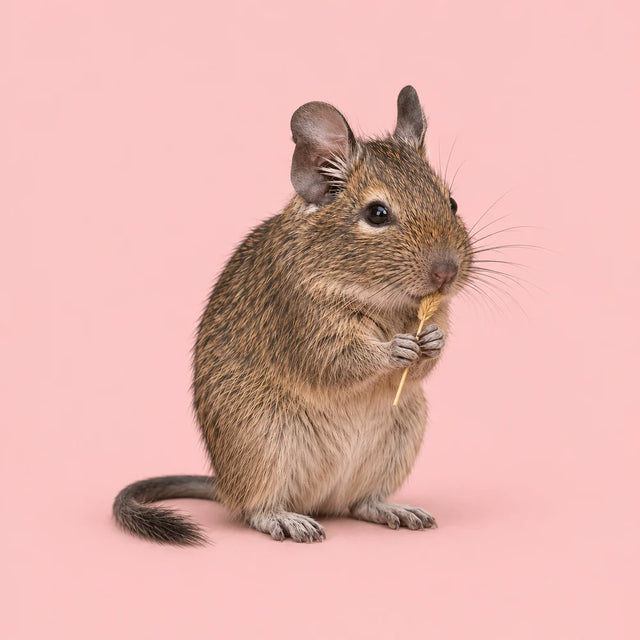
Degus are rodents from the hills of Chile. The RSPCA says wild degus live in northern and central Chile at up to 1,200 m in the Andes. They have a long, thin tail ending in a tuft. Burgess puts the body at about 15 cm (6 in), with the tail about the same again, and PetMD gives a weight of 6 to 10 oz (170 to 280 g).
They are awake in daylight, which is rare for a small pet. PetMD says they are busiest from morning to early evening. They dig, climb, chew, stash food and chatter all day; Burgess counts more than a dozen different sounds. They live 6 to 8 years, according to PDSA. PetMD describes the usual coat as soft brown, and you'll find more on colours in degu types and colours, odd details in degu facts, what each sound and posture means in degu behaviour, and life stages in how long degus live.
Degu housing: cage, layout and bedding
Buy the biggest tall metal cage you can fit. Wood Green and Burgess give 93 × 63 × 159 cm (37 × 25 × 63 in) for two to four degus. The smallest any good source accepts is about 70 × 45 × 70 cm (28 × 18 × 28 in), from Degutopia and PetMD, and only if they get an hour out every day. The cage must be metal, including the base, because PDSA notes degus chew through plastic and wood, and the roof should be solid because movement overhead frightens them. Our degu cage size guide has the full comparison and our pick of best degu cages shows what to buy.
Inside, give several levels linked by ramps and branches, a nest box big enough for everyone, and a separate hide for each degu, as the RSPCA asks. Our degu hides and houses page lists good options. The floor needs a deep layer of dust-free paper bedding with hay on top for digging; see the best bedding for degus and degu cage setup for a layout that works.
What do degus eat?
Mostly hay. Degus are strict plant-eaters with a gut built for fibre, and they are prone to type 2 diabetes, so the RSPCA says their diet must be low in sugar and fat. Wood Green breaks it down as about 80% hay, 5% nuggets and 15% natural forage treats such as dried herbs and safe branches.
| Food | How much | Notes |
|---|---|---|
| Grass hay (timothy, meadow, orchard) | Unlimited; at least their body size a day (Burgess) | The main food, also wears down teeth |
| Degu nuggets | 1 to 2 tbsp (about 10 g) per degu a day (PDSA) | No molasses; guinea pig or chinchilla nuggets if no degu ones |
| Leafy greens | A small handful, daily to twice weekly | Romaine, dandelion, herbs; introduce slowly |
| Root veg such as carrot | Tiny pieces, occasionally | The RSPCA lists them as occasional treats only |
| Fruit, seeds, nuts, sugary treats | None | Diabetes and weight gain risk |
The RSPCA says rabbit, hamster and gerbil foods and chinchilla mixes with dried fruit aren't suitable. Sources differ a little on greens: Burgess suggests a small handful daily, PDSA once or twice a week. We'd start at PDSA's amount and build up slowly if droppings stay firm. The detail is in our degu diet guide, the full list of safe foods is on what can degus eat, and the reasons behind the sugar rule are in degus and sugar.
Why degus need company
Degus must live with other degus. The RSPCA says they can become depressed if kept alone and should never be housed alone unless a vet or behaviourist advises it. Keep a same-sex pair or small group, or one neutered male with females, and never more than one male in a mixed group. Burgess suggests a pair from the same litter. Introducing strangers is slow: PDSA describes daily sessions of 15 to 30 minutes for about a week, because degus are territorial.
Exercise, toys and enrichment
Degus need to run, climb, dig and chew every day. Give a solid wheel at least 30 cm (12 in) across, the minimum Degutopia sets so the back stays flat; PDSA warns that running with an arched back can cause spine problems. Avoid open rungs and spokes. Our degu wheel guide covers sizes and safety.
PDSA suggests half an hour or more out of the cage each day in a safe pen or degu-proofed room, with cables covered and houseplants removed. Inside the cage, give cardboard to shred, safe branches such as apple, pear, hazel or willow, a dig box and scattered food. Find ideas in our degu enrichment guide and best degu toys and accessories.
Sand baths
Degus clean their coats by rolling in fine sand. The RSPCA advises a heavy, shallow bowl of chinchilla sand about 4 cm (1.5 in) deep, two or three times a week for about 20 minutes, then taking it away, because overuse can cause problems. PDSA adds that sand left in all the time can dry their skin. Never add talc. More in our degu dust bath guide.
Handling and taming
Degus tame well but rarely love being held. Wood Green and Burgess suggest 10 to 20 minutes each evening talking to them and offering treats from your hand, then letting them climb onto your arm when they're ready. Handle them close to the ground, as the RSPCA advises, and move them with a tunnel when you need to. Never pick a degu up by its tail: PetMD explains the skin can come away, and Wood Green says that injury needs a vet straight away. Our guide to taming and bonding with a degu goes step by step.
Cleaning the cage
Spot clean daily and do a full clean every one to two weeks. The RSPCA asks for toilet and feeding areas daily and the rest at least weekly; PDSA gives a deep clean every two weeks. Use hot water and a mild washing-up liquid, rinse well, and put a handful of clean old bedding back so it still smells familiar. Check nest boxes for hoarded food that has gone off. The full routine is in how to clean a degu cage.
Degu health: what to watch for
A healthy degu is alert, with bright eyes, clean ears, glossy fur and a clean tail and bottom, and its teeth are yellow-orange. The RSPCA says white teeth can be a sign of poor health, and asks you to check teeth at least weekly. The common problems are dental disease, diabetes, tail injuries, breathing infections and heatstroke.
- Eating less, dropping food or drooling (teeth)
- Fewer or smaller droppings (teeth or gut)
- Drinking and weeing more, cloudy eyes, weight gain (diabetes, says Wood Green)
- Runny nose or eyes, noisy or laboured breathing (infection)
- Lying flat and still in warm weather (heatstroke, an emergency)
- Any tail wound or loss of tail skin (needs a vet straight away)
PetMD advises an exotic vet check soon after you get degus, then yearly. Our degu health guide explains each sign and how fast to act.
Daily, weekly and monthly degu care checklist
Every day
- Fresh water, bottle checked for leaks and blockages
- Hay topped up and a measured portion of pellets
- Toilet corner and food area cleaned
- Hoarded food checked and removed if spoiled
- 30 minutes or more of time out and some hand-feeding
- Quick look at eyes, nose, fur, tail and droppings
Every week
- Sand bath two or three times
- Teeth checked for colour, length and shape
- Weight noted
- Full cage clean, or every two weeks if it stays fresh
- One or two toys or branches swapped for something new
Every month and year
- Chewed hides, shelves and branches replaced
- Wheel checked for wear and wobble
- Yearly check-up with an exotic vet
Getting degus
Start with rescues. An adult pair that already lives together saves you the slow job of introductions. Our guide to where to get a degu covers rescues, good breeders and what a healthy degu looks like, and degu names has ideas once they're home. In the US, Chewy notes degus are illegal in some states, so check local rules first.
Degu care questions
Are degus hard to care for?
Degus aren't difficult, but they are demanding. They need a companion, a tall metal cage, a strict low-sugar diet for life, daily cleaning and at least 30 minutes out of the cage, plus an exotic vet. PDSA doesn't recommend them as a first pet. If you can plan for all of that, the day-to-day jobs are simple.
How often should I feed my degus?
Keep hay available all the time and give pellets once a day. PDSA suggests 1 to 2 tablespoons (about 10 g) of degu nuggets per degu daily, scattered so they forage, and a small portion of leafy greens once or twice a week. Burgess suggests a small handful of greens daily. Fresh water must always be available.
What temperature do degus need?
Keep degus at 20°C (68°F) or below, as the RSPCA and Burgess advise. Degutopia gives 18 to 22°C (64 to 72°F) as ideal and 15 to 25°C (59 to 77°F) as the safe range. Degus can't sweat and get heatstroke easily, so keep the cage away from sun, radiators and warm rooms.
Do degus need a vet check?
Yes. PetMD advises seeing an exotic vet soon after you get degus, then once a year and whenever they seem unwell, and the RSPCA also asks for a yearly check. Find an exotic vet before you bring degus home, because many general practices don't see them. Pet insurance can help with unexpected bills.
How long can degus be left alone?
Degus need someone to feed them, check water and look them over every day, so the RSPCA says to arrange a daily visitor whenever you're away. A bonded pair keeps each other company during a normal working day. They should never be left for a weekend with just a full bowl and bottle.
Can degus live outside?
No. PDSA says degu cages should be indoors, away from draughts and direct sunlight. Degus are very sensitive to heat and need a steady temperature at or below 20°C (68°F), which an outdoor hutch or shed can't give in summer. Keep them in a cool, calm room of the house.
Sources
- RSPCA: Degus
- RSPCA: The right environment for degus
- RSPCA: Feeding degus
- RSPCA: Degu behaviour
- RSPCA: The appropriate company for degus
- RSPCA: Degu health and welfare
- PDSA: Are degus good pets?
- PDSA: The ideal environment for degus
- Wood Green: Introduction to degus
- Wood Green: Degus, your day-to-day guide
- Wood Green: Your degu's health
- PetMD: Caring for a degu
- Degutopia: Housing degus
- Degutopia: Degu enrichment
- Burgess Pet Care: The ultimate guide to happy, healthy degus
- Burgess Pet Care: Add some degus to your day
- Chewy: Degus as pets (vet reviewed)