Hides and houses
 Shelves and ledges
 Foraging and toys
 Cage accessories
 Kits and bundles
 Fairy forest
 Spooky mischief
 Sweetie stash
 Game mode
 Forest floor
 Castles and cathedrals

What do pet rats eat?
Pet rats, fancy rats and domestic rats are all the same animal, and they eat a mixed diet: rats are omnivores, like us. The base of a healthy diet is a complete rat food in nugget, pellet or block form. Every bite has the same balance of nutrients, so a rat can't pick out the tasty bits and leave the rest.
The RSPCA and Burgess both say to use food made for rats, not pellets for rabbits, guinea pigs, hamsters or other plant-eaters. RSPCA Australia suggests a food with about 14 to 16% protein and about 5% fat, with more protein only for rats that are breeding. Our pick: any rat-specific nugget in that range, from a maker that lists its nutrient levels clearly.
Seed and grain mixes are the common mistake. RSPCA Australia explains that rats pick out the sunflower seeds and other high-calorie pieces, ignore the rest, and end up overweight and short of nutrients. Woodgreen does publish a careful homemade mix for keepers who want to weigh and balance everything themselves. For most owners, nuggets plus fresh food is simpler and safer. Our rat diet and nutrition guide goes deeper on labels and life stages.
How much should I feed my rat?
Start with the amount on the packet, split across two meals, and adjust by weight. PDSA warns that rats put on weight easily and suggests weighing food out each day. If you make Woodgreen's homemade mix instead of buying nuggets, Woodgreen gives about 15 g (0.5 oz) of that mix per rat per day and weighs the rats weekly to check.
- Weigh each rat once a week on a kitchen scale and note it down.
- Count fresh food and treats as part of the day's food, not on top of it.
- Take out yesterday's leftovers every morning, before they go off.
- If food is still uneaten at the next meal, cut the portion slightly.
- Ring your vet about any weight loss or gain you can't explain.
Feed in the early morning and early evening. Rats are most active around dawn and dusk, and the RSPCA advises two meals a day to match.
Safe food for pet rats: the list
These are the foods the RSPCA, PDSA, Woodgreen, Burgess and RSPCA Australia list as safe. Offer one new food at a time over a few days, as PDSA suggests, so you can spot an upset stomach.
| Group | Safe foods | How often | Portion |
|---|---|---|---|
| Vegetables | Broccoli, carrot, cauliflower, white cabbage, kale, peas, green beans, cucumber, courgette (zucchini), sweet peppers (bell peppers), sweetcorn (corn), bok choy (pak choi), cress, chicory, celery, beet greens | Daily | A slim slice or a small cube per rat |
| Herbs | Parsley, basil, sage, coriander (cilantro) | Daily | A few leaves |
| Fruit | Apple (no pips), pear, ripe banana, strawberries and other berries, melon, peach, kiwi | A few times a week | A piece the size of the rat's ear |
| Protein | Hard-boiled egg, cooked lean chicken (Woodgreen suggests a boiled leg bone with some meat on, for the teeth), dried shrimp, a mealworm (small amounts: Woodgreen notes they are fatty) | Two or three times a week | A few small pieces |
| Pulses | Cooked lentils, cooked beans (Woodgreen names soya beans), peas, chickpeas | Two or three times a week | A few small pieces |
| Grains | Cooked rice, cooked or dry pasta, dry bread, plain popcorn, plain rice crackers, low-sugar cereal | Once or twice a week | A few small pieces |
| Seeds and nuts | Sunflower and pumpkin seeds, linseed, plain peanuts | Occasional, as rewards | A quarter teaspoon of seeds, or one nut |
For a single food, our rat food checker gives the answer in a second. We also have full pages on favourites such as bananas, broccoli and eggs.
Give the group several small piles of fresh food rather than one. The RSPCA notes that rats share food and even give the most to the hungriest rat, but several piles still cut squabbles and make sure the shy one gets a turn.
What can pet rats not eat?
Pet rats should never have onion, garlic, citrus fruit, grapes, raisins, rhubarb, avocado, chocolate, caffeine or alcohol. Sources agree on most of the list, and where one source says a food is fine and another says avoid it, we've followed the careful one.
| Food | Why to avoid it | Who lists it |
|---|---|---|
| Onion and garlic | Named as harmful; RSPCA Australia groups them with foods harmful to cats and dogs | RSPCA, Burgess, RSPCA Australia |
| Citrus fruit (orange, lemon, grapefruit) | Named by both as harmful, never to be given | RSPCA, Burgess |
| Grapes and raisins | Named as harmful; RSPCA Australia groups them with foods harmful to cats and dogs. None of our sources gives the cause. | RSPCA, Burgess, RSPCA Australia |
| Rhubarb | Named by both as harmful, never to be given. Neither gives the cause. | RSPCA, Burgess |
| Avocado | Named as harmful; RSPCA Australia groups it with foods harmful to cats and dogs | Burgess, RSPCA Australia |
| Chocolate, coffee, tea, alcohol | Named as harmful; RSPCA Australia groups them with foods harmful to cats and dogs | RSPCA, Burgess, RSPCA Australia |
| Walnuts | Named by both as harmful, never to be given | RSPCA, Burgess |
| Blue cheese | Burgess lists it as harmful; the RSPCA also says to keep fatty dairy to rare treats | Burgess, RSPCA |
| Sticky foods (thick nut butters, toffee) | Choking risk | RSPCA Australia |
| Sweets and other sugary or fatty foods, dairy | Too much leads to obesity and health problems | RSPCA, Burgess, RSPCA Australia |
If your rat has eaten chocolate, onion, garlic, grapes, raisins or rhubarb, take away what is left, note roughly how much is gone and ring your vet straight away. Don't wait for signs. Watch for a hunched posture, not eating, diarrhoea, wobbliness or fast breathing, and say exactly what was eaten and when.
RSPCA Australia offers a handy rule of thumb: if a food is harmful to cats or dogs, keep it away from rats too. If you are unsure about a human food, Burgess's advice is simply not to give it.
What do fancy rats like to eat?
Most fancy rats go wild for cooked egg, peas, sweetcorn, banana, berries, plain cooked pasta and a single sunflower seed. Each rat develops its own favourites, and the RSPCA suggests offering a variety so they can choose. Dumbo rats, rex, hairless and every other variety eat the same way; our pages on dumbo rats and the wider fancy rat family cover their care.
Save the very favourite food as a training reward. Because it is rare, it means more, and it keeps the day's calories in check.
What do pet rats drink?
Pet rats drink plain, fresh water, and nothing else. The RSPCA prefers bottles to bowls, because bedding and droppings soil a bowl quickly, and advises more than one bottle so nobody goes thirsty if one blocks. Woodgreen hangs one at each end of the cage.
Check bottles morning and evening for leaks and blockages, change the water daily and scrub the bottles regularly to stop green growth. Never give milk, juice, fizzy drinks, tea or coffee. Our rat drinking water guide covers bottle types and daily checks.
How to feed rats so they forage
Rats are natural foragers, and finding food is half the fun. PDSA, Woodgreen and the RSPCA all suggest scattering the day's food rather than tipping it into a bowl.
- Weigh the day's nuggets. Split them into a morning and an evening portion so you know exactly how much has gone in.
- Scatter half. Sprinkle it across the cage floor, the shelves and into fresh bedding (substrate) so the rats have to search.
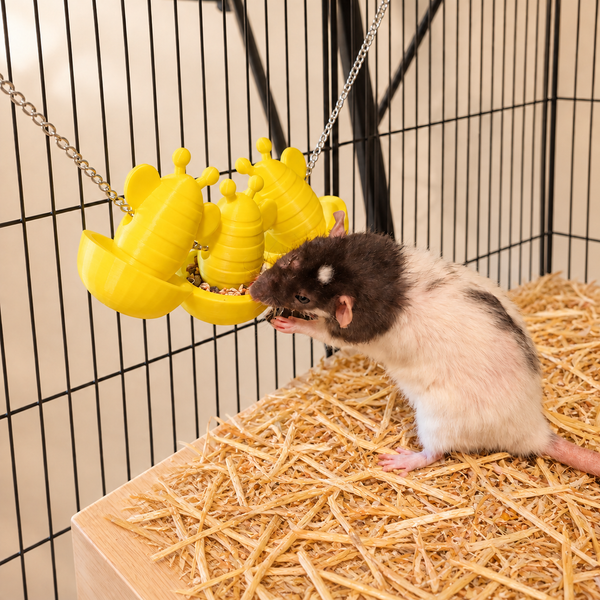
- Hide the rest. Tuck pieces into a paper bag, a cardboard tube with the ends folded, a rolled-up sock, an egg box or a pinecone.
- Add the fresh food. Put small piles of chopped veg in two or three places so every rat gets some.
- Offer something whole. A cooled boiled egg in its shell, a pea pod or a chicken bone gives them a job to do with their hands and teeth.
- Clear up next morning. Remove fresh food that wasn't eaten before it goes off, and use the leftovers to adjust portions.
For more ideas, see our 35 rat enrichment ideas, and for the whole picture of rat keeping, start at our pet rat care hub.
A simple daily feeding routine
- Morning: clear yesterday's fresh food, scatter half the nuggets, check and refill bottles.
- Evening: scatter the other half, add small piles of chopped veg, check bottles again.
- Two or three times a week: add a little cooked egg, chicken or pulses.
- A few times a week: a piece of fruit the size of each rat's ear.
- Weekly: weigh every rat and scrub the bottles.
Questions owners ask
What can I give my rat for enrichment?
Food is the easiest enrichment. Scatter the daily nuggets instead of using a bowl, hide peas or a sunflower seed in a paper bag, a cardboard tube or a pinecone, and offer a whole boiled egg in its shell. A digging box with a few treats buried in it keeps a group busy for ages.
Do dumbo rats eat anything different?
No. Dumbo rats are ordinary fancy rats with low-set ears, so they eat exactly the same diet: rat nuggets as the base, small amounts of fresh veg every day, a little fruit and cooked protein a few times a week, and fresh water always.
Is a seed mix or nuggets better for rats?
Nuggets (pellets or blocks) are the safer base. With a mix, rats pick out the fatty, tasty bits such as sunflower seeds and leave the rest, which leads to an unbalanced diet and weight gain. Some experienced keepers do feed a careful homemade mix, but it takes weighing and planning.
Can rats eat citrus fruit like oranges?
We'd skip it. The RSPCA and Burgess both list citrus fruit among the harmful foods never to give rats. There are plenty of safer fruits, such as apple, pear, strawberry and melon, so there is no reason to take the chance.
Why is my rat eating its own poo?
It is normal and healthy. Rats eat some of their own droppings, usually at night, to absorb nutrients the first pass through the gut missed. The RSPCA says stopping it can lead to deficiencies, so there is nothing to do except keep the cage clean as usual.
Can rats eat hamster or rabbit food?
Not as their main food. The RSPCA and Burgess both say to use pellets made for rats, not for rabbits, guinea pigs, hamsters or other herbivores, because the protein and fat levels are wrong for a rat. A little of a plain rabbit mix can go into a homemade rat mix, as Woodgreen's recipe shows.
How often should rats have treats?
Keep treats small and count them in the day's food. RSPCA Australia says treats should be no more than 10% of a rat's daily calories. In practice that means a piece of fruit the size of the rat's ear a few times a week, plus tiny training rewards.