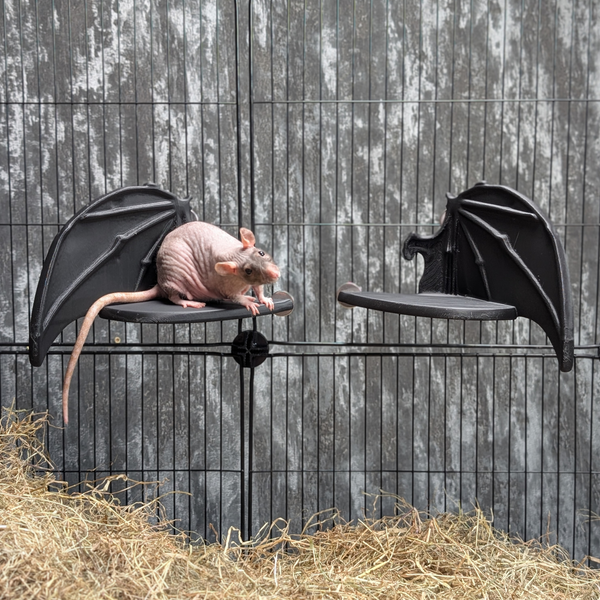
Hides and houses
 Shelves and ledges
 Foraging and toys
 Cage accessories
 Kits and bundles
 Fairy forest
 Spooky mischief
 Sweetie stash
 Game mode
 Forest floor
 Castles and cathedrals

Do rats make good pets?
Yes, for the right home. The NFRS calls them the most intelligent, affectionate and responsive of the small rodents, and well-handled rats rarely bite. But they need more space, company and time than people expect from a "small pet".
| Why people love them | What to be ready for |
|---|---|
| Bond closely with their people and come when called | Need at least two rats, so twice the vet bills |
| Learn tricks and can be trained with treats | Need a big cage and at least an hour out every day |
| Clean, and groom themselves and each other daily | Busy and noisy at night |
| Awake in the evening, when most people are home | Short lives: two to three years |
| Cheap to buy and to feed | Prone to breathing problems and lumps as they age |
If you want an animal to watch rather than handle, or you are away from home most evenings, rats will be lonely and bored. If you want a small pet that genuinely wants to be with you, they are hard to beat. Our guide to what rats cost sets out the money side.
Pet rat care for beginners: the basics
Here is the whole job on one card. Every number comes from the RSPCA, Woodgreen, PetMD, Humane World for Animals or the MSD Veterinary Manual.
| Need | What to give |
|---|---|
| Company | A same-sex pair or trio of bonded rats; mixed groups only with neutered males |
| Cage | As big as you can fit, with several levels, solid shelves and 1 cm (0.4 in) bar spacing |
| Bedding | Paper-based, hemp or kiln-dried shavings; no sawdust, cedar, pine or scented bedding |
| Hides | One more than the number of rats, each with more than one exit |
| Food | Rat nuggets, fed morning and evening, plus small amounts of vegetables, fruit and cooked egg |
| Water | Two bottles, checked morning and evening |
| Room | 19 to 23°C (66 to 73°F), away from sun, draughts, radiators and loud electronics |
| Exercise | At least an hour a day out of the cage, in a rat-proofed room or playpen |
| Cleaning | Spot clean daily; full clean every week or two |
| Health | Weekly weigh and body check; a vet who knows rats |
How big should a pet rat cage be?
For up to four rats, Woodgreen's minimum is 80 cm wide, 50 cm deep and 80 cm high (31 × 20 × 31 in), with bars no more than 1 cm (0.4 in) apart. For up to ten rats, it is 93 × 63 × 123 cm (37 × 25 × 48 in). Other sources work by volume per rat: Humane World for Animals says at least 2.5 cubic feet (0.07 m³) per rat, and Burgess says 3 cubic feet (0.085 m³).
The RSPCA gives no minimum and simply says as large as possible, because rats need to run, climb and stand up on their back legs. We follow Woodgreen's figures because they give real dimensions and a bar gap that stops young rats and females squeezing out. Avoid glass tanks, which trap heat and stale air, and wire floors, which hurt feet (RSPCA, PetMD).
Our guide to the best rat cages compares real cages against these numbers.
What are good things to put in a rat cage?
Think of the cage as a climbing frame with bedrooms. The RSPCA wants tunnels, ropes, hammocks, ladders and shelters, but warns not to fill every bit of space. Woodgreen adds litter trays, dig trays and hanging hides.
- Hides: one more than the number of rats, each with two ways out.
- Hammocks and fleece beds at different heights.
- Shelves and ledges, so rats can climb without long falls.
- Ropes, ladders and tunnels joining the levels.
- One to three corner litter trays with paper pellets.
- A dig tray filled with coco soil or shredded paper.
- Two water bottles, one at each end or on each level.
- Heavy ceramic bowls; the RSPCA says metal bowls give off ultrasound noise.
- Safe things to gnaw, such as apple wood or wooden chews.
- Plain tissue or shredded paper for nest building.
What do pet rats eat?
A complete rat nugget as the base, with fresh food on top. The RSPCA says to use pellets made for rats, not rabbit or hamster food, because rats are omnivores with different needs. PetMD warns against seed mixes, which let rats pick out the fatty bits.
- How much: Woodgreen feeds about 15 g (0.5 oz) per rat per day, scattered for foraging. PetMD gives 5 to 10 g per 100 g of body weight, which works out at 25 to 50 g for a 500 g male.
- When: morning and evening, as rats eat mainly at dawn and dusk (RSPCA).
- Fresh food: vegetables, some fruit, cooked egg, plain cooked rice or pasta, all counted within the day's allowance.
- Avoid: onion, citrus fruit, walnuts, rhubarb, grapes, raisins and chocolate (RSPCA).
Rats get fat easily, so PetMD and the RSPCA both advise weighing them regularly. Our safe food list for rats goes through everyday foods one by one.
Daily and weekly rat care
- Every morning and evening: feed, check and refill water bottles, and watch each rat moving, breathing and eating (RSPCA).
- Every day: spot clean droppings and wet bedding, and remove old fresh food (Woodgreen).
- Every day: at least an hour out of the cage (Humane World for Animals, Burgess).
- Every other day: empty litter trays (Woodgreen).
- Every week: weigh each rat and run your hands over them for lumps (RSPCA).
- Every week: wash smelly hammocks (Woodgreen).
- Every one to two weeks: full clean and fresh bedding; the RSPCA says weekly, Woodgreen fortnightly for most groups.
Our rat cage cleaning guide walks through the full clean step by step.
How to handle and tame a pet rat
- Let them settle. Give new rats a day or two in their cage before regular handling, as Woodgreen advises.
- Pick the right time. Handle them in the morning or evening, when they are awake (RSPCA).
- Start with treats. Offer a small treat from your flat hand at the cage door until they come to you.
- Scoop, don't grab. PetMD says to support the ribcage with one hand and the bottom with the other.
- Never lift by the tail. Burgess warns it can injure the tail or even cause it to come off.
- Keep sessions short. A few minutes, several times a day, builds trust faster than one long session.
Are rats intelligent pets?
Yes. The RSPCA says rats learn quickly, remember well and can be taught their names, high-fives, fetching and rolling over with rewards. Intelligence comes with a cost: rats get bored. Change the cage layout often, hide food, and give them new things to explore during free-roam time. Our rat facts page has more on how clever they are.
What are good toys for rats?
The best rat toys make them sniff, dig, shred and work for food. Woodgreen suggests pipes and tunnels, climbing frames, ropes, cardboard boxes, parrot toys, dig trays and "pea fishing" on hot days, where peas float in a shallow dish of cool water. The RSPCA suggests hiding food in tubes or scattering it in fresh bedding, and offering a whole cooled boiled egg to work at.
For more ideas, see our guide to rat toys that keep rats busy.
What is the best breed of pet rat?
There is no best breed, because all pet rats are one species. Dumbo ears, rex curls, hooded markings and dozens of colours are just looks; personality comes from the individual and how it was raised. The AFRMA says rats from friendly parents make friendlier pets, so the source matters more than the variety.
Sex makes more difference than variety. PetMD says males need more space, are generally lazier and cuddlier, and have stronger-smelling urine. Females are smaller and busier. Our guide to rat breeds and colours shows the varieties.
Keeping pet rats healthy
Rats hide illness well, so the RSPCA wants a quick look every morning and evening and a hands-on check each week. Call a vet if a rat stops eating, loses or gains weight fast, sneezes or wheezes, has red staining round the eyes or nose, sits hunched or has a lump. Breathing infections, lumps and tumours are the most common problems, and VCA says rats need a check-up at least once a year, twice as they age, but no vaccines. Keep the room at 19 to 23°C (66 to 73°F), as the RSPCA advises.
Rats can't vomit, so the RSPCA warns that even a small amount of something harmful can kill them. Before free-roam time, put away cables, houseplants, medicines and anything chewable you care about.
Our guide to signs your rat is sick explains how fast to act, and the pet rat care hub links every guide we have.
Who should not get rats?
The CDC, quoted by the RSPCA and Humane World for Animals, advises against pet rodents in homes with children under five, pregnant people or anyone with a weakened immune system. Rats may also not suit you if you can't give them time every evening, you need a silent bedroom, or the short lifespan would be hard on your family. If you are ready, our guide on where to get pet rats is the next step.
Questions owners ask
What is the best breed of pet rat?
There isn't one. All pet rats are the same species, and varieties such as dumbo, rex, hairless and hooded differ only in looks. Pick rats for health and temperament instead. Males tend to be bigger and lazier, females busier and more active, so choose the personality that suits you.
What breed of rat is best as a pet?
Any healthy, well-handled domestic rat. Choose rats that settle in your hands, are curious and come from friendly parents or a rescue that knows them. If you are new to rats, a furred variety is easier than a hairless one, which needs a warmer room and extra skin care.
Are rats intelligent pets?
Yes, very. The RSPCA says rats are quick learners with excellent memories and can learn their names, high-fives, fetch and roll over. That intelligence is why they need daily company, puzzles and foraging; a bored rat in a bare cage is an unhappy one.
What are some good things to put in rat cages?
Hides (one more than you have rats, each with two exits), hammocks, shelves and ledges at different heights, ropes, ladders and tunnels, a litter tray, a dig tray, two water bottles, heavy ceramic bowls and safe things to chew. Swap a few items around each week to keep it interesting.
What are some good toys for rats?
Toys that use their nose, paws and teeth: foraging toys, cardboard boxes and tubes to shred, a dig tray with soil or paper, hanging toys, ropes and parrot toys. Woodgreen also suggests pea fishing on hot days, floating peas in a shallow dish of cool water.
Can rats live alone?
No. The RSPCA says rats should never be kept alone, and Woodgreen says lone rats can become depressed, nervous or aggressive. Keep a same-sex pair at the very least; a trio means nobody is left alone when one dies.
Are rats good pets for children?
Rats can be lovely family pets, gentle and easy to handle, but an adult must be the main carer. The RSPCA says to supervise children because frightened rats can bite, and the CDC advises against pet rodents in homes with children under five.
Do pet rats smell?
Clean, healthy rats don't smell much; Adopt a Pet says odour usually comes from a dirty cage. Males' urine smells stronger than females' (PetMD). A daily spot clean, a litter tray and a full clean every week keep most homes smell-free.
Sources
- RSPCA: Pet rats
- RSPCA: Rat environment
- RSPCA: Rat diet
- RSPCA: Rat behaviour
- RSPCA: Rat health
- Woodgreen Pets Charity: Caring for rats as pets
- PetMD: Caring for a pet rat, what to expect
- Humane World for Animals: Is a rat the right pet for you?
- MSD Veterinary Manual: Providing a home for a rat
- Burgess Pet Care: How long do pet rats live for?
- VCA Canada: Owning a pet rat
- Adopt a Pet: What you need to know before adopting a pet rat
- National Fancy Rat Society: Keeping rats as pets
- AFRMA: Choosing your pet rat