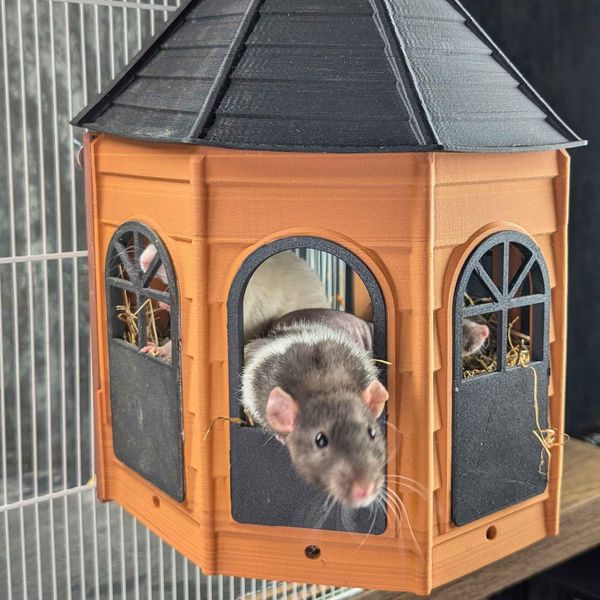
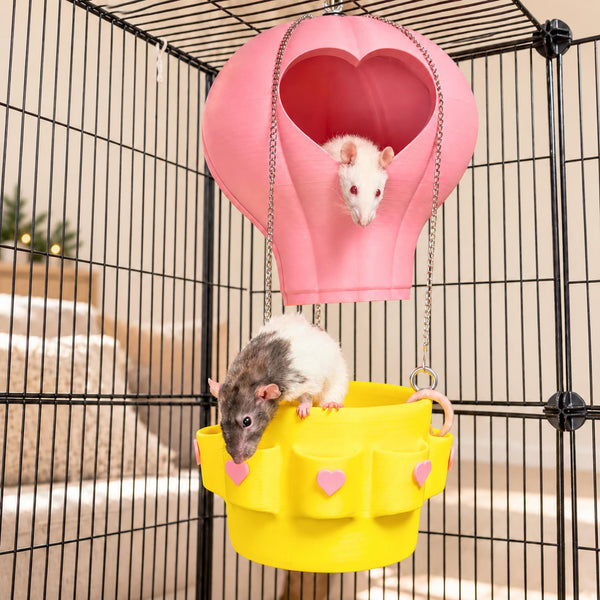
Hides and houses
 Shelves and ledges
 Foraging and toys
 Cage accessories
 Kits and bundles
 Fairy forest
 Spooky mischief
 Sweetie stash
 Game mode
 Forest floor
 Castles and cathedrals

What makes a good rat cage?
A good rat cage gives a group of rats height to climb, floors to dig and run on, and plenty of fresh air. Rats are climbers and explorers, so a tall cage with several levels is worth far more than a wide, low one. These are the points to check before you buy:
- Size: at least Woodgreen's 80 x 50 x 80 cm (31.5 x 19.7 x 31.5 in) for up to four rats.
- Bar spacing: 1 cm (about 1/2 in) or less, as Woodgreen and PetMD advise. RSPCA Australia allows up to 2.5 cm (1 in) for adult rats only, but young rats and does slip through gaps that wide.
- Solid floors and shelves: RSPCA Australia warns that wire mesh floors trap feet and can cause sore feet (bumblefoot).
- A deep base: sides of about 5 to 10 cm (2 to 4 in), as RSPCA Australia suggests, to keep bedding in.
- Wire sides: RSPCA Australia and PetMD both say solid-sided tanks trap ammonia from urine. Wire sides let it out.
- Big doors: full-width doors make cleaning and catching rats much easier.
- Horizontal bars: easier to climb and simpler to hang hammocks and shelves from.
- A coated finish: powder-coated or hammertone bars resist rust and clean more easily than bare metal.
How big should a rat cage be?
Bigger is always better, but here are the numbers to work from. Woodgreen is the only charity we found that gives exact minimums: 80 x 50 x 80 cm for up to four rats and 93 x 63 x 123 cm for up to ten, both with 1 cm bars. PetMD sets a floor of 24 x 24 x 24 in (61 x 61 x 61 cm) for a single rat, while stressing that rats should live in at least pairs. The RSPCA and PDSA give no figures; both say to give as much space as you can, and PDSA adds that large ferret and chinchilla cages are usually a good size.
| Group size | Woodgreen minimum (W x D x H) | Picks below that fit |
|---|---|---|
| 2 rats | 80 x 50 x 80 cm (31.5 x 19.7 x 31.5 in) | Critter Nation single, Savic Zeno 3 Empire |
| 3 to 4 rats | 80 x 50 x 80 cm (31.5 x 19.7 x 31.5 in) | Savic Zeno 3 Empire, Critter Nation double |
| 5 to 10 rats | 93 x 63 x 123 cm (36.6 x 24.8 x 48.4 in) | Ferplast Furet Tower, Savic Royal Suite XL |
We'd follow Woodgreen, because it is a UK animal charity's own minimum and the space leaves room for hides, a dig box and a wheel. RSPCA Australia points out that there is no hard evidence for an ideal size, and says to buy as big as you can afford, look after and fit in your home. To check a cage you already have, or one you are eyeing up, try our rat cage size calculator.
Work out a cage's volume before you buy: multiply width, depth and height in centimetres and divide by 1,000 for litres. Under 320 litres (11 cu ft) is below Woodgreen's minimum for four rats, whatever the box says.
The best rat cages to look at
We don't make cages, so these are from other shops we'd look at. Each one meets or beats the sizes above and has bars at or under the spacing we recommend, unless we say otherwise. Check the sizes and bar spacing on the shop's page before you order, as models change.
Savic Zeno 3 Empire
A tall cage at 100 x 50 x 116 cm (39 x 20 x 46 in), with 9.5 mm (3/8 in) bars, a 16 cm (6 in) deep base, three platforms with ladders and two front doors. It is well over Woodgreen's minimum for four, and the tight bars suit does and young rats. Our pick for a first group of three or four. The doors are small, so check you can reach every corner for cleaning.
MidWest Critter Nation (single unit)
The best-known rat cage in the US, with a footprint of about 36 x 24 in (91 x 61 cm), half-inch (1.3 cm) horizontal bars, full-width double doors and solid plastic floor pans. The single unit suits two or three rats. Add-on units stack on top, so you can buy for now and build up later.
MidWest Critter Nation add-on unit
A 36 x 25 x 24.5 in (91 x 64 x 62 cm) extra level with its own shelf, full-width plastic pan, ramp, double doors and dual-locking latches. Added to a single unit it makes a double, about 63 in (160 cm) tall, which suits a group of four to six. It only works with an existing Critter Nation.
Ferplast Furet Tower
A big two-storey cage at 80 x 75 x 161 cm (31.5 x 29.5 x 63 in), with an 18 cm (7 in) deep base tray, three doors, three platforms and wheels. Woodgreen's ten-rat minimum fits inside it, so it suits a larger group. The bars are 1.4 cm (just over 1/2 in) apart, fine for adult bucks but worth checking against small does and young rats.
Savic Royal Suite XL
The roomiest cage here: 115 x 67 x 81 cm (45 x 26 x 32 in) on its own, or 115 x 67 x 152 cm (45 x 26 x 60 in) with the extension. It has 1.3 cm (1/2 in) bars, doors that open across the whole front, deep removable trays, height-adjustable platforms and castors, and the levels can be split into two cages for introductions or a poorly rat. For a big group, or anyone who wants room for a full themed setup.
Savic Zeno 2 (budget pick, two rats only)
At 80 x 50 x 70 cm (31.5 x 19.7 x 27.5 in), with 9.5 mm (3/8 in) bars and a 16 cm (6 in) base, this is the smallest cage we'd look at. It is 10 cm (4 in) shorter than Woodgreen's minimum, so treat it as a home for a pair only, or as a spare for travel, introductions and recovery. If you can stretch to the Zeno 3, do.
Big rat cages for larger groups
For five or more rats, look for a cage of at least 93 x 63 x 123 cm (36.6 x 24.8 x 48.4 in), Woodgreen's minimum for up to ten. The Furet Tower and the Royal Suite XL both clear that. Very tall cages are often hard to move, so you clean them where they stand, and full-width doors matter more and more the bigger the cage gets. Add hammocks and safety nets under the high shelves so nobody takes a long fall; our rat hammock guide covers how to hang them.
Cheap and budget rat cages: what to look for
A budget cage is fine if it meets the size and bar spacing. A cheap cage that is too small is not a bargain, because you will buy a second one within months. Ways to save:
- Buy a modular cage, like the Critter Nation, and add a level later.
- Look for second-hand cages, then scrub and disinfect them with a pet-safe product before use.
- Ask local rat rescues: many sell or pass on cages they no longer need.
- Skip the accessory bundles; most included plastic bits get chewed or replaced.
- Check the bar spacing first. Many "ferret" or "chinchilla" cages are good value for rats; many cheap cages with 2 cm (3/4 in) or wider bars are not.
Rat cages to skip
| Type | Why we'd skip it |
|---|---|
| Glass tanks and solid plastic tubs | Poor airflow lets ammonia and heat build up (PetMD, RSPCA Australia). Use only short-term, for nursing mums or a poorly rat. |
| Hamster and mouse cages | Far too small for even one adult rat. |
| Wide-barred cages (over about 1.4 cm) | Does and young rats escape. Some cages sold "for rats" have 2.3 cm (just under 1 in) bars, which reviewers report rats squeezing through. |
| Wire floors and wire shelves | Trap feet and cause sore feet unless covered (RSPCA Australia). |
| Low, wide single-level cages | No climbing, which is half of what rats love doing. |
| Uncoated bars | Rust and hold smells; harder to keep clean. |
What do rats need in a cage?
A good setup has places to hide, sleep, climb, dig, eat and drink. Our complete rat cage setup guide goes level by level, but the short list is:
- A floor of dust-free bedding (substrate), with one spot 3 to 4 cm (1.5 in) deep for digging. See our guide to the best bedding for rats.
- More than one hide, within easy reach, so every rat can tuck away (RSPCA Australia).
- Hammocks, which most rats love to sleep in together.
- Shelves, ledges, ropes and ladders to make use of the height.
- Two water bottles, one at each end, as Woodgreen suggests, and a heavy ceramic bowl.
- Something to chew, a dig box and foraging toys.
- A wheel, for rats who will use one; our rat wheel guide covers the size.
Shelves and climbing ledges make the most of a tall cage:
Where to put the cage
Put the cage indoors, in a room that stays at 19 to 23°C (66 to 73°F), as the RSPCA advises, away from radiators, direct sun and draughts. Avoid conservatories, garages and sheds. Keep it off the floor and out of reach of cats and dogs (PetMD), and somewhere the rats can see and hear you, since they are sociable. Our rat temperature guide covers hot and cold weather in detail, and our pet rat care hub links to everything else.
Questions owners ask
What is the minimum cage size for 2 rats?
Woodgreen's minimum for up to four rats is 80 cm wide, 50 cm deep and 80 cm high (31.5 x 19.7 x 31.5 in), so that is the smallest we'd use even for two. Woodgreen also advises keeping at least three rats, so buying for three or four from the start saves a second cage later.
How big a cage do 4 rats need?
At least 80 x 50 x 80 cm (31.5 x 19.7 x 31.5 in), Woodgreen's minimum for up to four, with bars no wider than 1 cm. Bigger is better: a cage around 100 x 50 x 116 cm (39 x 20 x 46 in) gives four rats room for shelves, hammocks and a dig box.
How many rats should be in a cage?
At least two, and Woodgreen recommends three or more so nobody is left alone if one dies. Groups of three to six usually settle best. The number a cage can hold depends on its size: Woodgreen's larger minimum of 93 x 63 x 123 cm (36.6 x 24.8 x 48.4 in) is for up to ten.
What goes at the bottom of a rat cage?
A solid floor covered with a few centimetres of dust-free bedding (substrate), such as shredded card, paper bedding, hemp or dust-extracted horse shavings. RSPCA Australia suggests at least one area 3 to 4 cm (1.5 in) deep for digging. Avoid sawdust, cedar and pine shavings, and cotton wool.
What should not go in a rat cage?
Avoid wire-mesh floors, cotton wool or fluffy bedding, sawdust, cedar or pine shavings, rubber toys, metal chains, and loose-weave fabrics that can trap toes and teeth, as RSPCA Australia and Woodgreen warn. Skip glass or plastic tanks as the main home: they trap ammonia and heat.
Is a Critter Nation good for rats?
Yes, it is one of the most popular rat cages in the US. It has half-inch (1.3 cm) bars, full-width doors, solid plastic floor pans and a roughly 36 x 24 in (91 x 61 cm) footprint. The double unit suits a group of rats, and add-on units let you build it taller later.
What is the best breed of pet rat for a cage?
Every variety, from dumbos to rex and hairless rats, needs the same cage: rats differ in looks, not in housing needs. Hairless rats do need a warmer room and more fleece. Females and young rats are smaller, so they need the tighter 1 cm (1/2 in) bar spacing.