Hides and houses
 Shelves and ledges
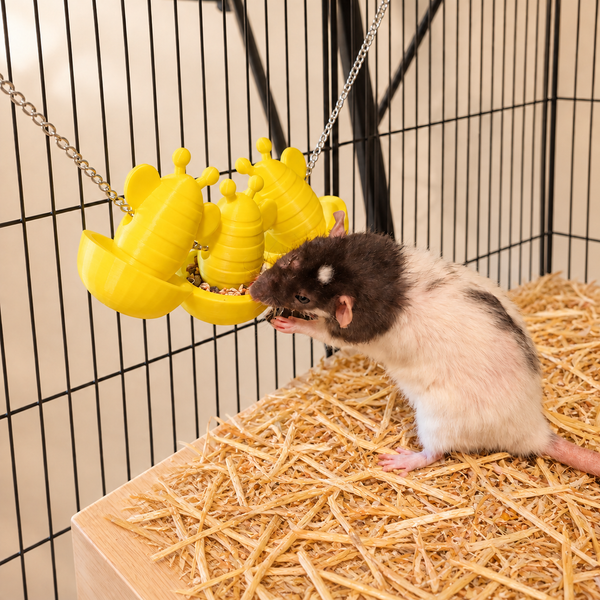
 Foraging and toys
 Cage accessories
 Kits and bundles
 Fairy forest
 Spooky mischief
 Sweetie stash
 Game mode
 Forest floor
 Castles and cathedrals

Rat enrichment ideas by activity
Pick the job your rats are missing, then jump to the ideas that cover it. Every idea below is labelled with the type of enrichment it gives.
| What you want to add | Ideas to try first |
|---|---|
| Foraging and searching | 1 scatter feeding, 9 dig box, 10 pea fishing, 13 coffee filter foragers, 22 foraging garlands and cups |
| Climbing and movement | 18 rope bridges, 24 multi-level shelves, 20 obstacle course |
| Hiding and resting | 3 paper bag hideouts, 23 themed hideaways, 26 hanging hides, 27 mansion hideouts |
| Chewing and shredding | 2 toilet roll tube puzzles, 6 fleece strips, 4 tissue paper dig pile |
| Exploring and training | 5 cardboard box maze, 19 trick training, 32 scent trails, 31 agility course |
| Out-of-cage activity | 20 obstacle course, 30 shoulder travel, 33 water play station |
Rat cage enrichment: first steps
If you are setting up cage enrichment from scratch, start with jobs before themes. Cover hiding, climbing, foraging, chewing and resting first, then add colour or style once the layout works.
- One stable hide per rat, plus one spare (the RSPCA suggests one more shelter than the number of rats)
- One climbing route from the floor to the top
- One scatter-feeding area
- One chewable or shreddable material, such as plain cardboard
- Enough open space for rats to move away from each other
Change one part at a time so you can see what your rats actually use. For the full layout, use our rat cage setup guide. If you are choosing bought pieces, read how to choose rat cage accessories before adding more to the cage.
Why enrichment belongs in everyday care
Choose activities your rats can approach and leave by choice, and watch how each rat uses them. A rat that ignores an idea has not failed a test; try a different one.
The RSPCA's pet rat behaviour advice asks owners to give rats chances to run, climb, forage, dig and explore under supervision, and to rotate toys regularly. Those everyday needs are the starting point for this list. RSPCA Australia adds that rats are cautious of new things, so give them time to adjust and let them choose whether to join in.
Build variety around the rats in front of you: easy routes, suitable shelters and activities they can use comfortably. Keep enough space to inspect the cage and reach a rat when you need to.
Simple activities count. A cardboard tube or a food search can sit alongside familiar shelter and normal feeding. Use food from the daily allowance rather than adding an extra meal, because rats gain weight easily (PDSA).
Enrichment is part of a good home, not a cure. Ask a vet about any sudden change in behaviour rather than assuming the rat only needs another toy.
The five welfare needs enrichment supports
In the UK, section 9 of the Animal Welfare Act 2006 sets out five welfare needs for every pet: a suitable environment, a suitable diet, the ability to show normal behaviour, being housed with or apart from other animals as suits them, and protection from pain, injury, suffering and disease. Enrichment directly supports four of them:
| Welfare need | How enrichment delivers it |
|---|---|
| Normal behaviour | Foraging, climbing, burrowing, exploring, social play |
| Suitable environment | Complexity, variety, choice, control over their space |
| Social housing | Group activities, shared resources, play together |
| Protection from pain and distress | Suitable activities, safe routes and daily checks that spot changes needing a vet |
The five types of enrichment (and why you need all five)
Most owners only think of toys. Good enrichment covers five types, and a balanced week uses all of them. RSPCA Australia groups them into three (foraging, social, and physical, sensory and occupational); we split the last one out so it is easier to plan.
| Type | What it means | Easy examples |
|---|---|---|
| 1. Foraging | Food takes searching, not just a trip to a bowl | Scatter feeding, hidden food in paper bags, tubes and boxes (PDSA), hanging food |
| 2. Physical | Climbing and moving at different heights | Ropes, ladders, shelves, branches, hammocks |
| 3. Sensory | New smells, textures and surfaces underfoot | Herbs, a new bedding (substrate) patch, a dig box |
| 4. Social | Time with other rats and calm time with you | A pair or small group, voluntary play, free roam |
| 5. Cognitive | Problem-solving, training and novelty | Puzzle feeders, scent trails, reward-based training |
Foraging copies the natural habit of searching for food. A bowl of pellets removes that whole job; scatter feeding, puzzle feeders and hidden food bring it back. The AFRMA notes that scattering food also means rats do not all feed at once, which reduces squabbles.
Physical enrichment needs usable levels and safe access. Height does not replace floor space, shelter or regular cage checks.
Sensory enrichment is often the simplest. RSPCA Australia suggests offering new scents and tastes. Rats rely heavily on smell, hearing, touch and whiskers because their eyesight is poor, so a new smell is big news to them. See our guide to what rats can see.
Social enrichment means compatible rat companions as well as considerate human contact. The PDSA says rats cannot live alone and should be kept in a pair or small group. Let rats come to you and do not force handling or play.
Cognitive enrichment can be as simple as reward-based training. The RSPCA gives stepping onto scales for a food reward as a useful example, and says never to punish a rat. Never hold back normal food to make a rat take part. Our guide to training pet rats covers three first skills.
The rule of five: each week, give your rats at least one activity from each type. The rotation plan further down shows how.
Free DIY rat enrichment (£0, under 10 minutes)
These use household items. Start here if your rats have never had enrichment beyond a food bowl.
1. Scatter feeding
Scatter some of the usual dry food around the cage instead of putting it all in a bowl; the PDSA recommends exactly this. Keep some food easy to find, watch each rat, and adapt the game for older or less mobile rats.
Type: Foraging. Best for: All rats, especially overweight or food-passive ones.
2. Toilet roll tube puzzles
Stuff a plain cardboard tube with shredded paper, a little dust-extracted hay and a few treats, then fold the ends shut. Rats love to shred and dig, and this gives them a legal target.
Type: Foraging and physical. Best for: Young, busy, destructive rats.
3. Paper bag hideouts
Plain brown paper bags make instant hides. Rats climb in, shred them, nest in them and drag them around. Replace them daily, or as soon as they are damp or soiled.
Type: Physical and sensory. Best for: Shy or nervous rats needing a temporary safe space.
4. Tissue paper dig pile
Crumple plain, unscented tissue paper into a shallow box and hide treats inside. It is gentle foraging for rats of any age or ability.
Type: Foraging and sensory. Best for: Elderly or less mobile rats.
5. Cardboard box maze
Cut doorways between delivery boxes, stack them and join them with plain paper tape or slot-together flaps (remove plastic tape and staples). Change the layout weekly and build "rooms" with connecting tunnels.
Type: Physical and cognitive. Best for: Curious explorers.
6. Fleece strips
Cut old fleece into wide strips and drape them across bars or tuck them into hides. Rats pull, rearrange and nest with them. Use wide strips that do not fray into threads, and remove any that do.
Type: Sensory and physical. Best for: Nest builders, which is most rats.
7. Rearrange the cage
Move one or two climbing pieces or a feeding spot to a new place. Keep the main beds where they are so the cage still feels like home.
Type: Cognitive and physical. Best for: Every rat. It is the simplest enrichment there is.
8. The "rat burrito" game
Wrap a treat loosely in a small piece of fleece or cotton fabric. Your rat unwraps it to find the reward, using scent, paws and problem-solving.
Type: Cognitive and foraging. Best for: Rats learning puzzle-type games.
Budget rat enrichment (under £5 or about $6, 10 to 30 minutes)
A small spend that adds a lot of depth.
9. Dig box
Fill a plastic storage box with coconut coir (coco soil), shredded paper and a little hay, then bury treats throughout. Woodgreen suggests coco soil for a dig tray, and the RSPCA suggests clean sand or compost in a digging box outside the cage. You can also sprout rat-safe herbs in it, such as basil, mint, parsley and coriander (cilantro). Our rat digging box guide has the full setup.
Type: Physical, foraging and sensory. Difficulty: Easy.
10. Pea fishing
Fill a shallow dish with room-temperature water (cool water on hot days, as Woodgreen suggests) and drop in frozen peas, sweetcorn (corn) or blueberries. Rats wade in and "fish" for floating food. A paint tray with a gentle slope lets nervous rats ease in. Supervise every session. Some rats hate getting wet: the RSPCA says never force a rat into water.
Type: Foraging, physical and sensory. Difficulty: Easy.
11. Herb garden scatter
Sprinkle dried chamomile, rose petals or fresh herbs across the cage. It is scent enrichment that works even for elderly or immobile rats.
Type: Sensory. Difficulty: Easy.
12. Frozen treat blocks
Freeze a little mashed banana with a few small treats in ice cube trays or silicone shapes. Rats lick, gnaw and work at the block over time, which makes it a good warm-weather idea. If your vet suggests hiding medicine in food, ask them first whether a frozen block suits that medicine.
Type: Foraging and cognitive. Difficulty: Easy.
13. Coffee filter foragers
Wrap treats in plain coffee filters, twist them shut and scatter several around the cage. They are quick to make in a batch.
Type: Foraging. Difficulty: Easy.
14. Hanging food kebabs
Thread rat-safe fruit and vegetables onto cotton string or a wooden skewer and hang it from the cage roof. RSPCA Australia suggests hanging food in different parts of the cage. Rats stretch, balance and work out how to pull food off. Check our list of what rats can eat before you choose.
Type: Foraging and physical. Difficulty: Easy to medium.
15. Muffin tin puzzle
Put treats in a muffin tin and cover each cup with a ball, crumpled paper or a small toy. Rats learn to remove the covers. Make it harder with heavier covers.
Type: Cognitive and foraging. Difficulty: Medium.
16. Bottle forager
Cut small holes in a clean, dry plastic bottle and fill it with dry food. Rats roll and push the bottle to shake food out. Bigger holes make it easier. Sand any sharp edges and take it away once it is chewed.
Type: Cognitive and foraging. Difficulty: Easy.
17. Lick mats
Spread a thin layer of mashed sweet potato or plain yoghurt on a textured silicone mat. It slows down fast eaters. Freeze it for extra challenge, keep portions small, and remove it before it goes off. See can rats eat yoghurt for how much.
Type: Foraging and sensory. Difficulty: Easy.
Mid-range rat cage enrichment (£5 to £20, about $6 to $25)
Lasting additions that make the cage more complex.
18. Rope bridges and climbing networks
Cotton or other natural-fibre rope bridges can link cage levels. The RSPCA recommends natural-fibre ropes and replacing them when worn, because rats chew as well as climb. Secure them, check for loose strands and match routes to your rats. Shelf height does not give cleaner air: keep up ventilation and cleaning throughout, and see our rat respiratory health guide for signs that need a vet.
Type: Physical. Difficulty: Medium.
19. Trick training sessions
Try a simple reward-based task, such as stepping onto the scales. The RSPCA also lists coming to their name, high-fives, fetching a ball and rolling over. Keep sessions to 5 to 10 minutes, use part of the usual food allowance, and stop if the rat loses interest. Never force or punish.
Type: Cognitive and social. Difficulty: Medium to hard.
20. Obstacle course (free roam)
During out-of-cage time, set out tunnels, boxes, ramps and treats, and change the layout each session. The RSPCA says an hour or so a day outside the cage is ideal, and an obstacle course makes that time count. Use our rat free roam guide to make the room safe.
Type: Physical and cognitive. Difficulty: Medium.
21. Bedding rotation
Try a different safe bedding (substrate) in one corner each clean: shredded card, non-scented hemp, paper-based bedding or a hay topping. Woodgreen lists shredded card, non-fragranced hemp and coco coir as suitable. Each change sparks fresh investigation. Avoid dusty, scented or coloured bedding (RSPCA). Compare options in our rat bedding guide.
Type: Sensory. Difficulty: Easy.
22. Foraging garlands and cups
Type: Foraging, physical and cognitive. Difficulty: Easy (hang and fill).
23. Themed hideaways
Type: Physical and sensory. Difficulty: Easy.
24. Multi-level shelf systems
Type: Physical. Difficulty: Easy.
Premium and advanced rat enrichment (£20 or more, about $25 and up)
For owners building a full enrichment setup.
25. Complete cage kits
Type: All five types. Difficulty: Easy.
26. Hanging hides
Type: Physical and sensory. Difficulty: Easy.
27. Mansion hideouts
Type: Physical and social. Difficulty: Easy.
28. Personalised food stations
Type: Foraging and cognitive. Difficulty: Easy.
29. Puzzle chains
Link several puzzles: scatter food leads to a dig box, which holds a favourite treat, which leads on to a hanging forager. Chained games keep rats busy far longer than a single puzzle. Change the order weekly.
Type: Cognitive and foraging. Difficulty: Hard.
30. Shoulder travel
Some rats love riding on shoulders or in a hoodie pocket. It mixes time with you with new smells, sounds and sights around the house. Start in a quiet, rat-safe room, only with relaxed, well-handled rats, and keep cables and other pets out of reach.
Type: Social and sensory. Difficulty: Medium (needs well-bonded rats).
31. Agility course
Build a set course of low hurdles, tunnels, ramps and weave poles. Rats that have mastered basic tricks can learn to run it for rewards. Keep jumps low and the floor soft.
Type: Cognitive, physical and social. Difficulty: Hard.
32. Scent trail games
Rub a favourite treat along a path across the cage or free-roam area, ending at a hidden reward. Rats follow their noses to the prize. Make it harder with branching trails and dead ends.
Type: Sensory and cognitive. Difficulty: Medium.
33. Water play station
A step up from pea fishing: a shallow, supervised tray of room-temperature water with floating objects, sunken treats and smooth stones to walk on. The RSPCA suggests shallow water only during supervised free roam, and only for rats that choose to go in. Never force or dunk a rat.
Type: Sensory, physical and foraging. Difficulty: Medium.
34. Quiet, not "sound enrichment"
Let rats rest without disturbance and avoid sudden or loud noise. The RSPCA asks owners to keep cages away from high-pitched sounds, speakers, TVs, vacuum cleaners and alarms, so a calm room is a better plan than playing sounds in the hope of changing behaviour. If a sound makes a rat startle or retreat, remove it. Learn what your rats' own noises mean in our rat sounds guide.
Type: Sensory. Difficulty: Easy.
35. Seasonal enrichment
Match ideas to the calendar: pumpkin or squash foraging in autumn, frozen fruit in summer, fresh spring herbs in the dig box, and extra nesting material in winter. Seasonal change keeps things new without effort.
Type: All types. Difficulty: Varies.
Signs your rats need more enrichment
These behaviours are worth noticing, but none points to a single cause. If a change is sudden, new or keeps going, or a rat seems unwell, ring a vet rather than assuming more enrichment is the answer. Rats hide pain well (RSPCA).
| Behaviour | What it can signal | First response |
|---|---|---|
| Bar chewing (repeated gnawing at cage bars) | Boredom, frustration or trying to escape (RSPCA) | Add foraging. Check the cage size; a bigger cage may help. |
| Barbering (pulling out its own or a cage mate's fur) | Boredom, social tension, or a health problem such as mites (RSPCA, PetMD) | See a vet to rule out skin causes. Add enrichment and enough hides for every rat. |
| Sleeping more at normally active times (dusk and night) | A change from normal that can come from illness, pain, stress or the setup | Check the cage and routine. If it lasts or comes with other changes, see a vet. |
| Fighting between cage mates | Social tension, pain, illness, fear or competition for resources | Check there are enough bowls, water points and hides for all at once (RSPCA). Injuries need a vet. |
| Weight gain | Diet, too little activity, or health causes | Weigh regularly, review food and activity, ask a vet about fast or unexplained change. |
| Pacing or tracing the same route | Repetitive behaviour from a poor environment (AFRMA lists pacing as a target of enrichment) | Overhaul enrichment and consider a bigger cage. Mention it to your vet. |
Plan good activities from the start, but do not treat repetitive behaviour as an automatic sign of boredom. Review the setup and speak to a vet about lasting or sudden changes. Our is my rat sick guide lists the warning signs.
The rotation strategy: how to keep rat enrichment fresh
A rat that ignores an old toy will often take a fresh interest in the same toy brought back after a few weeks away. Rotation is the single biggest upgrade most owners can make, and the RSPCA recommends rotating toys regularly.
The four-set rotation
Split your enrichment items into four sets and use one set per week. After four weeks, start again: each item has had three weeks away.
| Set | Week | Items |
|---|---|---|
| A | Week 1 | Foraging garland, mushroom hide, dig box, scatter feeding |
| B | Week 2 | Treasure chest hide, picnic bench feeder, rope bridge, frozen treat block |
| C | Week 3 | Dragon skull hide, pixel heart shelves, muffin tin puzzle, herb scatter |
| D | Week 4 | Mansion hide, hanging kebabs, bottle forager, cardboard maze |
Weekly rat enrichment schedule
| Day | Activity | Type | Time |
|---|---|---|---|
| Monday | Rearrange the cage with the new rotation set | Physical and sensory | 15 min |
| Tuesday | Scatter feeding (food in the bedding and on shelves) | Foraging | 3 min |
| Wednesday | Dig box or pea fishing | Foraging and physical | 10 min |
| Thursday | Training session (5 to 10 minutes of tricks) | Cognitive and social | 10 min |
| Friday | New scent (herbs, safe flowers, a new bedding sample) | Sensory | 5 min |
| Saturday | Longer free roam with an obstacle course | Physical and cognitive | 30 min or more |
| Sunday | Calm, voluntary time together and gentle handling | Social | 15 min |
Every day, whatever the schedule:
- About an hour of supervised free roam
- Scatter feeding for at least part of the daily food
- Fresh water and a food check
Clean between rotations
- Take the set out. Remove the week's items when you do the weekly clean, while the rats are awake rather than mid-sleep (RSPCA).
- Wash everything. Wash fabric and ropes hot (Woodgreen uses 60°C, 140°F, with non-bio detergent) and wipe hard pieces with a pet-safe cleaner. Washing also removes old scent marks, so items smell new when they come back.
- Dry and store. Let items dry fully before storing, so nothing goes damp.
- Keep a bit of home. Put back a handful of clean, used nesting material so the cage still smells familiar (RSPCA, PDSA).
- Add the next set. Bring in the next set and watch which pieces get used first.
| Enrichment that works | Enrichment to avoid |
|---|---|
| Scatter feeding | Wire-mesh or small wheels (feet catch and backs bend); choose a solid wheel at least 30 cm (12 in) across (Woodgreen, AFRMA) |
| Hammocks and ropes for climbing | Cedar or pine chips (PDSA) |
| Rotating new objects | Living alone |
| Daily out-of-cage time | A cage where nothing ever changes |
| Dig boxes with safe material | Exercise balls, which restrict exploring and cause stress (RSPCA) |
For wheels in detail, see our guide to rat wheels and sizes.
Quick reference table: all 35 rat enrichment ideas
| # | Idea | Cost tier | Type | Difficulty | Time |
|---|---|---|---|---|---|
| 1 | Scatter feeding | Free | Foraging | Easy | 3 min |
| 2 | Toilet roll puzzles | Free | Foraging, physical | Easy | 3 min |
| 3 | Paper bag hideouts | Free | Physical, sensory | Easy | 1 min |
| 4 | Tissue paper dig pile | Free | Foraging, sensory | Easy | 5 min |
| 5 | Cardboard box maze | Free | Physical, cognitive | Easy | 15 min |
| 6 | Fleece strips | Free | Sensory, physical | Easy | 5 min |
| 7 | Rearrange the cage | Free | Cognitive, physical | Easy | 10 min |
| 8 | Rat burrito game | Free | Cognitive, foraging | Easy | 3 min |
| 9 | Dig box | Budget | Physical, foraging, sensory | Easy | 15 min |
| 10 | Pea fishing | Budget | Foraging, physical, sensory | Easy | 5 min |
| 11 | Herb garden scatter | Budget | Sensory | Easy | 3 min |
| 12 | Frozen treat blocks | Budget | Foraging, cognitive | Easy | 5 min plus freezing |
| 13 | Coffee filter foragers | Budget | Foraging | Easy | 5 min |
| 14 | Hanging food kebabs | Budget | Foraging, physical | Easy to medium | 10 min |
| 15 | Muffin tin puzzle | Budget | Cognitive, foraging | Medium | 5 min |
| 16 | Bottle forager | Free | Cognitive, foraging | Easy | 10 min |
| 17 | Lick mats | Budget | Foraging, sensory | Easy | 5 min |
| 18 | Rope bridges | Mid-range | Physical | Medium | 20 min |
| 19 | Trick training | Free to budget | Cognitive, social | Medium to hard | 10 min a session |
| 20 | Obstacle course | Free to budget | Physical, cognitive | Medium | 15 min |
| 21 | Bedding rotation | Budget | Sensory | Easy | 15 min |
| 22 | Foraging garlands and cups | Mid-range | Foraging, physical, cognitive | Easy | 5 min |
| 23 | Themed hideaways | Mid-range | Physical, sensory | Easy | 5 min |
| 24 | Multi-level shelves | Mid-range | Physical | Easy | 10 min |
| 25 | Complete cage kits | Premium | All types | Easy | 15 min |
| 26 | Hanging hides | Premium | Physical, sensory | Easy | 5 min |
| 27 | Mansion hideouts | Premium | Physical, social | Easy | 5 min |
| 28 | Food stations | Mid-range | Foraging, cognitive | Easy | 5 min |
| 29 | Puzzle chains | Free to mid-range | Cognitive, foraging | Hard | 20 min |
| 30 | Shoulder travel | Free | Social, sensory | Medium | Ongoing |
| 31 | Agility course | Budget to mid-range | Cognitive, physical, social | Hard | 20 min |
| 32 | Scent trail games | Free | Sensory, cognitive | Medium | 10 min |
| 33 | Water play station | Budget | Sensory, physical, foraging | Medium | 15 min |
| 34 | Quiet room | Free | Sensory | Easy | Ongoing |
| 35 | Seasonal enrichment | Varies | All types | Varies | Varies |
Cost tiers: free; budget is under £5 (about $6); mid-range is £5 to £20 (about $6 to $25); premium is £20 or more (about $25 and up). These are rough bands, not prices.
Choosing a rat enrichment idea
Simple route: choose one small change for today, not a whole cage redesign. Rotate the type of activity through the week so your rats get foraging, movement, sensory, social and problem-solving time.
If you are stuck, start with the fastest useful option: scatter feeding, a cardboard dig box, a short free-roam route, or moving one familiar hide to a new spot. Small changes work best when they are regular and safe.
Weekly rat enrichment planner
A simple weekly rhythm stops you repeating the same activity every day. Aim for at least one activity from each type each week: foraging, physical movement, sensory exploring, social time and brain work.
What to track
- The main activity for each day
- Which enrichment type it covers
- What the rats used, ignored or destroyed
- Which cage pieces need cleaning before they go back in
- What to rotate next week
Keep the plan loose. If your rats ignore an idea, swap it out. If they love something, repeat it in a slightly different place or with a different food, scent, texture or route.
For a hanging resting place, see our rat hammock guide. For everything else about keeping rats, start at our pet rat care hub. This guide is general care advice from people who keep pet rats ourselves; it does not replace a vet.
Rat enrichment questions
What is rat enrichment?
Rat enrichment is anything that lets rats do what comes naturally: forage for food, climb, hide, chew, dig, explore and play with other rats. It covers the cage layout, daily food games, out-of-cage time and company. Toys are only one part of it.
How many enrichment ideas should I start with?
Start with two or three and rotate them. Scatter feeding, a stuffed cardboard tube and moving one hide is a good first week. The ideas on this page are grouped by type, so you can add one new thing at a time and see what your rats use.
Can enrichment replace company?
No. Rats are social and need other rats. The RSPCA says lone rats can become depressed even with plenty of human contact. Enrichment supports them but does not replace a cage mate. If your rat is on its own, read our guide to helping a lone rat.
What are good DIY rat enrichment ideas?
Plain cardboard tubes stuffed with paper and treats, brown paper bags, a delivery-box maze, coffee filter parcels, a muffin tin puzzle, a dig box of coco coir and pea fishing in a shallow dish. Remove tape and staples, and bin anything damp or soiled.
What games can I play with my rats?
Try scent trails ending at a treat, the "rat burrito" unwrapping game, pea fishing, an obstacle course during free roam, hide and seek with treats in your hands or sleeves, and short reward-based training such as coming when called or stepping onto the scales.
How often should I change rat enrichment?
Change something small every few days and do a bigger swap at the weekly clean. Keep main sleeping spots in the same place and put back a handful of clean, used nesting material so the cage still smells like home.
How do I make my rats forage?
Scatter part of their daily dry food around the cage instead of using a bowl, and hide some in paper bags, cardboard tubes and boxes, as the PDSA suggests. Hanging food and foraging cups add climbing. Use their normal food allowance so they do not gain weight.
Sources
- RSPCA: Rat behaviour
- RSPCA: Creating a good home for rats
- RSPCA: Rat health and welfare
- RSPCA: Company for rats
- RSPCA: Rat advice
- RSPCA Australia: Understanding environmental enrichment for rats
- PDSA: Rats as pets
- Woodgreen Pets Charity: Caring for rats as pets
- AFRMA: Environmental enrichment for the pet rat
- PetMD: 10 pet rat behaviours and what they mean
- UK legislation: Animal Welfare Act 2006, section 9