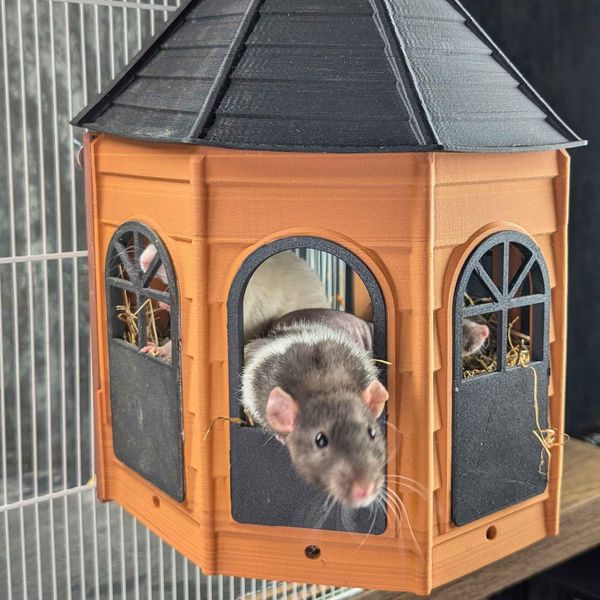
Hides and houses
 Shelves and ledges
 Foraging and toys
 Cage accessories
 Kits and bundles
 Fairy forest
 Spooky mischief
 Sweetie stash
 Game mode
 Forest floor
 Castles and cathedrals

How to read rat body language
Look at the whole situation, not one signal. Rats talk with their whole body: how tense or loose they are, where their fur, whiskers and tail sit, the noises they make, how they move and what they do with other rats. The same sign can mean two things. Tooth grinding can be pure contentment on your lap, or a rat calming itself at the vet. So always ask three questions together: what is the body doing, what is happening around the rat, and is this normal for this rat?
Rats lean on smell and touch more than sight, so a lot of their behaviour is sniffing, whisker work and scent. The RSPCA reminds owners that every rat has its own personality and different rats behave differently in the same situation. The more you watch your own rats when they are calm, the sooner you will spot when something is off. RSPCA guidance is to watch each rat morning and evening, when they are normally active, without disturbing them.
- Body: loose and soft, or tight, stiff and pulled in
- Coat: smooth and shiny, fluffed up, or scruffy and unkempt
- Whiskers: forward and moving, or pulled tight against the face
- Tail: loose and trailing, or low, rigid and flicking
- Eyes: bright, half closed and relaxed, boggling, or dull with red staining
- Sound: quiet, soft grinding, loud chattering, hissing or squeaking
- Movement: easy and curious, frozen, sideways, or walking strangely
- Routine: eating, drinking, grooming and coming out to play as usual
Rat body language chart
This chart pulls together what welfare groups, a rescue and a vet-written guide say about each sign. Use it to slow down and observe, not to diagnose. A short video plus notes on eating, breathing and when a behaviour started will help your vet far more than a label such as "sad" or "dominant".
| Signal | What you see or hear | What it usually means | What to do |
|---|---|---|---|
| Bruxing | Soft, steady tooth grinding | Contentment, or self-soothing when stressed | Check posture and setting together |
| Boggling | Eyes bulge in and out while grinding | Pleasure or deep relaxation | Check for other pain signs |
| Chattering | Loud grinding with pops or clicks, tense body | Annoyance, inner conflict, a fight brewing | Give space, watch the group |
| Loafing | Feet tucked under, body rounded, coat smooth | A comfortable rest | Nothing; compare with hunching |
| Hunching | Tight, stiff, rounded body, often with fluffed fur | Pain or illness | Contact a vet, especially if off food |
| Popcorning | Sudden hops and jumps, fast running | Excited, happy play | Enjoy it |
| Piloerection | Fur standing on end | Arousal, fear, aggression or illness | Give space; vet if it lasts |
| Sidling | Sideways walk with arched back | A threat, usually from a dominant rat | Watch closely; be ready to separate safely |
| Boxing | Two rats upright, pawing at each other | Defence; brief boxing in play is normal | Over a minute with other aggression: a real fight |
| Pinning | One rat holds another on its back | Play or rank, fine when they swap roles | Act if one rat is always the target |
| Tail flick | Sharp side-to-side movement | Irritation or overstimulation | Stop handling, let the rat move off |
| Freezing or flattening | Stops still or presses low to the floor | Startle or fear | Reduce noise, offer a hide |
| Whiskers forward | Whiskers sweeping, nose twitching | Curiosity, investigating | Let the rat explore |
| Whiskers pulled back | Whiskers tight against the face | Fear or discomfort | Back off and watch |
| Grooming | Calm self-grooming or grooming a friend | Relaxed, social | Nothing |
| Power grooming | One rat holds and grooms another firmly | Social rank; can become one-sided | Watch that both can walk away |
| Over-grooming or barbering | Bald patches, sore skin | Stress, skin trouble or a bossy cage mate | See a vet |
| Ear wiggling | Fast ear vibration in a female, tense still body, hops | She is in season | Nothing; it passes within a day |
| Head swaying | Side-to-side scanning | Pink-eyed rats judging distance | Vet only if it is new or with poor balance |
| Food stashing | Carrying food away to hide | Personality, not hunger | Remove fresh food before it goes off |
| Scent marking | Dribbles of urine, rubbing on objects | Marking territory, common in bucks | Normal; spot clean |
| Squeaking | A sharp squeak during contact | Protest, feeling threatened, or pain | Watch the context; check if repeated |
| Hissing | A breathy hiss | Back off | Give space |
| Porphyrin staining | Red-brown marks round eyes or nose | Stress, pain or illness | Vet if heavy, repeated or with other signs |
| Scruffy coat | Oily, matted, unkempt fur | Not grooming, often illness | See a vet |
| Extra hiding | Won't come out, even for favourite treats | Stress, illness or an unsafe cage | Check the cage and the rat; vet if it lasts |
Rat bruxing meaning: why rats grind their teeth
Bruxing usually means a rat is content. It is a soft, rhythmic grinding of the front teeth that sounds like gentle rasping or clicking. You will hear it when a rat is relaxed on your lap, being stroked in a favourite spot or settling down to sleep. Many owners call it the rat version of purring, and PetMD's vet-written guide describes it as a sign of happiness or affection.
It is not always happiness. Rats also brux to calm themselves when they are anxious, for example in a carrier or at the vet. Read the body. A loose, soft rat in a familiar place is content. A tense, hunched rat that is bruxing may be coping with stress or discomfort. If a bruxing rat also seems scared, stops eating or looks scruffy, PetMD advises a vet check.
Tell bruxing from chattering by volume and posture. Bruxing is soft and the rat is loose. Chattering is louder, with pops or cracks, and the rat is alert or puffed up. Chattering is a warning, not a compliment.
Boggling: the eyes that bulge
Boggling is when a rat's eyes vibrate in and out of their sockets, usually during strong bruxing. The jaw muscles that do the grinding sit right behind the eyes, so hard grinding pushes the eyes forward and back. It looks alarming the first time, and it is normal. The NZ Fancy Rat Society says it usually shows pleasure or contentment, but can go with pain if other pain signs are there.
Rat loafing: what the bread-loaf pose means
A loafing rat is usually comfortable. "Loafing" is an owners' word, not a vet term, for a rat sitting with its feet tucked under and its body rounded like a little loaf of bread, often with its eyes half closed. No welfare source we read describes loafing by name, so this is our reading from what they say about relaxed and painful postures.
The difference that matters is loaf versus hunch. A relaxed loaf has a smooth coat, a soft outline, easy breathing and a rat that wakes up and moves normally when something interesting happens. A hunched rat is tight and stiff, often with fur fluffed up, dull or half-shut eyes and little interest in food. The RSPCA lists a "hunched, stiff body posture" as a sign of pain, so a hunch that lasts, or comes with any change in eating, needs a vet.
| Check | Relaxed loaf | Painful hunch |
|---|---|---|
| Body outline | Soft, rounded, settled | Tight, pulled in, stiff |
| Coat | Smooth and flat | Fluffed up or scruffy |
| Eyes | Half closed, bright when open | Dull, squinting, red staining |
| Breathing | Slow and easy | Fast, shallow or noisy |
| When you offer a treat | Wakes up and takes it | Ignores it or moves slowly |
| How often | Now and then between naps | Most of the time, new behaviour |
For more resting poses, see our guide to rat sleeping positions.
Signs of a happy, relaxed rat
A happy rat is loose, curious and chooses to be near you and its cage mates. Greatfield Small Animal Rescue lists a soft body with relaxed shoulders and spine, bruxing, boggling, whiskers forward and moving, calm grooming and coming to you willingly as the main happy signs. PetMD adds popcorning: sudden hops and bursts of running, like a dog's zoomies. PetMD also notes that chirping during play goes with contentment.
- Comes to the cage door when you arrive
- Sniffs your hand with whiskers forward
- Climbs onto you by choice
- Bruxes and boggles while stroked
- Popcorns or races about at playtime
- Grooms itself and its friends calmly
- Sleeps in a heap with the others
- Eats, explores and plays as usual
Licking and gentle nibbling of your hand are usually exploring or social grooming. Keep your hand still and let the rat choose. Rats do much of this with each other: the National Fancy Rat Society describes rats in a group grooming each other, sleeping in a heap and playing tug-of-war with food. That is why rats need rat company, and why our guide to male or female rats starts with group size.
Signs of a scared or stressed rat
A scared rat freezes, flattens or hides. Greatfield lists a hunched, stiff body, tail held low and rigid or flicking sharply, freezing or pressing low to the ground, whiskers pulled tight against the face, hiding even from favourite treats, fur standing up with fast, shallow breathing, and hissing or backing away from normal handling. The RSPCA adds that a rat that wees or poos in a new place is frightened, and the best thing is to put it back in its familiar cage.
Some stress signs are slower: a rat that keeps trying to escape, starts avoiding contact it used to enjoy, or suddenly loses confidence. None of these is a diagnosis on its own, so pause and look closer at the cage, the group and the rat's health before deciding what is going on, and ask a vet or an experienced rescue if you can't find a cause.
Common causes are things the rat can't escape: sudden or high-pitched noise, a cage in a busy or bright spot, strong smells, a bullying cage mate or being handled before it is ready. The RSPCA lists alarms, vacuums, lawnmowers and speakers as noises to keep away from rats, and says bright light can stress them, especially albino rats. Give a stressed rat a dark hide with two exits, keep things quiet and let it come out on its own terms. Our rat training guide shows how to build confidence slowly.
Angry rat: signs of aggression
An angry or threatening rat puffs up, turns side-on and gets louder. Sidling, or crab walking, is the clearest sign: the rat moves sideways with its back arched, fur up, towards another rat. The NZ Fancy Rat Society says this is aggressive and is seen in real fights and standoffs, not in play. Other warning signs are a lashing tail, loud chattering, hissing and squealing.
Boxing, where two rats stand up on their back legs and paw at each other, is usually defensive: one rat keeping the other's teeth away. Short boxing during play is normal. The NZ Fancy Rat Society's rule of thumb is that boxing for over a minute with other aggressive signs is a real fight. Hormones play a big part in bucks: the National Fancy Rat Society describes young males sorting out rank as their hormones rise, with posturing and kickboxing that usually leaves no marks.
The MSD Veterinary Manual says aggression is uncommon in rats raised together as littermates, and that a rat rearing up to face your approaching hand is more likely to bite. If one rat is aggressive towards you, read our guide to pet rat biting.
Never put bare hands between fighting rats. Slide a piece of stiff card or a folded towel between them, then check both rats for bite wounds and have a vet look at any wound that bleeds, swells or weeps.
Play fighting or real fighting?
Play has pauses and turn-taking; a fight does not. Chasing, wrestling and gentle nipping are normal when the rats take turns and stop for breaks, and play usually ends with calm grooming. PDSA says play bites are aimed at the back of the other rat's neck and do no harm. Pinning, where one rat holds another on its back, is fine when the roles swap. It is a problem when one rat always pins the same rat.
| Watch for | Play | Real fight |
|---|---|---|
| Fur | Flat or briefly fluffed | Puffed up and staying up |
| Movement | Chasing, rolling, swapping roles | Sidling, arched back, cornering |
| Boxing | A few seconds | Over a minute, with other aggression |
| Sound | Quiet, or a brief squeak | Repeated squealing, hissing, loud chattering |
| Bites | Nips to the neck scruff, no marks | Bites to the rump, tail or face, blood |
| Afterwards | Grooming, sleeping together | One rat hides or avoids part of the cage |
If you are adding new rats, the same signs tell you how introductions are going. Our carrier method guide to introducing new rats walks through it step by step.
Rat sounds and what they mean
Most rat talk is quiet, so the sounds you can hear are worth noticing. Bruxing is soft contentment. Chattering is louder and tense. Hissing means back off. Squeaking usually means a rat feels threatened, often by a dominant cage mate, and some rats squeak on being picked up simply to complain. Greatfield points out that a loud squeak doesn't always mean pain, as rats squeak in excited play and short squabbles too. How vocal rats are varies a lot between individuals.
Two sounds point to health, not mood: sneezing and noisy, wheezy or rattling breathing. The RSPCA and PDSA both list these as signs of illness. See our full guide to rat sounds and noises for more.
Rat behaviour you might not expect
Some normal rat behaviour looks odd the first time you see it.
- Ear wiggling. A female in season vibrates her ears when touched, holds still and tense, and hops in short bursts. The NZ Fancy Rat Society says does come into season about every 5 days, usually for up to a day.
- Head swaying. Pink-eyed rats sway their heads side to side to judge distance, as their eyesight is poorer. Our guide to what rats can see explains more.
- Food stashing. Carrying food off to a hide is personality, not a sign of being under- or overfed. Take out fresh food before it goes off.
- Scent marking. PetMD says rats rub their flanks and face on things, and males also dribble urine, rub their rear ends over items or lift a back leg to mark. The RSPCA notes urine marking differs from weeing in amount and frequency.
- Endless grooming. Wood Green says rats spend many hours a day cleaning themselves. Calm grooming is normal; bald patches or sores are not.
- Night shifts. The MSD Veterinary Manual says rats sleep through most of the day and are most active at night, and PDSA warns they can be quite noisy in the evening.
When body language means your rat is unwell
A sudden change from your rat's normal is the sign to act on. Wood Green warns that rats are very good at hiding illness, so problems may not show until a rat is seriously unwell, and the RSPCA says rats don't show outward signs of pain until they may already be suffering. The RSPCA list of warning signs is the one to know:
- Hunched, stiff posture, walking strangely, poor balance or guarding one area
- Starry coat: oily, matted, unkempt or not grooming
- Red staining around the eyes and nostrils, especially if heavy or repeated
- Sneezing, wheezing, strange breathing, or discharge from eyes or nose
- Not eating or drinking, refusing foods it used to like, or drinking much more or less
- Over-grooming, especially the head and front paws, or bald patches
- New aggression, hiding more, avoiding the group or doing less
- Sleeping more during the hours it is usually awake
- A head tilt, lumps, weight loss or drooling
That red staining is porphyrin, a red-brown fluid from glands around the eyes. PDSA explains it can look like red tears or a nosebleed and that rats make more of it when stressed or in pain. A trace that doesn't come back is less worrying. Heavy or repeated staining can mean a serious problem. Breathing signs need a vet soon, as PDSA warns respiratory infections can get worse quickly. Our rat respiratory guide and is my rat sick checklist go into detail.
If a behaviour is sudden, intense or repeated, or comes with changes in eating, breathing, movement or weight, or involves an injury, note what you saw, take a short video if it won't delay things, and ring a vet who sees rats the same day.
How to learn your own rats' body language
- Watch before you handle. Sit by the cage for a few minutes morning and evening, when rats are usually up, and just observe each rat without touching.
- Learn each rat's normal. Note who is bold, who is shy, who sleeps where and who grabs food first. Your baseline makes changes stand out.
- Let them come to you. Rest your hand still in the cage and let each rat sniff it before you try to lift anyone. Greatfield advises slow approaches and letting the rat sniff first.
- Reward calm, confident moments. Offer a small treat or a favourite scratch spot when a rat approaches you, so coming to you feels good.
- Back off at stress signs. If you see freezing, fluffed fur, a flicking tail or whiskers pulled back, stop and give space rather than pushing on.
- Check the cage when stress becomes normal. If a rat is often stressed, look at noise, light, hides, cage mates and routine. The RSPCA says every rat should always have a dark hiding place, with one more shelter than there are rats.
- Weigh and write it down. The RSPCA suggests weighing rats regularly when you clean. A notebook of weights and odd behaviour is gold when you see a vet.
Hides, routes and a setup that lets rats behave like rats
For the full picture of looking after rats, start at our pet rat care hub, or see the illustrated rat body language visual guide.
Rat body language questions
What does it mean when a rat grinds its teeth?
Soft, steady tooth grinding is called bruxing. In a loose, relaxed rat being stroked or settling to sleep, it usually means contentment, much like a cat purring. Rats also brux to calm themselves when stressed, for example at the vet. Louder, harder grinding with a tense, alert body is chattering, which signals annoyance or a possible fight.
Why do my rat's eyes bulge in and out?
That is boggling. The jaw muscles used for grinding sit right behind the eyes, so hard bruxing pushes the eyes in and out. It looks alarming but usually goes with pleasure or deep relaxation. The NZ Fancy Rat Society notes it can go with pain if other pain signs are there too, such as hunching, a scruffy coat or not eating.
What does a loafing rat mean?
Loafing is owners' word for a rat sitting with its feet tucked under and its body rounded like a small loaf of bread. In a rat with a smooth coat, soft body and normal breathing, it is a comfortable resting pose. A tight, stiff, hunched ball with fluffed fur and dull eyes is different, and the RSPCA lists that as a sign of pain.
How do I know if my rat is angry?
An angry or threatening rat often puffs up its fur, arches its back and walks sideways (sidling), lashes its tail, chatters its teeth loudly or hisses. Boxing on the hind legs for more than a minute alongside these signs suggests a real fight. Give the rat space, stop handling and never put bare hands between fighting rats.
How do rats show they trust you?
Signs of trust are a rat that comes to the front of the cage to meet you, sniffs your hand with whiskers forward, climbs onto you by choice, grooms or licks your hand calmly and bruxes while being stroked. Trust is shown by choice, so the best test is whether the rat keeps coming back after you put it down.
Why does my rat squeak when I pick it up?
Some rats squeak on being lifted simply to protest, and how vocal rats are varies a lot from one to another. A rat that squeaks every time, or only when one part of its body is touched, may be sore. Check for lumps, wounds or a change in how it moves, and see a vet if the squeak is new.
Is a rat's red tear staining a sign of stress?
Red-brown staining around the eyes or nose is porphyrin, a natural secretion, not blood. PDSA and the RSPCA say more of it appears with stress, pain or illness. A trace after a busy day is usually nothing. Heavy or repeated staining, or staining with sneezing, noisy breathing or a scruffy coat, needs a vet check soon.
Do mice use the same body language as rats?
Many broad signals carry over: a hunched, puffed-up posture, freezing, hiding more than usual and a scruffy coat suggest fear or illness in mice as well as rats. Mice are smaller, faster and more nervous, so signs are quicker and easier to miss. Our pet mouse care guide covers mice in their own right.
Sources
- RSPCA: Rat behaviour
- RSPCA: Rat health and welfare
- RSPCA: Creating a good home for rats
- RSPCA: Pet rats
- PDSA: Rats as pets
- PDSA: Rat health
- NZ Fancy Rat Society: Rat behaviour
- Greatfield Small Animal Rescue: Rat body language, happy or stressed
- PetMD: Pet rat behaviours and what they mean (Lauren Jones, VMD)
- National Fancy Rat Society: Why rats need company
- National Fancy Rat Society: Boys will be boys
- MSD Veterinary Manual: Special considerations for rats
- Wood Green: Caring for rats as pets