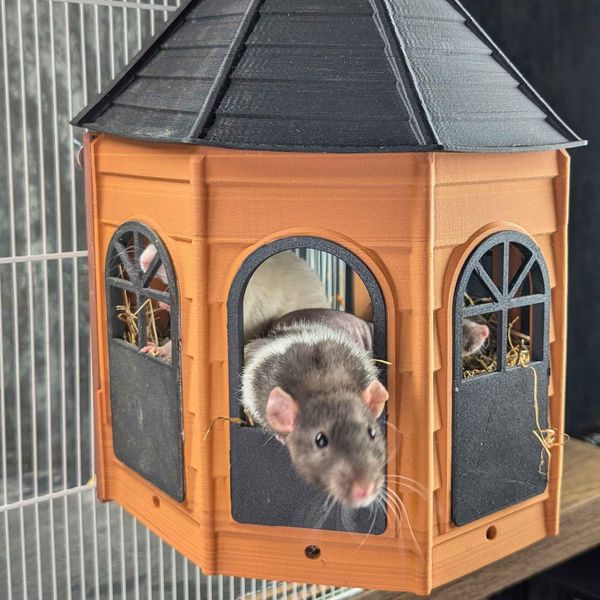
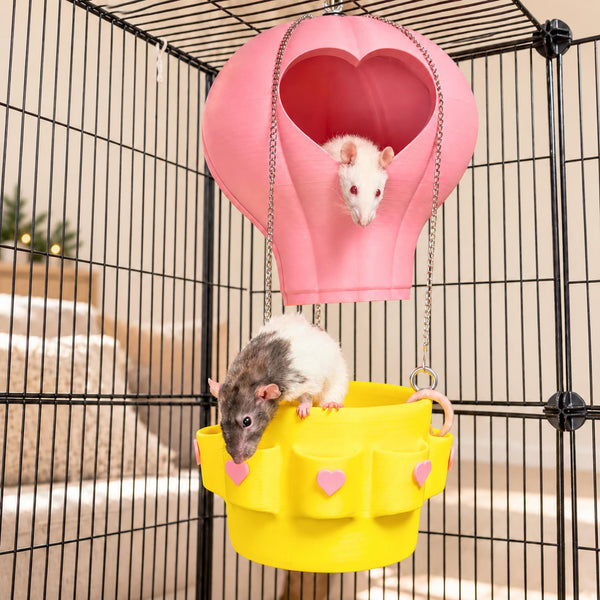
Hides and houses
 Shelves and ledges
 Foraging and toys
 Cage accessories
 Kits and bundles
 Fairy forest
 Spooky mischief
 Sweetie stash
 Game mode
 Forest floor
 Castles and cathedrals

For the wider picture, start with our pet rat care guide, which links every rat guide we have, or see the pet rat supplies guide for what a cage needs.
Quick reference
| Observation or option | Next step | Important limit |
|---|---|---|
| Usual resting pose, easy breathing | Observe without repeatedly waking | Compare with normal awake behaviour |
| Different pose, otherwise normal | Record and watch the whole rat | A pose has no guaranteed emotional meaning |
| Sleeping hunched and stiff, coat fluffed | Watch eating, drinking and movement today; book a vet check | The RSPCA lists a hunched, stiff posture as a sign of illness |
| Struggling to breathe or difficult to rouse | Contact a vet urgently | Do not wait for an online interpretation |
Rat sleeping positions and what they usually mean
| Position | What it usually goes with | Look closer if |
|---|---|---|
| Curled into a tight ball, nose tucked in | Ordinary sleep. Curling keeps body heat in, so you may see more of it in a cool room. | The room is below 19°C (66°F) and the rat also seems slow or shivery |
| Stretched out flat on the belly, legs splayed | Relaxed rest, often in a warm room or on a cool surface | The rat is flat and panting, or the room is above 23°C (73°F): see our rat temperature guide |
| Lying on the side or back | Deep, relaxed sleep in a rat that feels settled | The rat cannot right itself easily when it wakes |
| Piled together with cage mates | Normal social sleeping and shared warmth | One rat is suddenly always outside the pile |
| Sleeping alone in a different bed | Often just preference, more common in warm weather | It is new, and appetite, movement or group behaviour has changed |
| Dozing sitting up or crouched | A short nap | The rat stays hunched and stiff, with a fluffed coat or half-closed eyes |
| Twitching whiskers, paws or tail in deep sleep | Commonly seen in sleeping rats | Twitching or jerking continues when the rat is awake |
What does a curled-up or stretched-out rat mean?
The useful question is not which pose has a fixed translation, but whether your rat looks comfortable and behaves normally when awake. Rats may rest in different positions on the same day. A photograph cannot establish their temperature, breathing effort, pain level or relationship with their cage mates, so avoid turning a cute sleeping picture into a health certificate.
Watch without moving the rat first: are breaths easy, and is the resting place accessible? Compare with your own previous observations rather than an online picture of a different rat. A familiar pose with a new symptom deserves attention; an unfamiliar pose without other changes is not, by itself, a diagnosis. If you want to read your rats better while they are awake, our visual guide to rat body language and our guide to rat sounds and noises cover what the ears, eyes, tail and teeth are telling you.
When do rats sleep?
Rats sleep mostly during the day and are most active at night, dawn and dusk, according to the RSPCA. PetMD describes them as nocturnal or crepuscular (active around dawn and dusk), and notes that many pet rats shift a little towards their owner's routine over time. Expect plenty of daytime naps broken by short spells of waking to eat, drink, groom and rearrange the bedding.
Where they sleep shifts too. Rats often move between a closed hide, a hammock and an open shelf depending on the temperature and who else is in the bed. The RSPCA recommends one more shelter than you have rats (so three for two rats), each with more than one exit, and a safe, dark hiding place for every rat. Hammocks count as places to rest as well as enrichment; our guide to rat hammocks covers what to look for.
How can I watch without disturbing their sleep?
Look in quietly at times they are already awake, and save handling for those times too. RSPCA guidance says rats need undisturbed rest and suitable places to retreat, and it suggests keeping feeding, cage cleaning and interactions to their active periods wherever possible. It also advises against housing rats in a busy, noisy part of the home during the day.
- Pick your moment. Look in during the early evening or first thing in the morning, when rats are naturally stirring.
- Look before you touch. Stand still for a minute and watch breathing and position. Do not lift a hide or open the bed to check.
- Note the basics. Write down where each rat rests and how it lies. One line per rat is enough.
- Check again when they wake. Watch each rat at food or free-roam time: do they come out, eat, groom and move as usual?
- Compare with last week. If one rat now sleeps away from the others, check whether that is usual and whether mobility, appetite or group interactions have changed.
A choice of resting places is more useful than insisting that every rat use the same bed. Keep the cage accessible for necessary checks without removing every familiar object. The RSPCA also advises keeping the cage in the same place, out of direct sunlight, dark at night and away from loud noises and strong artificial smells.
Which changes need a vet rather than a position chart?
Breathing that appears laboured, open-mouth breathing, collapse or difficulty rousing a rat needs urgent veterinary advice, not a wait to see whether another sleeping pose looks better. Watch the whole animal. The RSPCA and RSPCA Australia list these as signs that a rat may be unwell:
- Sneezing, especially several bouts within an hour or two, wheezing, or breathing strangely
- A hunched, stiff body posture or sitting differently from normal
- Staying alone in a corner instead of nesting with cage mates
- A dull, unkempt or matted coat, or sunken, dull eyes
- Red staining around the eyes and nose (chromodacryorrhoea, a red pigment rather than blood)
- Ears pinned flat and eyes squinted, which can indicate pain
- Stumbling, weak legs, limping or shuffling
- Eating less, drinking a lot or not drinking at all, or losing weight
- Reduced activity when they would normally be awake
If your rat is eating less, losing weight, moving differently or no longer managing familiar routes, arrange a veterinary check. Record a short undisturbed video if doing so will not delay care. Tell the clinic when you last saw normal activity and whether other rats have changed too. Our guide Is my rat sick? goes through each sign in turn.
Is my rat sleeping more than usual?
A rat that sleeps through times it would normally be up, or is slow to wake, deserves a closer look the same day. Older rats do rest more, and our guide to caring for rats at every age covers that change. But sleeping more together with eating less, a fluffed or unkempt coat, or a hunched posture is a reason to call a vet. A rat that is hard to rouse is urgent.
Check the room first. A cage in a hot spot, in direct sun or in a cold draught changes how rats rest. The RSPCA gives 19 to 23°C (66 to 73°F) as ideal. PetMD gives a wider band of 65 to 80°F (18 to 27°C); we follow the RSPCA's narrower range because rats handle heat badly.
Make one useful observation today
Choose the part of this topic that fits your own rat rather than changing several things at once. Write down what you saw, what you changed and what happened next. Keep necessary veterinary care separate from optional accessories: a new hide, shelf or toy is not evidence that a health concern has been resolved. For concerning symptoms, contact your vet instead of waiting for a home experiment to work.
Related rat guides and accessories
Read on with rat body language, rat respiratory signs, what to feed a rat and rat enrichment ideas.
Frequently asked questions
Can a sleeping pose prove my rat trusts me?
No. A pose alone does not establish trust or health. A rat that sleeps stretched out in the open is usually comfortable in its surroundings, but trust shows better when your rat is awake: coming to the cage door, taking food from you and climbing onto your hand by choice.
Should I wake my rat for playtime?
No. Arrange ordinary play around their active periods, which for most rats are evening, night, dawn and dusk. The RSPCA lists undisturbed rest as one of a rat's core needs, so do not wake normal daytime rest just to fit a game into your schedule.
Why is one rat sleeping separately?
There is no single explanation. Some rats simply like a different spot, especially in warm weather. Compare with their usual habits, social interactions, appetite and mobility. RSPCA Australia lists a rat staying alone in a corner instead of nesting with cage mates as a possible sign of illness, so discuss new, concerning changes with a vet.
Can I diagnose breathing problems from a photo?
No. A still photograph cannot show breathing effort reliably. Laboured breathing, open-mouth breathing, wheezing or a rat that is hard to rouse needs urgent veterinary attention. A short, quiet video may help the vet if taking it does not delay care.
Do they have to sleep in the new hide?
No. Give them choice. Rats often switch beds with the season and the time of day, and many ignore a new hide for a while. Check access and placement rather than forcing them into an accessory. The RSPCA suggests one more shelter than you have rats, each with more than one exit.
Is it normal for a rat to twitch in its sleep?
Small twitches of the whiskers, paws or tail while a rat is deeply asleep are commonly seen and, on their own, are not a worry. Watch what happens when the rat is awake. Twitching, jerking or loss of balance while awake is different and needs a vet check.
Why does my rat sleep sitting up?
Rats sometimes doze sitting or crouched, especially in a short nap. If your rat sits hunched and stiff for long periods, with its coat fluffed up or eyes half closed, treat that as a possible sign of pain or illness. The RSPCA lists a hunched, stiff posture among the signs to call a vet.
General information, not an individual veterinary assessment. Source guidance checked November 2026.