Hides and houses
 Shelves and ledges
 Foraging and toys
 Cage accessories
 Kits and bundles
 Fairy forest
 Spooky mischief
 Sweetie stash
 Game mode
 Forest floor
 Castles and cathedrals

Rat cage accessories by theme: quick answer
For themed rat cage accessories, start with the job the cage needs: a hide for cover, shelves for climbing, cups for foraging and bowls for feeding. Gothic rat cage accessories and fairy rat cage accessories work best when the theme still gives rats usable places to hide, perch and explore.
- Gothic cage pieces: dark themed hides, shelves and setup pieces.
- Fairy cage pieces: mushroom and woodland-style cage accessories.
- Rat hides: start with cover, then add climbing and foraging.
Start here: gothic rat cage accessories that are safe for pet rats
This page is here to make your next choice easier. Keep the practical points, then compare pieces when you are ready.
- Start with the problem you are solving: cover, climbing, sleeping or something to do.
- Compare size, placement and daily use before choosing.
- Use the shop links as the next step, not the first.
What every rat cage needs before the accessories
A themed cage still has to cover the basics the welfare charities ask for. The RSPCA wants hiding, climbing and investigating places at different heights, with ropes, ladders, tunnels, hammocks and shelters, without filling the whole cage. Use this as the base list, then theme it.
| Accessory | Its job | How many | Gothic version |
|---|---|---|---|
| Hides and shelters | Dark, safe place to sleep and hide | One more than the number of rats | Skull, cauldron or bat cave hide |
| Shelves and ledges | Routes between levels, perching | Enough that no step is a big leap | Bat wing shelf, dark ledge |
| Hammocks | Soft beds up high | At least one per level used for sleeping | Black or deep-coloured fabric |
| Ropes, ladders, tunnels | Climbing and balance | Two or more routes up | Dark rope, black tubes |
| Food bowls and forage cups | Eating and searching | Several for a group (RSPCA) | Ceramic bowls, themed cups |
| Water bottles | Drinking | Several, refilled twice daily (RSPCA) | Any colour; check daily for leaks |
| Litter trays | Toilet corner | One to three on different levels (Woodgreen) | Corner tray |
Our guide to what a rat cage should have in it goes zone by zone, and how to choose rat cage accessories covers fit and safety for each piece.
What makes a strong rat cage for a themed setup?
A strong rat cage is big, escape-proof and solid enough to carry shelves and hides on its bars. Every accessory hangs off the cage, so get this right first.
- Size: Woodgreen asks for at least 80 cm high, 50 cm deep and 80 cm wide (31 × 20 × 31 in) for up to four rats, and 123 × 63 × 93 cm (48 × 25 × 37 in) for up to ten. The NFRS gives 60 × 30 × 30 cm (2 × 1 × 1 ft) as the bare minimum for a pair; we'd treat that as too small for a themed setup.
- Bars: about 1 cm (0.4 in) apart (Woodgreen), and no more than ½ in (1.25 cm) (PetMD), so young rats and does cannot squeeze out.
- Floor: solid, not wire mesh, to protect feet (RSPCA, PDSA).
- Build: metal bars that hold their shape when a shelf and a rat are hanging on them, with doors wide enough to reach every corner for cleaning.
- Colour: black bars suit a gothic look and make pale pieces stand out.
Our best rat cages guide compares cages, and the rat cage size calculator checks yours.
Style should not beat safety
Rat cages are working spaces. They are slept in, climbed over, chewed, scent-marked, cleaned, rearranged and tested by animals with very strong opinions.
That does not mean the cage has to look plain. It means gothic rat cage accessories should earn their place. A bat shelf should add a usable path. A skull hide should give cover. A themed set should make the cage more interesting, not harder to clean.
If a piece is only decorative and your rats cannot safely use it, it belongs outside the cage.
What counts as gothic rat cage decor?
Good gothic cage decor usually falls into one of these groups:
- shelves and ledges for climbing paths
- perches for extra height and movement
- enclosed hides and cabins for sleep and cover
- themed cage sets that combine hide, perch and decor
- dark or bat-shaped pieces that still have a practical job
The theme can be gothic, witchy, bat-shaped, skull-led or darkly cute. The function still comes first.
Choose shelves and ledges for movement
Shelves and ledges are the easiest way to add gothic style without wasting space. They break up the height of the cage and give rats more paths between hammocks, hides, ropes and platforms.
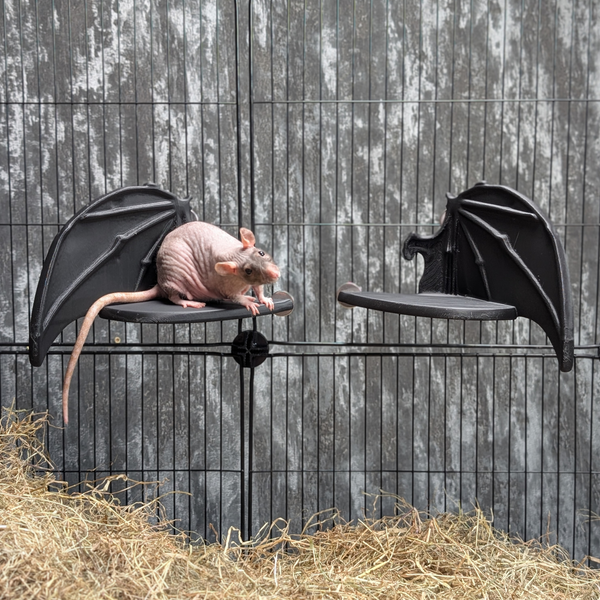
Look for secure cage fittings, a usable standing surface, and a shape that does not leave awkward gaps. A bat wing shelf can look dramatic and still work as a climbing point.
Choose hides and cabins for cover
Rats need places to disappear. The RSPCA says every rat must always have a safe, dark place to hide, nest and sleep, with more shelters than rats and more than one way out. A gothic hide or cabin should be enclosed enough to be useful, with an entrance your rats can use comfortably and a surface you can clean.
Build a gothic setup without crowding the cage
A themed cage looks better when the layout still makes sense. Start with the paths your rats already use, then work through these in order.
- Place one dark hide. Put it near a settled sleeping corner your rats already choose.
- Add a climbing piece. One bat shelf or gothic ledge on a route between levels.
- Add a perch by the hammock path. A small platform or perch where rats already travel to their bed.
- Leave open floor. Keep space clear for running and digging.
- Balance hard with soft. Hammocks and soft bedding (substrate) alongside harder surfaces.
Do not fill every gap. Rats need movement, airflow and clear paths as much as they need places to hide. The RSPCA specifically says enrichment should not fill the whole cage.
What to check before buying gothic rat accessories
Use this checklist before buying anything for the cage:
- Is it stable when fixed or placed?
- Can your rats use it without slipping or awkward gaps?
- Is it easy to wipe clean?
- Are there tiny parts that could come loose?
- Are the edges smooth enough for normal cage use?
- Does it add sleep, climbing, cover, perching or foraging value?
- Does it fit your cage bars, shelf depth or floor space?
If any answer is no, skip it. A good rat cage accessory should be useful before it is pretty.
Avoid unsafe gothic cage decor
Some dark decor looks good in photos but does not belong in a rat cage:
- loose ornaments with no function
- small swallowable parts
- sharp metal, brittle plastic or rough edges
- painted pieces where the finish is unknown
- heavily scented items (the RSPCA warns against strong smells near rats)
- anything that cannot be cleaned properly
- decor that blocks normal movement around the cage
DIY rat cage accessories that suit a dark theme
You can make a lot of a gothic cage yourself, cheaply and safely, from things the charities already suggest. Keep everything clean, dry and free of staples, tape and glue.
- Cardboard boxes with holes cut in them (Woodgreen): paint-free brown card looks fine in a dark cage and can be shredded.
- Large cardboard tubes as tunnels and hides (RSPCA).
- Fleece hammocks in black or deep purple, hung with shower curtain hooks (Woodgreen). Hem the edges so there are no loose threads.
- Natural fibre ropes, such as cotton, for climbing; replace them when worn (RSPCA).
- Tunnels and pipes from smooth tubes (AFRMA suggests large cardboard or PVC tubes).
- A dig tray with coco soil for foraging (Woodgreen).
For more home-made ideas, see our 35 rat enrichment ideas and safe shredding toys.
Cleaning matters with dark cage decor
Dark pieces hide dirt better than pale ones, which is not always useful.
Choose accessories you can remove, inspect and wipe down. Check corners, entrances, fittings and the underside of shelves. The RSPCA advises spot cleaning through the week and a full clean once a week, leaving a handful of clean used nesting behind so the cage still smells like home. If a piece becomes hard to clean or damaged, take it out until you can inspect it properly.
For our own rat accessories, follow the care instructions on the product page first. Our rat cage cleaning guide covers the daily, weekly and deep clean routine.
Gothic, witchy, cute or full dark?
You do not need one fixed theme. The strongest setups usually mix one bold piece with practical cage basics. Let the theme guide the mood, not the welfare choices.
| Style | What it looks like | Pieces of ours to start with |
|---|---|---|
| Dark and simple | Black hammocks and one bat shelf | Bat Wing Rat Cage Shelf |
| Witchy | Cauldron shapes and deep colours | Gothic Rat Cage Accessories Set |
| Cute goth | Softer shapes and playful skulls | Gothic Skull Rat Hide |
| Full dark fantasy | Dragons and sculptural skulls | Dragon Skull Rat Hide |
More ideas for building a look are in rat cage aesthetic: how experienced owners style their setups and our rat cage themes page.
Why buy gothic rat cage accessories from Bruxlings?
Rat cage accessory kit guide
Choose the next cage piece
If you are deciding what the cage actually needs, check the cage zones first with best rat accessories by cage zone.
Rat care guides
If you are planning a cage, start with the setup guide, then use the accessories and enrichment pages to choose the pieces that suit your rats.
- Plan the cage setup
- Choose cage accessories
- Add enrichment ideas
- First cage checklist: what new owners need in the first week
- Rat cage aesthetic: how experienced owners style their setups
- Every pet rat care guide
Frequently asked questions
Are gothic rat cage accessories safe?
They can be, when they are stable, cleanable, smooth enough for cage use and free of loose small parts. The theme is not the problem; poor function is. Check the fitting, edges and entrance before use, and remove any piece that becomes damaged or hard to clean.
What gothic accessories can I put in a rat cage?
Good options include shelves, ledges, perches, enclosed hides, cabins and themed sets that add climbing, cover, sleeping space or enrichment. Black or deep-coloured hammocks, dark ropes and cardboard hides also suit a gothic cage and cost very little.
Are bat wing rat shelves useful?
Yes, a bat wing rat shelf is useful when it mounts securely and gives rats another path through the cage. It should work as a shelf first and a gothic shape second: a usable standing surface, a firm fit on your bars and no awkward gaps around it.
What should I avoid in a gothic rat cage setup?
Avoid loose ornaments, tiny swallowable parts, sharp edges, unknown paints or coatings, strong scents, and anything that is hard to clean or blocks normal movement. Ornaments made for fish tanks, reptiles or the shelf at home are not made to be chewed.
How do I clean gothic rat cage accessories?
Follow the product care instructions first. In general, choose pieces you can remove, inspect and wipe clean, and check corners, entrances, fittings and the underside of shelves. Spot clean through the week and do a full clean weekly, as the RSPCA advises.
Can decorative rat cage accessories still be enriching?
Yes. A decorative piece adds enrichment when it gives rats something useful to do, such as climb, perch, hide, sleep, explore or forage. A piece that only looks good and goes unused is taking up space rats could use.
Where should I start with a gothic rat cage?
Start with one useful focal piece, such as a hide or a shelf, then build the rest of the cage around movement, sleeping areas, hammocks and clear paths. Make sure the cage itself is big enough and has narrow bars before you add anything.