Hides and houses
 Shelves and ledges
 Foraging and toys
 Cage accessories
 Kits and bundles
 Fairy forest
 Spooky mischief
 Sweetie stash
 Game mode
 Forest floor
 Castles and cathedrals

Quick summary
Rats are clever, social animals that make active use of enrichment when it genuinely interests them, not just because it is there. The difference between a cage your rats explore all evening and one they ignore is usually the quality and variety of what is in it, not the amount. This guide covers what rats actually use, what welfare charities ask for, and how to choose pieces that work for the rats and still look good.
Rats are not satisfied with a single level and a wheel. A cage with two surfaces is the equivalent of a studio flat with no furniture: technically habitable, not actually adequate.
Not sure your cage is big enough? Try our rat cage size and fit calculator, or read our guide to the best rat cages.
There is a thing that happens when you first get rats. You buy the cage. You add a water bottle, a food bowl and maybe a hammock from a pet shop. You consider it done. The rats disagree.
Fancy rats are not hamsters. They are social, intelligent, spatially curious animals that spend a large part of their waking hours climbing, perching, travelling and investigating. The PDSA describes a good rat cage as an adventure playground with different levels to climb and exercise on. This is where cage furniture stops being an optional extra and starts being about welfare.
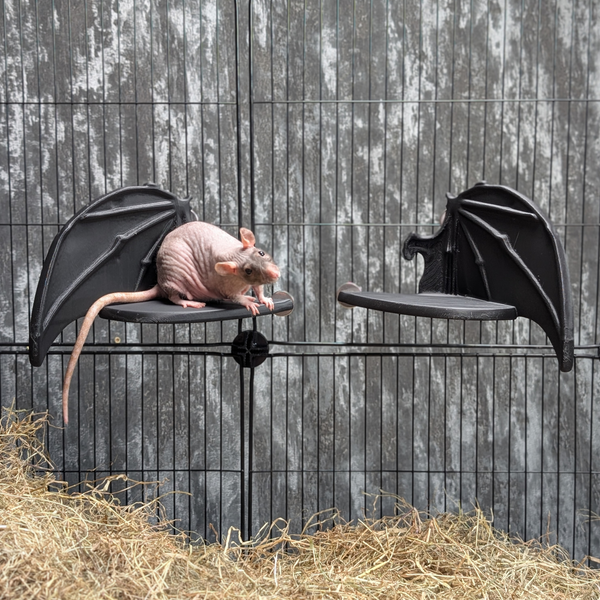
That is the job our Dragon Rat Shelf Set was designed for: adding climbing routes and resting space up the height of a cage that has bars to fix to.
Enrichment vs furniture: why the distinction matters
Enrichment and furniture do different jobs, so a cage needs both. Rat keepers often use "enrichment" as a catch-all, but it helps to split it: enrichment is foraging, sensory interest and problem-solving objects; furniture is the perching, resting and travelling structure of the cage.
Foraging is a way to use part of the usual daily food allowance, not extra food. The RSPCA recommends several food objects for a group, not one, to avoid competition, plus chances to search for and handle food. Keep ordinary access to food easy and watch each rat, rather than assuming one item changes the whole group.
Cage furniture is different. It is about the space itself. Rats like height, choices and routes between levels. A cage with a floor and one top hammock asks rats to make a yes-or-no choice. A cage with three or four levels at different heights, joined by shelves and ledges, allows something much closer to natural movement.
The practical upshot: enrichment can be rotated weekly and improvised from cardboard. Cage furniture is infrastructure. You would not rotate your stairs out every Thursday.
| Furniture | Enrichment | |
|---|---|---|
| Examples | Shelves, ledges, ramps, hides, hammocks, ropes | Forage cups, scatter feeding, paper parcels, dig boxes, chews, training |
| Main job | Climbing routes, resting and hiding at height | Searching, digging, shredding, thinking |
| How often it changes | Rarely; move a piece only to fix a route | Every week or two |
| What goes wrong without it | Rats crowd the floor or one hammock | Rats ignore the cage and may gnaw bars |
Three numbers worth keeping in mind:
- Three or more levels for a group of three or more rats. The PDSA asks for different levels; we'd treat three as the working minimum for a group.
- A long rest every day. Rats are most active at dawn, dusk and night (RSPCA), so they sleep through much of the day. Hides and resting spots matter as much as toys.
- Every week or two: the pace to rotate enrichment and keep interest up.
What multi-level actually means for rat welfare
A tall cage needs usable routes and resting places, not just empty height. The RSPCA asks for hiding, climbing and investigating places at different heights, with ropes, ladders, tunnels, hammocks and shelters, without filling the whole cage. Arrange pieces so your actual rats can move between food, water, beds and the toilet corner, and keep access suitable as their mobility changes. See the RSPCA guidance on a rat's home when planning the layout.
The RSPCA lists the stress signs to watch for: over-grooming, more hiding than usual, more aggression or squeaking, and fear of new things. It also links gnawing at cage bars and bald patches from over-grooming each other (barbering) to boredom and frustration. A richer, better-connected layout is the usual first fix once a vet has ruled out illness.
None of this is complicated. It needs shelves at different heights, at least one hide with a raised entrance, and some way to move between levels other than a single rope. A good shelf set gives you that structure without designing the whole thing from scratch.
The Dragon Rat Shelf Set fits on standard cage bars without tools. Check the bar fitting on the product page against your own cage before you order.
Why theme matters in the rat community
The fancy rat world is a hobby, not just pet keeping, and that changes what people want from cage furniture. The UK has its own National Fancy Rat Society, and keepers everywhere build setups, photograph them, share them and swap ideas on layouts.
In a hobby, how a piece looks is part of its value, alongside what it does. Someone choosing a dragon-themed shelf set wants a cage that looks like something, not just somewhere to perch. The theme is why they picked that piece over a plain wooden board.
This is not vanity. The keeper puts care and creativity into the setup, and the setup says something about them. A well-made themed piece joins in with that in a way an unmarked plywood ledge does not. It is also why plain pet-shop furniture often gets swapped out: it has no character and does not start a conversation.
The rule we follow: the theme can lead the look, never the welfare. Our guide to gothic rat cage accessories and our rat cage themes page show how to keep a themed cage practical.
Related pieces
The problem with most cage shelves
Most pet-shop shelves fail in one of three ways, and rat owners learn this quickly:
- It gets ignored because it is too small to sleep on.
- It is chewed apart within a couple of weeks.
- It will not attach to the bar spacing of the cage you actually own.
The answer the community keeps arriving at is handmade: either DIY, which is a time investment most keepers are not keen on, or specialist pieces designed for rats from the start rather than adapted from something else. A good shelf has a smooth surface that is comfortable to lie on and is big enough for a rat to sleep curled up, not just perch for a moment.
The Dragon Rat Shelf Set: what it is and what it does
The shelves attach to cage bars without tools. Each surface is sized for a rat to rest on, not just pass over. The dragon theme is in the shape of the shelves themselves, so the cage reads as themed without a complete accessory overhaul.
The pair can go at matching heights or staggered, to build a route across or up the cage. Plan where each will sit, and check the space and the bar fitting on the product page before ordering.
Building the right cage: a practical framework
If you are starting from a bare cage or doing a big upgrade, this is the order careful rat keepers tend to work in. Our complete rat cage setup guide goes into each step in more detail.
- Start with routes. Rats should be able to get from the bottom third of the cage to the top third without one climb or jump of more than about 15 cm (6 in). That means shelves, ledges or ramps at regular heights. This is the part not to skip.
- Add resting places at height. Hammocks do this, and so do shelves wide enough to curl up on. Rats sleep up high when they can, and if the only high bed is the top hammock, cage mates end up competing for it. Our rat hammock guide covers hanging them safely.
- Add hides at more than one level. Rats feel safest in enclosed spaces. A floor hide is good, one in the upper middle of the cage is better, and one on each level is ideal for three or more rats. The RSPCA asks for one more shelter than you have rats.
- Then add enrichment on rotation. Foraging toys, puzzle feeders, forage cups and things to shred and carry. These change every week or two; the furniture does not. Our 35 rat enrichment ideas will keep you going.
The Dragon Rat Shelf Set covers the first two steps: routes and raised resting places. If your cage has a single floor level and one hammock, more levels like these are the place to start. For the full list of what a cage needs, see best rat accessories by cage zone, and for every rat guide in one place, our pet rat care hub.
Frequently asked questions
Do rats need shelves in their cage?
Yes. Rats like to climb and rest at height, and the PDSA and RSPCA both ask for different levels with places to climb, hide and investigate. Shelves and ledges turn empty height into usable routes, so a rat can travel from floor to roof without one big jump.
How many levels should a rat cage have?
For a group of three or more, aim for at least three usable levels joined by more than one route. Neither the RSPCA nor the PDSA sets an exact number, but both ask for different levels, so more levels in a bigger cage is better than one tall empty space.
What is the difference between rat cage furniture and enrichment?
Furniture is the structure: shelves, ledges, ramps, hides and hammocks that let rats travel, rest and hide. Enrichment is the activity: foraging, digging, shredding and puzzles. Furniture stays mostly in place; enrichment is changed every week or two to keep it interesting.
How far can a rat safely jump or fall in the cage?
No charity gives a set figure, so we use a rule of thumb: keep each step between levels to about 15 cm (6 in) and put a hammock or shelf under high routes. Young rats leap further, but older or unwell rats need shorter, easier steps.
How often should I change my rat cage layout?
Rotate enrichment every week or two, and swap a hide or toy into a new spot now and then. Change one thing at a time and leave the main routes and beds where they are, so the cage stays familiar. The RSPCA advises keeping the cage itself in one place.
Are themed rat shelves as good as plain ones?
They can be, if they do the job first: a secure fitting, a surface big enough to rest on, smooth edges and nothing loose. The theme only changes the look. Check the fitting and size against your cage, and remove any piece that becomes damaged.