Hides and houses
 Shelves and ledges
 Foraging and toys
 Cage accessories
 Kits and bundles
 Fairy forest
 Spooky mischief
 Sweetie stash
 Game mode
 Forest floor
 Castles and cathedrals

A hide is not a luxury. The RSPCA says every rat must always have a safe, dark place to hide, nest, sleep and rest, and that shelters should outnumber rats by one so nobody has to compete for a bed.
What is the difference between a rat house and a rat hide?
Types of rat hides and hideouts compared
Most cages work best with a mix of types, so rats can choose by mood, temperature and who they want to sleep next to.
| Type | Good for | Watch out for |
|---|---|---|
| Cardboard box or large tube | Cheap, chewable, easy to replace (RSPCA, Woodgreen) | Throw away once damp or soiled |
| Floor house | Easy access for every age | Takes floor space; check the footprint |
| Wall-mounted hide | Uses side space, adds a level | Needs a firm fixing and an easy approach |
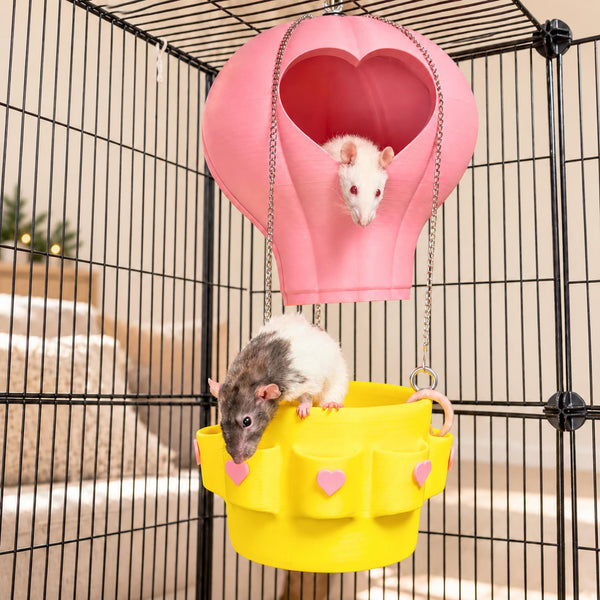
| Hanging hide (sputnik style) | Another resting position up high (Woodgreen) | Movement and drops underneath |
| Hammock with a cover | Soft, warm bed at height | Loose threads and worn seams |
| Soft bed or mat | Different sleeping texture | Inspect threads and seams; wash often |
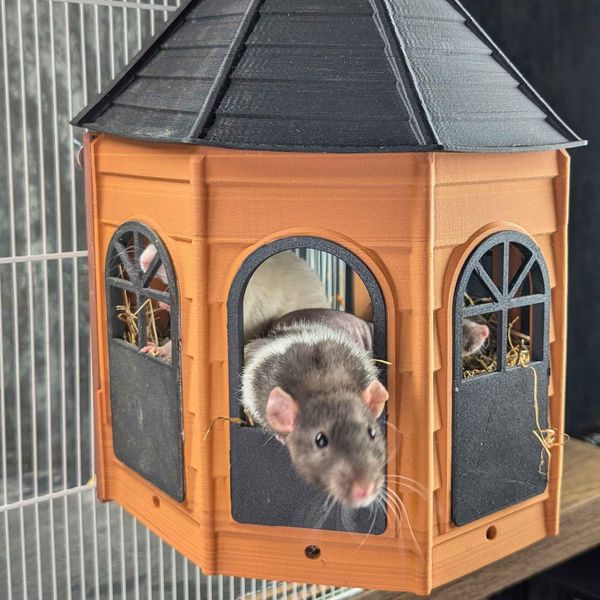
| Themed decorative hide | Cover plus a look you love | Real usable space inside, not just outer shape |
How do I choose the right size rat house?
Measure the space in your cage and compare it with the product's stated dimensions. Plan for adult size: the NFRS puts adult does at around 300 g (10.5 oz) and bucks at around 500 g (1.1 lb), and PetMD gives 35 to 45 cm (14 to 18 in) long including the tail. A medium rat or a doe needs less room than a big buck, and bucks are often the ones that pile in together.
Think about whether rats may sleep together and how easily each one can turn round. Do not estimate capacity from the outer silhouette: decorative roofs and walls do not all become usable bed space. The RSPCA suggests shelters big enough for the group to sleep together if they choose, plus others so a rat is never forced to share a crowded one. In practice that means one roomy hide and several smaller ones.
- Measure the floor, shelf or wall space where it will go.
- Compare with the inside dimensions on the product listing, not just the outside.
- Check the doorway: a rat should go in without squeezing.
- Check there is room inside to turn round.
- Keep at least one other resting place free.
Are hanging hides or floor houses better?
Neither is better in general; choose by access and your group's mobility. A floor house gives a simple, low resting option; a hanging hide needs a secure fixing and a reliable approach. Neither belongs over an unprotected long drop. For older rats, lower a familiar shelter and keep food and water nearby. If climbing ability changes suddenly, see an exotics vet rather than assuming the cage needs a more exciting route. Our guide to caring for rats at every age covers setting up for seniors.
What should I check before putting a hide in the cage?
Check the whole item, fit it as instructed, then watch the first visits.
- Inspect it all over. Look at edges, entrances and the surfaces you cannot see in the main photograph.
- Fit it and test it. Fix it as instructed and push it gently to check for movement.
- Check your own access. Make sure cage doors still open and you can reach the back of the cage for cleaning.
- Add nesting. A handful of paper strips or white tissue, never cotton wool (RSPCA).
- Watch the first visits. Hesitation, squeezing or difficulty turning are reasons to move it or swap it.
- Keep checking. Remove a damaged accessory when wear creates sharp edges or trapping risks.
Best rat hideouts and mats for sleeping
Rats like a choice of textures: an enclosed hide, a soft hammock and a flat bed or mat. The PDSA suggests warm nest boxes such as hammocks, beds or cardboard boxes lined with tissue or blankets, and PetMD notes rats line their nests with fleece, paper towels and cardboard.
- A covered hide on the floor or a low level for deep sleep.
- A hammock or hanging hide up high. See our rat hammock guide.
- A fleece mat or soft bed on a shelf, with no loose threads.
- Nesting paper inside hides so rats can build their own bed.
- A spare washed set, so a clean bed goes in when the other is in the wash.
Woodgreen suggests washing hammocks and fabric at 60°C (140°F) with non-bio detergent, and swapping hammocks weekly or more often when they smell.
Which rat house fits a themed cage?
Can a rat hide replace enrichment?
Quick comparison
| Option | Purpose | What to check |
|---|---|---|
| Floor house | Simple approach | Floor footprint |
| Wall-mounted hide | Uses side space | Fixing and access |
| Hanging hide | Another resting position | Movement and drops |
| Soft bed | Different sleeping texture | Threads and seams |
Real cage accessories to compare
Choose the theme once the hide does its job
A theme can tie the cage together without deciding the layout. Compare the shape and scale with the rest of the cage, then check it still gives usable cover.
| Theme | Shapes that suit it | Pieces of ours to compare |
|---|---|---|
| Bright or natural | Strawberry, mushroom, cafe, acorn and cottage forms | Fairy Mushroom Rat Hide; Teapot hide and shelf set, for a character-led layout that leaves the route around it open |
| Dark or gothic | Skull and gothic shapes | Gothic Skull hideout; check the entrance, edges and fitting before use |
| Fantasy and storybook | Castle and mushroom-house forms | Rat Mansion, a house-shaped hide; check its dimensions against your floor space |
| Retro and novelty | Old everyday objects, such as a television | Retro TV Rat Hide |
More to explore
- How to choose rat cage accessories, including hides
- Retro TV rat hide guide: a novelty hide for themed cages
- Rat cage setup guide
- Rat hammock guide
- Rat cage themes
- Every pet rat care guide
Frequently asked questions
Where do pet rats usually hide?
Pet rats rest in sheltered beds, boxes, hides and hammocks, often up high. Each rat has favourite spots that can change with temperature and company. Offer several accessible choices at different heights and learn each rat's normal routine, so you notice when it changes.
How many hides does a rat cage need?
Can rats chew through a house?
Treat no accessory as chew-proof. Rats need to gnaw because their front teeth never stop growing, so they will test everything. Inspect wear at every clean, follow each item's own care guidance and replace cardboard hides once they are damp or chewed through.
Do all rats need to fit in one house?
Not necessarily. The RSPCA suggests shelters big enough for the group to sleep together if they want, plus enough others that no rat is forced to share. Check the actual usable space inside each bed, not the outside shape.
What is a rat's biggest enemy in the cage?
For a pet rat, the real dangers are cats, dogs and other pets near the cage, heat and draughts, long falls, and unsafe objects such as loose threads or swallowable parts. Focus on secure housing, easy access, sound fixings and changes in health or behaviour.
Should I wake a hiding rat?
Avoid needless disturbance: rats rest through much of the day and are busiest at dawn, dusk and night. Do check welfare, though. A new pattern of hiding, poor appetite or reduced activity is a reason to call an exotics vet, as the RSPCA lists hiding more than usual as a stress sign.
What should I put inside a rat hide?
Paper-based nesting such as white tissue, shredded paper or paper strips, which rats will arrange themselves. Avoid cotton wool and fluffy bedding that can tangle round legs, and scented or coloured bedding. Leave a little clean used nesting at cleaning time so it still smells familiar.