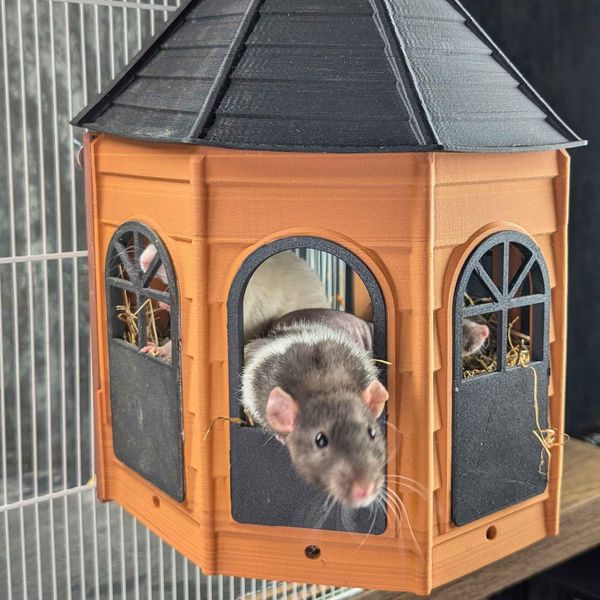
Hides and houses
 Shelves and ledges
 Foraging and toys
 Cage accessories
 Kits and bundles
 Fairy forest
 Spooky mischief
 Sweetie stash
 Game mode
 Forest floor
 Castles and cathedrals

The headlines
Five things every rat owner needs to know, with the short answer to each.
- Food: rat nuggets as the base, a little fresh veg every day, and a short list of foods to avoid.
- Check the cupboard before you share: the RSPCA says to avoid raisins, and guinea pig food and hamster food are not made for rats.
- Eyesight: rats see poorly, in the dark or under red light, and lean on their whiskers.
- Cage set-up: at least 80 x 50 x 80 cm (31.5 x 19.7 x 31.5 in) for up to four rats, with solid floors and one more hide than you have rats.
- Inside the cage: hammocks, ropes, ladders and shelves for climbing, plus toys to chew and shred.
What owners ask about
Questions fall into seven groups. Each has a short answer and a guide that goes further:
| Topic | The short answer | Read more |
|---|---|---|
| Buying, keeping and handling | Get two or three of the same sex; let them settle first | Where to get pet rats |
| Cages and set-up | Tall, wire-sided, solid floors, at least 80 x 50 x 80 cm | Rat cage set-up guide |
| Food and diet | Rat nuggets, small daily veg, few treats | What to feed a rat |
| Feelings and behaviour | Social, playful, clever; never keep one alone | Rat sounds and signals |
| Senses (sight, hearing, smell) | Poor eyesight; whiskers and smell do the work | What rats can see |
| Health | Rats hide illness; check weekly and know the vet signs | Is my rat sick? |
| Lifespan and age | Usually 2 to 3 years | How long rats live |
"Can rats eat...?" Ten quick answers
Ten foods owners often check, in A to Z order. Short answers follow the RSPCA, Woodgreen and RSPCA Australia.
| Question | Short answer |
|---|---|
| Can rats eat carrots? | Yes, washed and in small pieces. |
| Can rats eat guinea pig food? | Not as their main food. It is made for a plant-only diet; the RSPCA says herbivore pellets do not give rats the nutrients they need. |
| Can rats eat hamster food? | Not as their main food. Seed mixes let rats pick out the fatty bits, such as sunflower seeds, and leave the rest. |
| Can rats eat lettuce? | Romaine and other dark leaves, yes, in small amounts. Iceberg is mostly water. |
| Can rats eat pak choi? | Yes, a good leafy green (bok choy in the US), washed and in small amounts. RSPCA Australia names it. |
| Can rats eat rabbit food? | Not as their main food. Like guinea pig food, it is made for a plant-only diet. |
| Can rats eat raisins? | Best avoided: RSPCA advice lists grapes and raisins among foods not to give rats. |
| Can rats eat romaine lettuce? | Yes, in small amounts with other greens. |
| Can rats eat squash? | Yes, washed, peeled and seeded, in small pieces. |
| Can rats eat Weetabix? | A small piece of a plain one is fine as an occasional treat. |
For anything not on the list, try the rat food checker or our full list of what rats can eat.
Can rats eat iceberg lettuce?
Yes, a small piece of iceberg lettuce is safe, but it is the weakest choice of salad for a rat. None of the welfare guides we checked names iceberg directly, so this answer comes from what they say about a rat's diet. Iceberg is mostly water and carries little goodness, so it fills a small stomach without adding much. The AFRMA recommends salad greens and calls kale a favourite, and RSPCA Australia names pak choi (bok choy), kale, parsley, beet greens and broccoli as good fresh foods.
- Wash it well and shake it dry.
- Offer a piece about the size of your rat's ear, Woodgreen's guide for fresh food portions.
- Mix it with darker leaves such as romaine, kale or pak choi rather than serving it alone.
- Take out anything uneaten the same day; PetMD says within 10 hours.
- Count it as part of the day's food, not on top of it, as the RSPCA advises.
If your rat gets loose droppings after a lot of watery salad, cut back and reintroduce slowly. Our guide to rats and lettuce compares every type.
Can rats eat Weetabix?
Yes, a small piece of plain, original Weetabix is fine as an occasional treat. It is a wholegrain wheat cereal, and Woodgreen says any cereal you give rats should be under 5% sugar, so check the label on the box you have. The AFRMA lists dry, low-sugar cereals such as shredded wheat and puffed wheat as suitable rat treats.
- Give it dry, not soaked in milk: the RSPCA says to keep dairy to the odd treat.
- A piece about the size of your thumbnail per rat is plenty.
- A few times a week at most, inside the day's food allowance.
- Skip chocolate, honey, banana or other flavoured versions. Chocolate is on the RSPCA's do-not-feed list.
- Crumble it into bedding or a cardboard tube so they forage for it.
Our page on rats and Weetabix covers other breakfast cereals too.
Twenty quick answers
Twenty common questions on food, the cage and the senses, with the answer to each.
| Question | Answer |
|---|---|
| Can rats eat raisins? | Best avoided. The RSPCA lists grapes and raisins among foods not to give. |
| What can pet rats eat? | Rat food, most veg, some fruit and plain cooked grains. Avoid the do-not-feed list. |
| What can rats eat daily? | Rat food plus everyday veg such as kale, broccoli, carrot, pak choi and green beans. |
| What can rats eat? | Most plain veg, some fruit, cooked egg, plain cooked rice and pasta, and plain cereals. See the ten foods above. |
| What do pet rats eat? | Rats are omnivores: a complete rat food plus small amounts of veg, fruit, cooked egg, grains and seeds. |
| What do pet rats like to eat? | Favourites on Woodgreen's treat list include boiled egg, peas, banana and strawberries. Use them as small rewards. |
| What do rats eat? | Pet rats do best on a complete rat food. Wild-style scavenging on scraps leads to a poor diet and weight gain. |
| What to feed a rat | Rat nuggets or pellets as the base, about 15 g (0.5 oz) per rat a day, plus a little fresh veg. Feed morning and evening. |
| What to feed pet rats | Rat food first, fresh food second, treats last and small. |
| What to feed rats | Rat nuggets, fresh veg, and treats kept under 10% of what they eat. |
| How big does a rat cage need to be? | At least 80 x 50 x 80 cm (31.5 x 19.7 x 31.5 in) for up to four rats, Woodgreen advises. |
| How big should a rat cage be? | As big as you can fit. Up to ten rats need at least 93 x 63 x 123 cm (36.6 x 24.8 x 48.4 in). |
| How to set up a rat cage | Solid floors, deep dust-free bedding, hides at several heights, hammocks, ropes, food bowls and two water bottles. |
| What do rats need in their cage? | Space to climb, somewhere dark to hide for every rat, safe bedding, fresh water and company. |
| What to put in a rat cage | One more hide than you have rats, places to climb, nesting material, a dig spot and toys you can rotate. |
| Can rats see in the dark? | They are busy in the dark, but by whisker and nose. The RSPCA says rats have poor vision. |
| Can rats see red light? | Rats see poorly in general. Our rat vision guide covers colour and lighting in detail. |
| Can rats see? | Yes, but not well. Smell, hearing and whiskers matter more. |
| Do rats have good eyesight? | No. They rely on whiskers for mapping and balance, so never trim them. |
| What do rats see? | Not much detail. They find their way by touch and smell more than sight. |
What do pet rats eat?
Pet rats eat a complete rat food, either nuggets or pellets made for rats, plus a little fresh food every day. The RSPCA says pellets for rabbits, guinea pigs, hamsters or other plant-eaters do not give rats what they need. Rats are omnivores, so small amounts of fruit, veg, cooked egg, grains and seeds round the diet out.
| Food group | How much | Examples |
|---|---|---|
| Rat nuggets or pellets | About 15 g (0.5 oz) per rat a day, roughly two tablespoons (Woodgreen) | Any complete food made for rats |
| Fresh veg | Small amounts daily, about the size of a rat's ear each | Kale, broccoli, carrot, pak choi (bok choy), green beans, courgette (zucchini), parsley, peas, celery |
| Fruit | Small pieces, a few times a week | Banana, strawberry, pear, melon, apple (no pips), berries, kiwi |
| Protein treats | A few times a week | Boiled egg, plain cooked chicken, a mealworm |
| Grains | A few times a week | Plain cooked rice or pasta, dry bread, cereals under 5% sugar |
| Fatty seeds and nuts | Occasionally, one or two | Sunflower seeds, peanuts (not both at once, says Woodgreen) |
The RSPCA says to feed twice a day, morning and evening, because rats eat mainly at dawn and dusk, and to adjust amounts so they finish their food and stay a healthy weight. PetMD and RSPCA Australia both keep treats and extras to no more than 10% of the daily diet. Our rat food chart has the full detail.
Never feed grapes, raisins, chocolate, onion, citrus fruit, rhubarb or walnuts (RSPCA), or avocado, garlic, coffee, tea, alcohol or sticky foods (RSPCA Australia). Rats cannot vomit, so if yours has eaten any of these, ring your vet straight away.
Sources disagree on a few foods. Woodgreen lists grapes as an occasional treat while the RSPCA says to avoid them, and the AFRMA allows small amounts of avocado while RSPCA Australia says no. We follow the more careful advice in both cases.
Can rats see in the dark?
Rats are most active at night, dawn and dusk, but they are not seeing their way around: the RSPCA says rats have poor vision and rely on their whiskers to map their surroundings and keep their balance. Smell and hearing do much of the rest. This has real effects on how you keep them:
- Never trim whiskers. The RSPCA is clear on this.
- Keep the cage layout the same and move it only when you have to, so rats can learn their routes.
- Put ledges and shelves within an easy step of each other, especially for older rats.
- Talk to your rats as you approach so you do not startle them.
- Keep the room fairly dim by day and dark at night, as the RSPCA advises.
Our guide to what rats can see covers colour, red light and pink-eyed rats.
How big should a rat cage be, and what goes in it?
For up to four rats, Woodgreen's minimum is 80 cm wide, 50 cm deep and 80 cm high (31.5 x 19.7 x 31.5 in), and for up to ten it is 93 x 63 x 123 cm (36.6 x 24.8 x 48.4 in), both with bars 1 cm (about 1/2 in) apart. The RSPCA asks for a solid floor, not wire mesh, and for the number of shelters to be one more than the number of rats. Keep the cage at 19 to 23°C (66 to 73°F), out of direct sun and draughts.
- A thick layer of dust-free bedding (substrate), with no sawdust, pine or cedar.
- One more hide than you have rats, at different heights.
- Hammocks, ropes, ladders and shelves for climbing.
- Nesting material: plain tissue, shredded paper, dust-extracted hay.
- Heavy ceramic food bowls and two water bottles.
- A dig box and toys to chew and shred, rotated often.
Our guides to the best rat cages and setting up a rat cage go step by step.
Feelings, behaviour and handling
Rats are social, clever and playful. The RSPCA says they need the company of other rats, and Woodgreen recommends a group of at least three of the same sex so no one is left alone if one dies. They can be trained with small rewards to come to their name, fetch and weave through objects. Woodgreen advises letting new rats settle for a day or two before regular handling, and finds females tend to be more active and males more cuddly. To read what each squeak, tooth grind and posture means, see our guide to rat sounds and signals.
Health and lifespan
Pet rats usually live 2 to 3 years. Rats hide pain, so the RSPCA recommends watching them every morning and evening and feeling each rat over for lumps. Woodgreen notes that lumps are very common, especially in females, from about one year old, and that breathing infections are common and made worse by dusty bedding, poor airflow and stress. Ring your vet if a rat stops eating, loses or gains weight fast, sneezes or wheezes, has a hunched or stiff posture, or sleeps through its usual active hours. Our guides to signs a rat is sick and how long rats live go further.
For the cage
Where to go next
- New to rats: the first-time rat owner guide and your first 30 days.
- Food: the rat food checker and the rat diet guide.
- Reading your rats: rat body language.
- Making the cage fun: enrichment that keeps rats busy and our rat cage accessories.
- More surprising facts: our rat facts page, and every guide in one place on our pet rat care hub.
Frequently asked questions
Can rats eat iceberg lettuce?
Yes, a small piece will not hurt, but it is a poor choice. Iceberg is mostly water with little nutrition, so it fills a rat up without giving much back. Darker leaves such as romaine, kale and pak choi (bok choy) carry far more goodness. Keep any lettuce to a small amount alongside their normal rat food.
Can rats eat Weetabix?
Yes, a small piece of plain original Weetabix is fine as an occasional dry treat. Woodgreen advises only cereals under 5% sugar, so check the label and skip chocolate, honey or fruit versions. A piece about the size of your thumbnail, a few times a week, is plenty. Do not soak it in milk.
Can rats eat raisins?
No, they are best avoided. The RSPCA lists grapes and raisins among foods not to give rats, along with onion, citrus fruit, walnuts, rhubarb and chocolate. Some other guides allow grapes, but rats cannot vomit, so we'd follow the RSPCA and pick a safe treat such as a blueberry or a small piece of banana instead.
What can rats eat daily?
Rat nuggets or pellets made for rats, about 15 g (half an ounce) per rat per day according to Woodgreen, plus a little fresh veg. Good everyday veg include kale, broccoli, carrot, pak choi (bok choy), green beans and courgette (zucchini). Fresh water should always be there, ideally from more than one bottle.
Can rats see in the dark?
Rats are most active at night, dawn and dusk, but they do not rely on their eyes. The RSPCA says rats have poor vision and use their whiskers to map their surroundings and keep their balance, with smell and hearing doing much of the rest. That is why you should never trim a rat's whiskers.
How long do pet rats live?
Usually 2 to 3 years, according to Woodgreen, VCA and the AFRMA. Good food, a roomy clean cage, company of other rats and prompt vet care all help. Lumps and breathing problems become common from about a year old, especially in females, so weekly health checks matter as rats age.
Do rats like to be held?
Many do once they trust you. Woodgreen advises letting new rats settle for a day or two before regular handling, as a new home can be frightening and a scared rat may bite. VCA notes rats handled gently from a young age are easy to handle and seldom bite. Woodgreen finds males tend to be more cuddly and females more active.