Hides and houses
 Shelves and ledges
 Foraging and toys
 Cage accessories
 Kits and bundles
 Fairy forest
 Spooky mischief
 Sweetie stash
 Game mode
 Forest floor
 Castles and cathedrals

Yes, rats can eat squash. Unusual Pet Vets lists squash and pumpkin for rats in moderation, and Chewy's vet-informed guide includes pumpkin and zucchini (courgette). Give each rat a small cube of plain butternut or other squash, raw or cooked and cooled, a few times a week. Peel it, remove the seeds, and skip soup, butter and glazes.
| Safe? | Yes, plain flesh |
|---|---|
| How much | A small cube or thin slice per rat |
| How often | A few times a week |
| Best served | Peeled, seeds out, raw or plain cooked and cooled |
| Watch out for | Butter, salt, sweet glaze, soup, the squash drink |
Does squash mean butternut squash or a drink?
Here we mean the vegetable, particularly butternut squash. In the UK, "squash" can also mean a concentrated fruit drink (cordial). Those are completely different questions. A spoonful of sweet drink is no substitute for a plain piece of vegetable, and rats should only drink plain water.
Can rats eat squash?
Yes. Unusual Pet Vets puts pumpkin and squash on its list of foods to give in moderation, and Chewy's guide, with input from two vets, lists pumpkin and zucchini among safe vegetables. Burgess lists courgette (zucchini), a summer squash. The UK RSPCA gives a general rule rather than a squash-specific portion: small amounts of vegetables as part of the daily allowance, not on top of it. This page applies that general advice carefully to a plain food. It isn't a claim of any health benefit.
Which squash can rats eat?
| Squash | OK? | Notes |
|---|---|---|
| Butternut squash | Yes | Sweet orange flesh; peel and deseed. See our butternut squash page. |
| Pumpkin | Yes | Plain flesh only, not pie filling |
| Courgette (zucchini), yellow summer squash | Yes | Soft, watery, skin is fine. See our courgette page. |
| Acorn, spaghetti and other winter squash | Yes, our reading | Our sources say "squash" generally; treat plain flesh like butternut |
| Squash soup, mash, honey-roast | No | Onion, salt, butter, sugar |
| Squash cordial (the drink) | No | Sugar or sweetener; not a vegetable |
Raw, boiled or baked butternut?
Any of the three, kept plain. CoFID gives separate entries for raw, boiled and baked butternut flesh (table below). Cooking changes the water content, so the figures change per equal weight: baked butternut has nearly twice the sugar per 100 g of raw, because it has lost water. Plain softened flesh is easier to separate from the tough skin; let it cool completely. Avoid taking a portion from seasoned soup, a sweet roast or buttery mash, where the other ingredients become the problem.
What about the seeds and skin?
The nutrient entries here are for flesh, not seeds or rind, so we don't use them to endorse a bowl of roasted seeds. Removing seeds and the tough peel of winter squash makes the serving clear and repeatable. That's a preparation choice, not a claim that a trace of ordinary edible peel is poisonous; courgette skin is soft and fine to leave on. Seed snacks with added salt or seasoning are a different product: skip them.
How to prepare squash for rats
- Wash and peel. Wash the outside, then peel tough winter squash such as butternut.
- Scoop out the seeds. Remove the seeds and stringy centre.
- Cut small. A cube about the size of your rat's ear, or a thin slice, per rat.
- Cook plain if you like. Boil, steam or bake with nothing added, then cool completely.
- Clear leftovers. Cooked squash goes soft and spoils fast; remove it the same day.
How strong is the feeding evidence?
Good enough for a careful yes. Two vet-informed sources name squash or pumpkin, and the RSPCA's general vegetable rule covers it. None gives a squash-specific amount, so introduce it without making several other changes at once, keep the staple in place and remove soft leftovers. If your rat ate plain squash, just watch for an upset stomach. Ongoing loose droppings, or a soup with unknown ingredients, are reasons to ring your exotics vet.
The food facts, not a rat serving size
These are values per 100 g (3.5 oz) of the named food, from Public Health England's CoFID 2021 dataset, table 1.3 Proximates. They describe the food, not an amount to feed a rat.
| Exact entry and code | Water (g) | Sugars (g) | Fat (g) | Protein (g) |
|---|---|---|---|---|
| Squash, butternut, raw (13-355) | 86.4 | 4.5 | 0.1 | 1.1 |
| Squash, butternut, boiled in unsalted water (13-643) | 91.0 | 5.1 | 0.1 | 0.9 |
| Squash, butternut, baked (13-644) | 85.2 | 8.4 | 0.2 | 1.4 |
Keep the whole ration in view
The RSPCA recommends a food made for rats as the staple, with fresh variety inside the normal allowance, and RSPCA Australia suggests leaning on dark greens and non-starchy vegetables. Rotate squash with carrots, pak choi and broccoli. Read our rat diet and nutrition guide, look up another food in the rat food checker or the safe food list for rats, or start at the pet rat care hub. Sweets such as marshmallows and chocolate are a no.
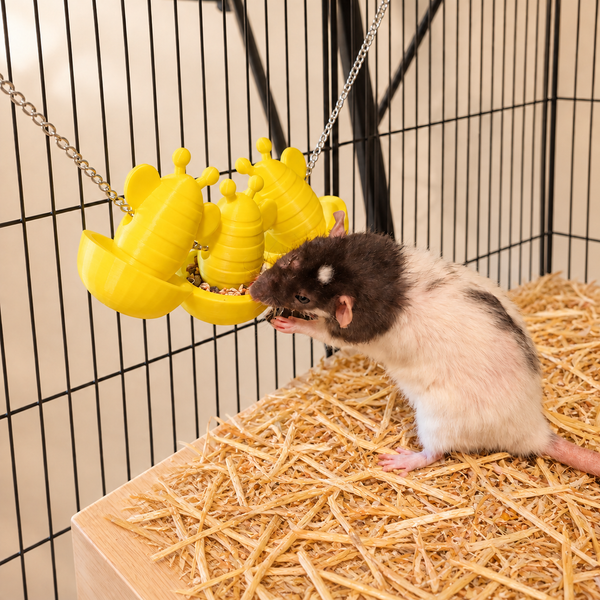
Make the usual food interesting
Questions owners ask
Can rats have butternut squash?
Yes. Plain butternut flesh is a good fresh extra. Give a small cube per rat, raw or plain cooked and cooled, a few times a week. Our butternut squash page goes into more detail on that one variety.
Can rats eat raw butternut squash?
Yes. Raw butternut is safe, just firm. Peel it, scoop out the seeds and cut a small cube or a thin slice your rat can grip. Many rats find lightly cooked squash easier to eat, especially older rats.
Can rats eat cooked squash?
Yes, if it is plain. Boiled, steamed or baked squash with nothing added is fine once it has cooled completely. A spoonful of squash soup, buttery mash or honey-roast squash is not, because of the other ingredients.
Can rats eat pumpkin?
Yes. Pumpkin is a winter squash, and Unusual Pet Vets and Chewy's vet-informed guide both list it for rats. Treat it the same way: plain flesh, small pieces, no pie filling or spiced pumpkin products.
Can rats drink squash (the fruit drink)?
No. In the UK, squash is also a sweet fruit cordial. It is sugar or sweetener in water and adds nothing for a rat. Give plain fresh water only, every day.