Hides and houses
 Shelves and ledges
 Foraging and toys
 Cage accessories
 Kits and bundles
 Fairy forest
 Spooky mischief
 Sweetie stash
 Game mode
 Forest floor
 Castles and cathedrals

A hide that carries the Halloween theme
What to keep out of a Halloween cage
Most shop-bought Halloween decorations are made for shelves, not for animals that chew everything they reach. Keep these outside the cage and out of paw's reach during free-roam time:
- Stretchy fake cobweb. The fine strands can wrap around toes and tails, and rats may swallow them. RSPCA Australia warns against fluffy and loose-fibre materials for the same reason.
- String lights and cables. Rats chew wires. Keep any lights well away from the bars, and cover cables in free-roam areas.
- Candles and real pumpkin lanterns. An open flame near bedding is a fire risk, and the smoke is bad for small lungs. The RSPCA advises keeping rats away from smoke and strong artificial smells.
- Glitter, paint and plastic confetti. Anything that flakes ends up eaten or in the bedding. RSPCA Australia lists small pieces that could be swallowed among things to avoid.
- Halloween sweets. They are not rat food. Keep wrappers and bowls of sweets off the floor.
- Plastic bags and packing. RSPCA Australia lists them as a suffocation risk. Clear decoration packaging away before free roam.
- Scented items. Scented candles, sprays and air fresheners count as strong artificial smells the RSPCA says to keep away from rats.
- Rubber masks and toys. RSPCA Australia lists rubber among items to keep out of a rat's enclosure.
Chocolate, raisins and grapes are on the RSPCA's list of foods never to give rats. Rats cannot vomit, so if one gets into the sweet bowl, ring your vet straight away and tell them what was eaten and roughly how much.
Trick-or-treat night can also be loud, and in the UK fireworks often follow a few days later. The RSPCA lists doorbells and sudden, unpredictable noises among sounds to keep away from rats. If your cage sits near the front door, move it to a quieter room for the evening, and cover part of the cage so the rats have somewhere dark to retreat to. Keep the room between 19 and 23°C (66 and 73°F), away from radiators and draughts, as the RSPCA advises.
Spooky hides rats can actually use
Each of these is a working hide first: an enclosed space to sleep in, with fittings for standard wire cage bars. The RSPCA says every rat must always have a safe, dark hiding place, with one more shelter than you have rats, and that shelters should have more than one exit and fit all the rats if they want to sleep together. Check each size against your own group.
| Hide | What it is | Approximate size |
|---|---|---|
| Witch Cauldron Rat Hide | A round black cauldron with a bubbling top | 19 cm high, 20 cm wide (7.5 x 7.9 in) |
| Gothic Bat Rat Hide | A black bat with a wide doorway | 25 x 24 x 23 cm (9.8 x 9.4 x 9.1 in) |
| Gothic Skull Rat Hide | A white skull with a pink bow and two large eye openings | 23 cm (9.1 in) high and wide |
| Gothic Skull Rat Hide and Hanging Nest | A larger open skull that hangs from its chain or sits lower in the cage | 25 cm (9.8 in) high |
| Dragon Skull Rat Hide | A dragon skull with several openings to climb through | 25 x 22 x 24 cm (9.8 x 8.7 x 9.4 in) |
For older or less agile rats, put the spooky hide on the floor or a low shelf rather than high up. A hanging skull can sit lower in the cage and still look the part.
Our guide to choosing rat houses and hides covers doorway sizes and placement in more detail.
Shelves for climbing routes
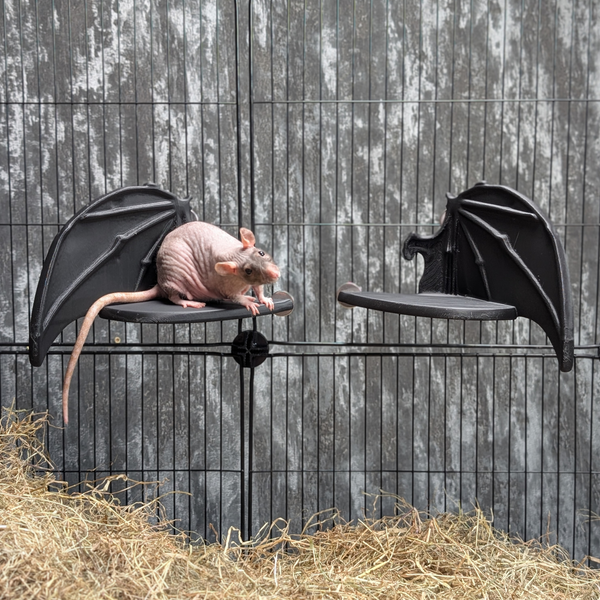
Shelves break up the empty height in a tall cage and give the theme a second level. For a separate climbing route, compare these:
| Shelf | What it is | Approximate size |
|---|---|---|
| Bat Wing Rat Cage Shelf | A single wing-shaped ledge | 20 to 25 cm (8 to 10 in) wide |
| Dragon Rat Shelf Set | Two dragon shelves to mount at matching or staggered heights | Check the listing |
Place shelves within an easy step of each other and of the hides, so no rat has a long unbroken fall. Rats see poorly and rely on their whiskers, so a steady, familiar route matters more than a dramatic one.
The whole look in one set
Setting it up
- Measure first. Check each piece's size against the space between your shelves and the doorway sizes your biggest rat needs.
- Swap, don't add. Take one everyday hide out for each spooky one you put in, so the cage doesn't get crowded. Keep the total at one more hide than you have rats.
- Check the fittings. Fix each piece to the bars and press on it gently before the rats go in. It should not tip, swing or slip.
- Keep a familiar smell. Move some used bedding into the new hide so it doesn't smell strange.
- Hide treats for the first few days. A few pieces of their normal food in the new pieces helps cautious rats explore them.
- Keep food, water and routes clear. Make sure the new layout leaves bowls, bottles and the usual paths easy to reach.
- Watch the first night. Check every rat is using a hide and nobody is stuck, cramped or being kept out.
Halloween decor outside the cage
If you want cobwebs, lights and pumpkins, put them where rats can never reach them: across the room, not on the cage, the cage stand or a free-roam table. Do a sweep before every free-roam session for dropped sweets, wrappers, cables and decoration bits, as the RSPCA asks that rats outside the cage are always supervised in an area where they cannot hurt themselves. Our free-roam safety guide has a full check.
A little raw, plain pumpkin flesh, washed, peeled and seeded, can be a seasonal treat in the same way as other squash. Never give pieces of a carved lantern that has held a candle. Our guide to rats and squash covers portions.
After Halloween
Every piece here stays in the cage after Halloween. A skull or a cauldron is just as good a bed in March. For other ideas through the year, see our rat cage themes, the complete rat cage set-up guide and our pet rat care hub.
Frequently asked questions
Is fake cobweb safe for rats?
No. Stretchy fake cobweb has fine strands that can wrap around toes and tails, and rats may swallow them. RSPCA Australia warns against fluffy and loose-fibre materials for the same reason. Keep it off the cage and well out of reach of free-roam areas, or skip it and let a skull or bat hide carry the theme.
Can rats eat pumpkin at Halloween?
A little raw, plain pumpkin flesh, washed, peeled and seeded, is fine as a small treat, in the same way as other squash. Never give pieces of a carved lantern that has held a candle, and skip pumpkin pie, sweets and anything sugary. Our guide to rats and squash covers portions.
What Halloween sweets are dangerous for rats?
Chocolate, raisins and grapes are on the RSPCA's list of foods never to give rats, and sugary foods should be kept to tiny treats. Halloween sweets are not rat food at all. Rats cannot vomit, so if yours has eaten chocolate or raisins, ring your vet straight away and say what and how much.
Can I put a pumpkin lantern or candle near the cage?
No. An open flame near bedding is a fire risk, and the RSPCA advises keeping rats away from strong smells such as smoke. Battery tea lights are safer in the room, but keep them and any cables out of reach, because rats chew wires. Put the cage somewhere calm and dim instead.
How do I keep rats calm on trick-or-treat and fireworks nights?
Move the cage away from the front door and windows to a quieter room for the evening, and cover part of the cage so the rats have somewhere dark to retreat. The RSPCA lists doorbells and sudden noises among sounds to keep away from rats. Make sure every rat has a hide.
What makes a good rat hide?
A good hide is dark inside, has more than one way out, and is big enough for all the rats who want to sleep in it together. The RSPCA advises having one more shelter than you have rats, at different heights, so nobody is ever without a safe place. Check doorways suit your biggest rat.