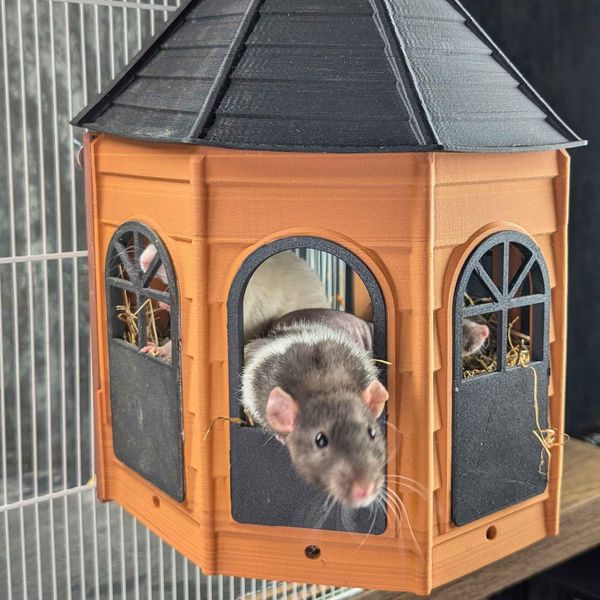
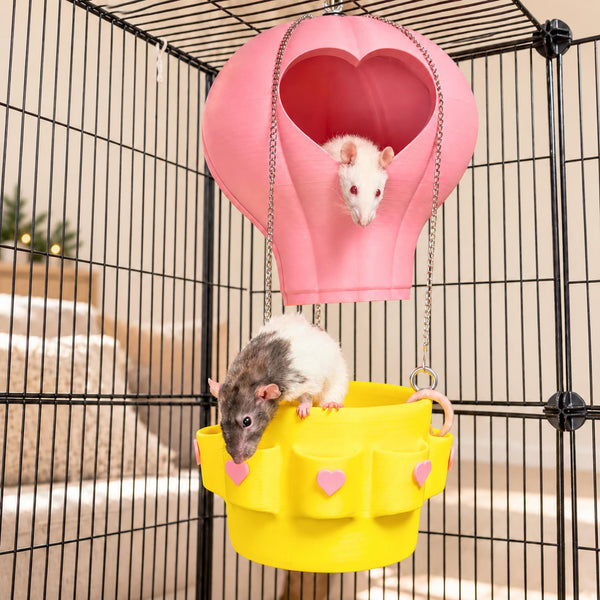
Hides and houses
 Shelves and ledges
 Foraging and toys
 Cage accessories
 Kits and bundles
 Fairy forest
 Spooky mischief
 Sweetie stash
 Game mode
 Forest floor
 Castles and cathedrals

Do rats need a playpen?
Rats need daily time out of the cage, and a playpen is one of the two safe ways to give it. PetMD says all rats need time outside their cage every day, closely supervised. The RSPCA recommends supervised time in a room they can't escape from or hurt themselves in, or a large exercise pen with room to run, climb and hop. A pen is the easier of the two to make safe, because there is less floor to check and fewer places for a rat to vanish into. Once you know your rats and have checked a whole room, our rat free-roam safety guide covers the next step.
Choose the place before the pen
Start with a quiet indoor area where you can see the whole floor. A pen can still leave cables, furniture gaps, plants, cleaners, small objects or other pets within reach. Close doors and windows, move other animals away, and tell the household the rats are out.
Check the area from floor level, including corners, furniture, vents and possible climbing routes. Keep the pen away from moving furniture such as recliners and sofa beds. Remove loose wires and unsafe chewable items. Supervision does not make an unsafe edge safe.
Pick a room that stays comfortable. The RSPCA's ideal for rats is 19 to 23°C (66 to 73°F), away from direct sun, draughts, loud speakers and sudden noise such as a vacuum cleaner, so a playpen in a sunny conservatory or next to the television is a poor spot.
Types of rat playpen compared
Any pen sold for rodents or other small pets can work if it suits rats. The difference is how each one fails, so you know what to watch.
| Type | Good for | What to watch |
|---|---|---|
| Pop-up fabric pen with a zip or floor | Quick to put up and pack away; soft sides are hard to climb | Rats can chew through fabric; walls can sag; check zips and seams |
| Wire or mesh panel pen with a door | Sturdy, adjustable shape | Mesh gives footholds to climb; check gap size so no head fits through |
| Smooth solid panels joined together | Few footholds, easy to wipe | Panels can be pushed apart at the joins; check corners and the base |
| A checked, empty corner walled off with boards | Uses space you already have | Furniture beside it acts as a step; gaps under skirting and behind units |
Pens made for rabbits and guinea pigs are often low and open-topped. Rats climb and jump far better than either, so check the height against your own rats before you trust it.
Build a boundary that stays put
Use a stable, smooth-sided barrier with joined edges that can't be pushed apart easily. Check for gaps at corners, doorways and where panels meet the floor. A rat that can reach a seam may investigate it; watch how your own rats respond rather than assuming a barrier that worked once will always contain them. For mesh, PetMD's limit for rat cage bars is a gap of 1.25 cm (½ in) or less, and the RSPCA warns that once a head is through, the whole body will follow.
Before the rats go in, press gently against each section and inspect the joins. Remove nearby objects that could help a rat climb over. Watch the top edge as well as the bottom: some rats climb, some push, and some find a route you didn't expect. If one gets over, starts climbing repeatedly, or focuses on a gap, calmly end the session and change the layout before trying again.
Keep the pen on a floor that gives secure footing and is straightforward to clean. Rats chew, gnaw and scent mark when they are out, as the RSPCA notes, so a washable cover over carpet or wood saves you work. Avoid loose threads, loops or frayed fabric that could catch toes or teeth. If you cover a surface, lay it flat and check it during the session.
How to set up a rat playpen
- Check the room. Shut doors and windows, move other pets out, and clear cables, plants, cleaners and small objects from floor level.
- Put up the sides. Lock every join, check the corners and the base, and move anything beside the pen that could act as a step.
- Lay the floor. Put down a flat, dry, washable cover with no loops or loose threads.
- Add a few things. Place a hide, a tunnel or paper, a low stable climb and a forage spot, with open floor between them.
- Test it. Press each panel and look along the top edge before the rats go in.
- Count them in. Bring the rats in a carrier or by hand, count them, close the exit, and stay.
- Count them out. At the end, count every rat back into the cage or carrier, then inspect the pen for chewing and new gaps.
Set up a useful, simple layout
A playpen doesn't need many objects. Start with enough open floor for movement and a few familiar things that invite different activities:
- A hide or open cardboard box with a clear way in and out
- A tunnel or paper to investigate and rearrange
- A low, stable route to explore, without a risky drop
- A small forage opportunity using part of the rats' usual food
Rat play area ideas
Once the basics work, rotate in one new idea at a time. The RSPCA suggests rotating toys regularly, because rats are quick learners who get bored, and it lists a digging area, a foraging tray and a water bath as parts of a good exercise pen.
| Idea | How to do it | Check |
|---|---|---|
| Digging box | A shallow box of clean sand or compost, as the RSPCA suggests, with a few treats buried in it | Plain, chemical-free compost; expect mess. See our rat digging box guide |
| Foraging tray | Part of their usual food scattered in shredded paper or a tray | Use their normal ration so they don't overeat |
| Shallow water bath | A tray with a little room-temperature water and a few peas to fish out | Shallow, supervised, never force a rat in, as the RSPCA advises |
| Cardboard castle | Boxes and large tubes taped open with several doorways | Plain cardboard; remove tape that comes loose |
| Paper shredding | Scrunched plain paper or a stuffed tube to pull apart | Avoid glossy or inked paper. See safe rat shredding toys |
| Low climbing route | A ramp or a pile of stable boxes a short step high | No drop a rat could fall from |
| Training game | Teach a recall to a sound with a tiny treat | See how to train pet rats |
Supervise and adjust as you go
Stay with the rats for the whole session. Keep the exit closed, count the rats when they go in and when they come out, and pay attention to the edges rather than looking only at the toys. Watch for climbing, chewing, pushing at a join, hiding where you can't reach, or getting unsettled by a sound or movement.
Let the rats approach you and explore at their own pace. If they are new to the pen, keep the first arrangement plain and make it easy to return to their familiar cage or carrier. Don't chase a rat around the pen to make interaction happen. If a rat becomes hard to see or pick up, end calmly and make the next setup simpler.
When the session ends, inspect the barrier, floor covering and objects. Look for a shifted panel, new gap, loose thread or chewed edge. Remove damaged items and repair the setup before using it again. Repeat the floor-level check whenever you move the pen or change the room. If a rat does chew something it shouldn't, such as a cable or a plant, ring your vet straight away and keep any packaging or leaves to show them; our guide is my rat sick? covers the signs to watch afterwards.
Quick check before opening the cage
- Doors and windows are shut; other pets are elsewhere.
- Cables, plants, medicines, cleaners, small objects and escape gaps are out of reach.
- Panels and joins are stable, with nothing beside the pen that could act as a step.
- The floor is clear, dry and free of loose loops or threads.
- Hides and enrichment are arranged so every rat stays visible and reachable.
- You can stay present until every rat is back in its cage or carrier.
Wash the floor cover and wipe the pen on the same day you clean the cage, so it doesn't build up smells; our rat cage cleaning guide covers products that are safe to use. For everything else your rats need, start at our pet rat care hub.
Rat playpen questions
Can I leave rats in a playpen while I do something else?
No. Stay with them throughout. Rats test boundaries, find new gaps and chew things you didn't expect, so a pen doesn't make unsupervised time safe. The RSPCA's advice is to always supervise rats outside the cage. If you need to step away, put them back in the cage first.
What should I put in a rat playpen?
Start with a hide with a clear way in and out, a tunnel or paper to investigate, a low stable route to climb, and a small forage activity using part of their usual food. Add a digging box if you like. Leave enough open floor to move about and keep every rat in view.
What height and material should a rat playpen be?
There is no universal height or material that guarantees containment. Choose stable sides with few footholds and secure joins, then watch your rats test them. Mesh may be climbed or chewed; fabric can be shifted or chewed. Inspect the edges each time, stay present and stop if a rat finds a route out.
Are fabric or mesh playpens escape-proof?
No. No material guarantees containment for every rat. Fabric pop-up pens can be chewed through, and mesh panels give rats footholds to climb. Inspect the pen before every session and supervise, rather than relying on a product label or a session that went well last time.
What if my rat keeps trying to get out?
End the session calmly and check for a route, an unstable edge or a nearby climbing aid. Make the next layout simpler and move anything that acts as a step. If the setup can't keep your rat contained while you supervise, choose a different secure area, such as a fully rat-proofed room.
How long should rats play outside the cage?
Every day, as long as you can supervise. PetMD says all rats need time outside the cage daily, and neither it nor the RSPCA sets a fixed number of minutes. Watch your rats: when most of them are back in the hide or grooming instead of exploring, the session has done its job.
Can I use a rodent playpen made for other small pets?
Often, yes, as long as it suits rats. Many pens sold for rabbits and guinea pigs are low and open-topped, and rats climb and jump far better than either. Check the sides are tall and smooth enough for your rats, the panels lock together, and the gaps are too small for a head to fit through.
Is a playpen better than free roaming?
It is smaller and easier to make safe, so it suits new rats, young rats and rooms you can't fully rat-proof. The RSPCA suggests either a rat-proofed room or a large exercise pen. Many owners start with a pen and move to a checked room once they know their rats.