Hides and houses
 Shelves and ledges
 Foraging and toys
 Cage accessories
 Kits and bundles
 Fairy forest
 Spooky mischief
 Sweetie stash
 Game mode
 Forest floor
 Castles and cathedrals

| Safe? | Yes |
| How much | A piece of leaf about the size of your rat's ear |
| How often | Most days, rotated with other greens |
| Best served | Raw or lightly steamed, washed, torn up |
| Watch out for | Tough stems, kale crisps, too much at once |
Is kale good for rats?
Yes. Unusual Pet Vets, an exotic animal practice, puts kale on its list of everyday vegetables for rats, and the RSPCA in Australia names kale among the dark greens to give as part of the daily food allowance. Woodgreen, the UK animal charity, lists it among its suggested fresh foods. Dark leafy greens like kale add variety, fibre and interest to a diet built on complete rat pellets or blocks.
The one limit is family. Kale is a brassica, like cabbage and broccoli, and the vet-reviewed Vet Desk suggests cabbage-family veg should stay under about 20% of a rat's diet, because large amounts can cause gas.
How much kale can a rat have?
A piece of leaf about the size of your rat's ear per rat, most days. That is a small amount: fresh veg is a side to the pellets, not the main meal. Count it as part of the day's food, not extra on top, and on some days swap kale for a non-brassica such as cucumber or celery leaves.
How to prepare kale for rats
- Wash it. Rinse curly kale well, as grit hides in the folds.
- Strip the stem. Pull the leaf away from the tough central rib.
- Tear it up. Tear a piece about the size of your rat's ear for each rat.
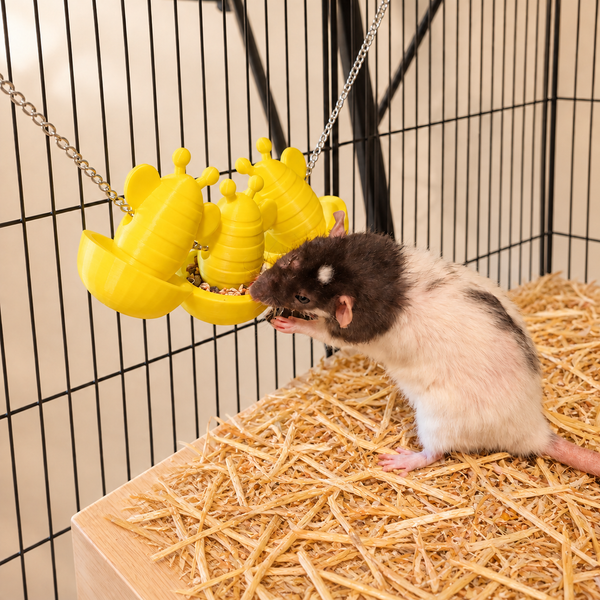
- Scatter or hide it. Scatter the pieces, or tuck them into a foraging toy so the rats work for them.
- Clear leftovers. Remove wilted pieces after a few hours, before they go off.
Curly, cavolo nero, baby kale and kale crisps
| Form | OK for rats? |
|---|---|
| Curly kale, raw | Yes, most days |
| Cavolo nero (Tuscan or lacinato kale) | Yes, same rules |
| Baby kale | Yes, soft and easy to chew |
| Steamed, plain and cooled | Yes |
| Frozen, plain, thawed | Yes |
| Kale crisps (kale chips), kale in garlic or butter | No |
Other greens to rotate
Good partners for kale are pak choi, spring and savoy cabbage, broccoli and, once or twice a week, spinach. The full list is in what can rats eat, the daily balance is in our rat diet guide, and everything else is in our pet rat care hub.
Kale questions
Can rats eat kale stems?
Yes, but the thick central rib is tough and stringy, so most rats leave it. Strip the leaf off the stem and give the leafy part. If you want to use the stem, slice it very thinly across the grain. Baby kale has soft stems and can be given whole.
Can rats eat kale crisps (kale chips)?
No. Shop-bought and homemade kale crisps are usually baked with oil and salt, and often cheese or spice. That turns a healthy green into a salty, fatty snack. If you make your own, take a few raw leaves out for the rats before you add anything.
Is kale better than spinach for rats?
For everyday feeding, yes. Kale is on the everyday lists of Unusual Pet Vets and the RSPCA in Australia, while spinach is high in oxalates, which is why spinach works better as a once or twice a week green. Rotating several greens is better still.
Can baby rats eat kale?
Yes, once they are fully weaned and eating solid food well. Start with a piece of soft baby kale or the tender part of a leaf, about the size of a thumbnail, and check their droppings stay firm before giving more.