Hides and houses
 Shelves and ledges
 Foraging and toys
 Cage accessories
 Kits and bundles
 Fairy forest
 Spooky mischief
 Sweetie stash
 Game mode
 Forest floor
 Castles and cathedrals

Are there different breeds of chinchilla?
No. There are two wild species and many colours, but no breeds. San Diego Zoo Wildlife Alliance names the two species as the long-tailed or Chilean chinchilla, Chinchilla lanigera, and the short-tailed chinchilla, Chinchilla chinchilla. Both are endangered in the wild.
Almost every pet chinchilla in the US is thought to descend from about 11 animals brought from Chile in the 1920s by a mining engineer, Mathias F. Chapman, says San Diego Zoo Wildlife Alliance. Chewy's vet-reviewed care sheet says most pets are a cross between the long-tailed and short-tailed species. Since then, breeders have selected for new coat colours, and PetMD notes that domestic chinchillas are now about twice the size of wild ones while keeping the same quiet, shy nature.
So when people talk about chinchilla "breeds" they mean colour types. Breeders call them mutations, because each new colour started as a natural change in one animal's genes that was then bred on.
What colours do chinchillas come in?
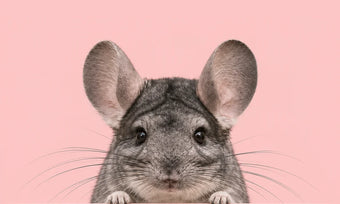
The wild colour is blue-grey, says the MSD Veterinary Manual, and each hair is banded grey, white and black, says San Diego Zoo Wildlife Alliance. Today pets also come in black, white, beige, brown and mixes. These are the colours UK breeders on the National Chinchilla Society list name, grouped the way the Society groups them:
| Colour | Group | What it means |
|---|---|---|
| Standard grey | Standard (wild type) | The original wild colour: grey with a pale belly. The most common pet colour. |
| Beige | Dominant mutation | A pale, warm beige coat in place of grey. |
| Wilson white | Dominant mutation | A white chinchilla carrying the white gene. |
| Pink white | Mix of beige and white | White with beige genes, which can come from a beige and Wilson white pairing. |
| Black velvet | Dominant mutation | A dark, velvety top coat over a lighter belly. |
| Brown velvet | Dominant mutation | The velvet gene with beige, giving a darker brown top. |
| Ebony | Named by UK breeders | Dark coats, from light to very dark. |
| Violet | Recessive mutation | A soft grey with a lilac tone. |
| Charcoal | Recessive mutation | A deep grey. |
| Black pearl | Recessive mutation | A dark recessive colour bred in the UK. |
| Lowe recessive white (goldbar) | Recessive mutation | A recessive white, different from Wilson white. |
| Blue diamond | Named by UK breeders | A pale blue-grey type offered by some breeders. |
Chewy also names pastel, chocolate and mosaic as colour types you will see advertised, especially in the US. Mosaic usually means a white chinchilla with patches of grey. Names vary between countries and breeders, so the same animal can be sold under two different names. If a colour matters to you, ask the breeder what its parents were.
What do dominant and recessive colours mean?
A dominant colour shows when a chinchilla carries just one copy of the gene. A recessive colour only shows with two copies, so a grey chinchilla can quietly carry violet and pass it on. The National Chinchilla Society gives two examples: a standard grey bred to a dominant colour should give roughly half greys and half of that colour, while a violet bred to a grey that carries violet gives roughly half violets and half greys that carry the gene.
The Society also says colour mutations tend to have less dense, weaker fur than good standard greys, which is why breeders keep crossing back to greys. For a pet that doesn't matter much, but it is a reason to choose a chinchilla for health and temperament first and colour second.
What is an angora chinchilla?
An angora chinchilla has a long, soft coat instead of the usual short, dense fur. They are also sold as Royal Persian Angoras. They are rare: of the four breeders on the National Chinchilla Society's UK list, only one mentions them, and only "occasionally". Expect a wait and a search to find one.
We couldn't find a welfare charity or vet source on caring for long-coated chinchillas specifically. Reasoning from what vets say about chinchilla fur in general, we'd expect a long coat to need gentler, more frequent brushing with a soft brush and a careful eye for matting and fur rings, and the warmth of a long coat is one more reason to keep the room cool. Ask any breeder how they groom their angoras before you buy, and see our guide to where to get a chinchilla for questions to ask.
Does colour change a chinchilla's care or personality?
No. Every colour is the same animal with the same needs: unlimited hay, a small daily measure of plain pellets, a tall cool home, dust baths and a companion. We found no welfare or vet source that links coat colour to temperament, and we'd treat any claim that one colour is "friendlier" with caution. How a chinchilla was handled when young matters far more, says the MSD Veterinary Manual.
For a first chinchilla, we'd pick a healthy, calm standard grey or any colour from a rescue. Our full chinchilla care guide covers everything they need, whatever the colour, and chinchilla name ideas by colour will help once you've chosen.
Holland Lop chinchilla, Mini Lop and Mini Rex: chinchilla rabbits
A Holland Lop chinchilla, chinchilla Mini Lop or chinchilla Mini Rex is a rabbit, not a chinchilla. In rabbits, "chinchilla" is the name of a coat colour, named for its likeness to the grey, ticked fur of the real chinchilla. Variants such as blue chinchilla, sable chinchilla and broken chinchilla (chinchilla with white patches) are rabbit colour names too. The American Rabbit Breeders Association notes that one rabbit colour, the Czech Frosty, is "genetically the same as Chinchilla" apart from one gene, which shows how breeders treat chinchilla as a colour.
There are also whole rabbit breeds named after it. The American Rabbit Breeders Association recognises three: the Standard Chinchilla, the American Chinchilla, which it calls the rarest, and the Giant Chinchilla. The Giant Chinchilla Rabbit Association says the first Giant Chinchilla was born in Kansas City on Christmas Day 1921, and ideal adults weigh 5.9 to 6.8 kg (13 to 15 lb), which is about ten times the weight of a chinchilla.
If a rabbit is what you're after, our guide to rabbit breeds covers Holland Lops, Mini Lops and Rex rabbits, and where to get a rabbit covers rescues and breeders.
Where can you find a particular chinchilla colour?
From a specialist breeder, or sometimes a rescue. Standard greys are the colour most often in pet shops and rescues. For a particular colour or an angora, look at breeder lists from national clubs such as the National Chinchilla Society in the UK. The Society is clear that it does not approve breeders or inspect premises, so judge each breeder yourself: ask about the parents, their teeth and their health, and walk away from anyone who keeps males and females together without a plan. Read our guide to where to get a chinchilla before you contact anyone, and our chinchilla facts page for the fun side of their fur.
Chinchilla breed and colour questions
Are chinchillas friendly?
Chinchillas of every colour are gentle and rarely bite, says the MSD Veterinary Manual, but they are shy and most dislike being held. Friendly usually means a chinchilla that comes to say hello and takes food from your hand. Regular, gentle handling while young makes the biggest difference, not the colour.
Are chinchillas hard to care for?
Not complicated, but demanding. They need a cool room below about 18°C (64°F) all year, a tall cage, unlimited hay, dust baths, a companion and one to two hours of your time a day, says PetMD. They also live 10 to 15 years or more. Colour makes no difference to any of that.
Is a chinchilla easy to take care of?
Once the set-up is right, the daily jobs are simple: top up hay, give a measured spoon of pellets, check water, offer a dust bath and spot-clean. The hard parts are heat, space and time. They suit calm adults and older children who are happy to watch more than cuddle.
Do you need 1 or 2 chinchillas?
Two. The RSPCA says chinchillas should live with at least one other friendly chinchilla, and PDSA suggests a same-sex pair that grew up together. Two chinchillas of different colours get on just as well as two of the same, so pick on temperament and sex, not coat.
Why can't chinchillas touch water?
They can drink and get a damp paw, but they should never be bathed. Their fur is so dense that wet fur can take days to dry, which raises the risk of fungal skin infection, warns Chewy's vet-reviewed care sheet. Every colour keeps clean the same way: rolling in chinchilla dust.
What foods are bad for chinchillas?
Nuts, seeds, dried fruit, sugary or fatty foods, chocolate, caffeine and alcohol are all out, say PetMD and Chewy. PDSA also advises against muesli-style mixes and most shop-bought treats. Every colour of chinchilla has the same delicate gut, so the same rules apply.
Sources
- San Diego Zoo Wildlife Alliance: Chinchilla
- National Chinchilla Society: Buying the right chinchilla
- National Chinchilla Society: Chinchilla breeders in the UK
- MSD Veterinary Manual: Description and physical characteristics of chinchillas
- Chewy: Chinchilla care sheet
- PetMD: How long do chinchillas live?
- VCA Animal Hospitals: Chinchillas, owning
- RSPCA: Chinchilla company
- PDSA: Are chinchillas the right pet for you?
- American Rabbit Breeders Association: Recognized breeds
- Giant Chinchilla Rabbit Association
- PDSA: Your chinchilla's diet