Hides and houses
 Shelves and ledges
 Foraging and toys
 Cage accessories
 Kits and bundles
 Fairy forest
 Spooky mischief
 Sweetie stash
 Game mode
 Forest floor
 Castles and cathedrals

What is a teddy bear hamster?
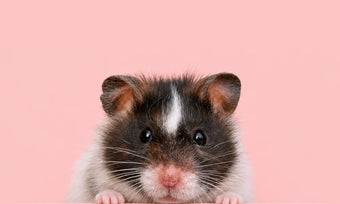
It is a Syrian hamster with a long coat. PetMD's vet-written guide lists "teddy bear" as one of the Syrian hamster's other names, along with golden hamster. Pet shops in the UK and US often sell long-haired Syrians as teddy bear hamsters and short-haired ones as golden or fancy hamsters, but they are the same animal and need the same care. Our full Syrian hamster guide covers the species in depth.
Long coats are most common and most dramatic in males. The Vet Desk's breed profile says long coats are most common in males, and it is the adult boys that grow the long "skirt" of fur over the back end. Long-haired females usually have a much shorter, fluffier coat, so a female teddy bear hamster can look little different from a short-haired Syrian.
How to recognise a teddy bear hamster
- A big hamster: 15 to 18 cm (6 to 7 in) long as an adult
- Long, soft fur, longest over the back and bottom, especially on males
- No dark stripe down the back
- Round face, big eyes and small rounded ears
- Lives alone and is usually calm once tamed
Not sure if you have a Syrian or a dwarf? The difference is mostly size and the stripe.
| Hamster | Length | Weight | Back stripe | Can live with others? |
|---|---|---|---|---|
| Teddy bear (long-haired Syrian) | 15 to 18 cm (6 to 7 in) | 90 to 140 g | No | No, always alone |
| Short-haired Syrian | 15 to 18 cm (6 to 7 in) | 90 to 140 g | No | No, always alone |
| Russian dwarf (Campbell's or Winter White) | 5 to 10 cm (2 to 4 in) | Much smaller | Yes | Sometimes, if paired young |
| Roborovski | 4 to 5 cm (1.5 to 2 in) | 20 to 25 g | No | Sometimes, if paired young |
Sizes are from PetMD and social rules from the RSPCA. A "Russian teddy bear hamster" or "miniature teddy bear hamster" is not a real type: a tiny fluffy hamster is a dwarf, and our Russian dwarf hamster guide and Roborovski hamster guide cover those. There is no giant teddy bear hamster either. Syrians are simply the biggest pet hamster, and a well-fed adult male in full coat can look very large.
Teddy bear hamster colours
Syrians come in many colours and patterns, and the long coat can appear in any of them. PetMD lists golden with a white or cream belly, cinnamon, piebald and cream. The Vet Desk adds beige, black, sable and white, and notes that all-black Syrians are sold as black bear hamsters.
| Name you will see | What it usually means |
|---|---|
| Golden, orange, brown | The wild-type colour: golden brown top, white or cream belly |
| Black, black bear | A black Syrian, often with a little white on the feet or chest |
| White | White all over, with dark or red eyes depending on the colour |
| Cream | Pale, warm cream all over |
| Cinnamon | Warm orange-brown |
| Sable | Very dark brown, close to black |
| Black and white, panda, brown and white, piebald | Sellers' names for a coloured Syrian with white patches or a white band |
| Calico, orange and white | Sellers' names for a mix of colour patches, often with white |
Colour names change between shops, so treat them as descriptions rather than breeds. Colour makes no difference to temperament or care.
Teddy bear hamster temperament
Teddy bear hamsters are usually the gentlest pet hamster to hold. PetMD says Syrians are friendly, warm up with time and gentle contact, and suit handling by children, and Wood Green calls the Syrian the largest and easiest hamster to handle. The Vet Desk describes males as more laid-back and females as spunkier.
They are still solitary, nocturnal animals. They wake in the evening and are busiest at night, and a hamster woken suddenly or grabbed from above may nip. Our guide to taming a hamster takes you through it, and hamster behaviour explained helps you read the signs.
Do teddy bear hamsters need to live alone?
Yes, always. The RSPCA says Syrian hamsters aren't naturally sociable and should always live on their own, and PDSA warns that Syrians living together will fight and can be seriously injured or killed. That includes littermates, two females and pairs sold together as babies. Your hamster gets its company from you, from a good setup and from things to explore.
Grooming a long-haired hamster
A teddy bear hamster's coat needs a little help. The Vet Desk says long-haired Syrians need occasional brushing with a small brush or fine-toothed comb, and that over-grooming strips natural oils from the coat. Never bathe a hamster in water: offer a sand bath instead.
- Pick your moment. Groom in the evening when your hamster is awake, sitting on the floor or over a towel.
- Use a soft tool. A clean soft toothbrush or a small fine-toothed comb works well on long fur.
- Brush with the fur. Short, gentle strokes from head to tail, a few at a time. Stop if your hamster wriggles and try again later.
- Check the back end. Bedding, droppings and food can catch in a male's long skirt. Ease them out with your fingers or the comb.
- Leave mats to a vet. Don't cut tangles out with scissors near the skin. A vet can remove a bad mat safely.
Long coats tangle with fluffy, stringy nesting material and catch wood shavings. Shredded plain paper and paper-based bedding come out of the coat easily, and they are safer for every hamster.
The best cage for a teddy bear hamster
The best cage is the biggest one you can fit, with at least 100 × 50 cm (40 × 20 in) of unbroken floor. PDSA and Wood Green both use that minimum, and Wood Green asks for 50 cm (20 in) of height for Syrians and says females may need more space. PDSA says single-level cages tend to be better than tall multi-level ones, because hamsters see poorly and can fall.
- Floor of at least 100 × 50 cm (40 × 20 in)
- Bar spacing no wider than 1 cm (about ⅜ in), as Wood Green advises for Syrians
- Bedding at least 25 cm (10 in) deep, as PDSA recommends
- A solid wheel at least 30 cm (12 in) across, never one with rungs
- A sand bath with hamster-safe sand
- Several hides, including a multi-room hide, plus tunnels and cork
- A water bottle with a metal spout, or a heavy bowl
- A quiet spot at a steady 18 to 21°C (64 to 70°F), away from draughts and direct sun
Long-haired Syrians need a full 30 cm (12 in) wheel at least: a smaller wheel bends the back. Our guides to hamster cage size, wheel size, bedding and the best hamster cages cover each piece.
The best food for a teddy bear hamster
A good hamster pellet or complete dry food as the base, about 10 g (one level tablespoon) a day according to Wood Green, plus a teaspoon or two of fresh vegetables and herbs, which PDSA recommends. PDSA also suggests timothy hay for fibre and chewing, the odd protein treat such as plain boiled egg or a mealworm, and constant fresh water. It warns that muesli-style mixes shouldn't be the only food, because hamsters pick out the sugary bits.
There is no special teddy bear hamster food. Feed a long-haired Syrian exactly as you would a short-haired one. Our hamster diet guide and safe food list have the details.
Weekly care checklist
- Daily: fresh water, a portion of dry food and a teaspoon of veg; remove old fresh food
- Daily: spot-clean the toilet corner
- Weekly: gentle brush, and check the back end for tangles or soiling
- Weekly: check eyes, nose, teeth, ears and bottom while handling
- Weekly: weigh your hamster on kitchen scales and note any change
- Weekly: sift or replace the sand
- Every few weeks: partial bedding change, keeping some old bedding
Teddy bear hamster health problems
Long-haired Syrians share the Syrian's health problems, plus coat trouble: tangled or soiled fur around the bottom can hide a wet tail or a sore. Watch for a wet or dirty bottom, diarrhoea, weight loss, a lump, overgrown teeth, hair loss or flaky skin, and eyes that are dull or crusted.
A wet, smelly bottom with diarrhoea, or a hamster that is hunched and won't eat, needs an exotics vet the same day. Wet tail can be fatal without quick treatment.
Our hamster health guide explains what is normal and when to call the vet, and the hamster lifespan guide covers getting older.
Teddy bear hamsters for sale: where to find one
Start with rescues. Rescues such as the RSPCA, Wood Green, Blue Cross and local small-animal rescues in the UK, or shelters in the US, can match you with a calm adult whose temperament they already know. If you buy from a breeder or shop, ask:
- How old is the hamster, and is it already living alone?
- Has it been sexed by someone experienced? A female kept with males may be pregnant
- Can I see where it lives and what it eats?
- Has it been handled, and how does it react?
A healthy teddy bear hamster has bright eyes, a clean dry bottom, a clean nose, a full coat without bald or crusty patches and an alert, curious manner. Avoid any hamster that is hunched, wet underneath or very thin. Our guide to where to get a hamster has the full checklist, and the complete hamster care guide covers everything else.
Teddy bear hamster questions
Is a teddy bear hamster a Syrian hamster?
Yes. Teddy bear hamster is a pet-shop name for the long-haired Syrian hamster, the same species as the golden hamster. PetMD's vet-written breed guide lists teddy bear as another name for the Syrian. It is a coat type, not a separate breed, so care is the same as for any Syrian, plus gentle grooming.
How long do teddy bear hamsters live?
About 2 to 3 years, the range PetMD gives for Syrian hamsters, with some reaching 3 or a little more. The long coat doesn't change lifespan. A big cage, deep bedding, a steady room temperature, a balanced diet and early vet help for any illness give your hamster the best chance of a long life.
Can two teddy bear hamsters live together?
No. The RSPCA says Syrian hamsters aren't naturally sociable and should always live on their own, and PDSA warns that Syrians kept together fight and can be seriously injured or killed. That includes siblings and pairs sold together as babies. One teddy bear hamster per cage, always.
Is there a Russian or miniature teddy bear hamster?
No. Teddy bear hamsters are always Syrians, the biggest pet hamster. Russian dwarf hamsters are a different, much smaller species with a dark back stripe, and they can be fluffy but are not long-haired Syrians. A tiny hamster sold as a mini teddy bear is a dwarf hamster, and needs dwarf care.
Are teddy bear hamsters good for children?
They are the best of the pet hamsters for gentle handling. PetMD says Syrians are friendly once settled and suited to handling by children, and Wood Green calls them the easiest hamster to handle. They are awake at night, though, and may nip if woken or grabbed, so an adult should do the daily care.
Why are my male teddy bear hamster's balls so big?
Large testicles that bulge at the back end are normal in an adult male Syrian, and they can look huge on a small animal. What isn't normal is one side suddenly larger than the other, redness, a wound, or a hard lump. Any of those needs an exotics vet within a day or two.
What is the best bedding for a teddy bear hamster?
Soft, paper-based bedding, deep enough to burrow: PDSA asks for at least 25 cm (10 in). Long fur picks up bits, so avoid stringy fluffy nesting material and wood shavings. Shredded plain paper or paper-based bedding with a pile of hay or plain paper for the nest works well.