Hides and houses
 Shelves and ledges
 Foraging and toys
 Cage accessories
 Kits and bundles
 Fairy forest
 Spooky mischief
 Sweetie stash
 Game mode
 Forest floor
 Castles and cathedrals

Are there different gerbil breeds?
Not really. PetMD says there are 87 known gerbil species, but the one kept as a pet almost everywhere is the Mongolian gerbil. Its Latin name, Meriones unguiculatus, is often translated as "little clawed warrior". The pet gerbils in rescues and shops in the UK and US are all this species.
What people call "breeds" are really colour and coat varieties, bred from the wild colour since gerbils were first kept as pets. Gerbil Care UK says the first captive colony came from 20 pairs caught in 1935, and 11 pairs were taken to the United States in 1954. Every colour you see today comes from changes in a handful of genes, which the National Gerbil Society explains on its genetics page.
Two big clubs set the colour standards: the National Gerbil Society (NGS) in Britain, founded in 1970, and the American Gerbil Society (AGS). Their lists overlap but use slightly different names, so we give both where they differ.
The wild colour: agouti
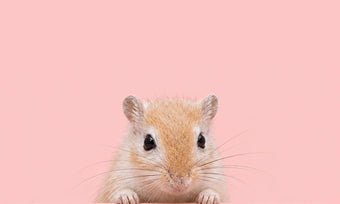
The MSD Veterinary Manual describes the wild coat as agouti, a mix of grey, yellow and black, with an off-white belly. Each hair is banded, so the coat looks flecked, or "ticked". This is the gerbil most people picture.
- Golden agouti. The NGS standard: a soft golden-red top with black ticking on the back and sides, a clear line to a white belly, black eyes with grey eye circles.
- Grey agouti. A white top with black ticking, giving a pepper-and-salt grey, with a white belly and black eyes with white eye circles.
- Nutmeg and silver nutmeg. Ticked like an agouti, but with no white belly: the ticking runs down into a dark cream or light grey belly, with a dark line along the middle.
Self gerbils: one even colour
A self gerbil is the same colour all over, with no white belly and no markings. The NGS and AGS both recognise these.
| Colour | What it looks like | Eyes |
|---|---|---|
| Black | Jet black, even over the body, black toenails | Black |
| Slate | Dark slate blue-grey, even all over | Black |
| Blue | Dark bluish grey, which the standards compare to old pewter | Black or dark |
| Lilac | Leaden grey with a lilac cast | Ruby or dark red |
| Dove | Soft, light dove grey with a silvery cast | Ruby |
| Pink-eyed white | Pure white with no shading | Pink |
| Ruby-eyed white | Pure white with no shading | Ruby |
| Black-eyed white | Pure white (an "any other variety" class at the NGS) | Black |
| Cream | Cream or buttermilk from tip to root (AGS) | Any |
| Red fox (saffron) | Deep reddish gold fading to a dark cream belly, no white belly. The AGS calls it red fox, the NGS saffron | Ruby |
White-bellied gerbils: golds, creams and honeys
These have a coloured top and a clean white belly. Many have red or ruby eyes, which gives them a softer look.
| Colour | What it looks like | Eyes |
|---|---|---|
| Argente golden | Clear golden top with no ticking, blue-grey undercoat, white feet, white belly | Ruby |
| Argente cream | Light apricot top with a silvery cast, white belly | Ruby |
| Dark-eyed honey | Deep orange shading softly into a white belly, dark ticking along the spine, rump and tail | Dark |
| Red-eyed honey | Bright yellow shading into a white belly | Red |
| White-bellied cream | Even pale cream top with a clear line to a white belly | Ruby |
| Pearl | Overall silver grey, with grey ticking heavier on the nose and rump (a newer, provisional NGS standard) | Near black |
Pointed gerbils: Himalayan, Siamese and Burmese
Pointed gerbils have darker "points" on the nose, ears, feet and tail, like a Siamese cat. The AGS groups them as colourpoints.
- Himalayan. A pure white body with coloured ears, feet and tail, and pink eyes.
- Siamese. A rich beige coat with dark sepia or chocolate points, black eyes and a pale cream belly.
- Burmese. Rich mauve shading from the spine to a dark cream belly, black eyes and points like the Siamese. Darker and moodier than a Siamese.
Gerbil patterns: spotted, pied, mottled and patched
Any of the colours above can also carry white markings. The standards set out exactly where they go.
| Pattern | What to look for | White allowed |
|---|---|---|
| Spotted (white spot) | White spots on the nose, forehead and nape, with four white feet and a white tail tip in the NGS standard | Spots only |
| Pied | White patches over a base colour, with a clear white collar all round the neck, and sometimes a white blaze on the face | Up to 50% |
| Mottled | Small white patches scattered over the base colour, collar optional | Up to 75% |
| Patched | Three colours: two shades of the base colour plus white, with at least one full colour patch (AGS) | Varies |
White spots come from one spotting gene. The National Gerbil Society explains that a double dose is fatal, so pairing two spotted gerbils gives 25 percent fewer pups. A good breeder pairs spotted with non-spotted, so it is a fair question to ask.
Rex and coat types
Coat type is separate from colour. The AGS standard for rex says the coat "shall be short and dense with a distinct rippled or curled pattern", and the whiskers curl too. A rex can come in any colour. Every other pet gerbil has the normal short, smooth coat with a furry tail and a tuft at the tip, as the MSD Veterinary Manual describes.
Other gerbil species kept as pets
A few other gerbils and jirds turn up in specialist homes and at National Gerbil Society shows, which run classes for them. They are not the same animal as the Mongolian gerbil, and their care differs, so read species-specific advice before taking one on.
- Fat-tailed gerbil (duprasi). Named for its thick tail. The NGS shows duprasi as a class of their own, a sign they are a separate hobby with their own keepers.
- Shaw's jird. A jird, the wider family name gerbils share. The NGS notes Shaw's jirds are more robust than Mongolian gerbils and cope well with surgery.
- Pallid gerbil. The NGS warns pallids are more delicate than Mongolians, often go into shock from injections and respond poorly to surgery, so you need a very experienced vet.
Never mix species, and never put a gerbil from a different species in with your clan. Different species do not form groups together, and fights between gerbils can be serious or fatal.
Does colour affect personality or health?
Very little, as far as the welfare sources go. Temperament comes from good breeding, early handling and the clan a gerbil grew up in, not its coat. The RSPCA does note two small colour effects: black gerbils scent-mark more than agouti gerbils, possibly because of hormone and brain differences, and females may prefer males of their own colour.
The bigger health factor is where a gerbil came from. Woodgreen says overgrown front teeth are more common in poorly bred gerbils, and the NGS asks breeders not to breed from gerbils that have fits or cataracts. A healthy, well-handled gerbil of any colour beats a rare colour from a careless source every time. Our guide on where to get a gerbil lists what to ask.
How to choose a gerbil colour
- Start with personality, not colour. Watch the gerbils for a few minutes. Pick a calm, curious pair that comes forward to sniff, from a clean, spacious tank.
- Pick a pair, not a single. The RSPCA says gerbils should never live alone, so choose two same-sex littermates. They can be different colours.
- Think about telling them apart. Two golden agoutis look almost identical. A golden agouti with a black, or a Siamese with a pied, makes it easy to know who is who.
- Ask about the parents. A breeder should tell you the colour, temperament and health of both parents and keep records, as the AGS code of ethics expects.
- Then pick a name. Colour makes it easy: see our gerbil names for ideas by colour and for pairs.
Every colour needs the same home and the same care, all set out in our gerbil care guide. For more about the species itself, our page of gerbil facts covers the wild burrows and the clan life behind every colour, and gerbils as pets helps you decide if they suit your home.
Gerbil breed and colour questions
How many gerbil breeds are there?
None in the way dogs have breeds. Nearly every pet gerbil is the same species, the Mongolian gerbil. What differs is colour, pattern and coat. The National Gerbil Society in the UK has show standards for around 25 colours and patterns, and the American Gerbil Society recognises a similar list.
What is the rarest gerbil colour?
No society publishes a rarity list, and what is rare changes from country to country and year to year. Colours on the National Gerbil Society's provisional list, such as pearl and blue, are newer and less often seen. Breeders and shows are the best place to ask what is scarce near you.
Does a gerbil's colour change its personality?
Mostly no. Colour is a coat gene, and temperament comes far more from handling and the clan a gerbil grew up in. The RSPCA does note that black gerbils scent-mark more than agouti gerbils, which may be linked to hormone differences, but they are not known to be less friendly.
Are gerbils friendlier than hamsters?
Many owners find them easier to enjoy. Gerbils are awake in short bursts day and night and live happily in pairs, while the RSPCA calls hamsters nocturnal and says Syrian hamsters must live alone. Neither is a cuddly pet: Woodgreen says gerbils suit families happy to watch rather than hold.
How many gerbils should be kept together?
Two or three of the same sex, ideally littermates. The RSPCA says gerbils should never live alone and that groups should form early in life. Colour makes no difference to who gets on, so you can pick a mixed-colour pair. Larger groups are more likely to fall out as they mature.
Can different gerbil species live together?
No. Mongolian gerbils, fat-tailed gerbils, Shaw's jirds and pallid gerbils have different social lives and sizes, and the National Gerbil Society shows them as separate classes. Keep each species only with its own kind, and research the species you choose before buying, as care differs.
What do gerbils need in their cage?
Every colour needs the same home: a glass tank of at least 100 x 50 x 50 cm for a pair, 20 to 25 cm of diggable paper and hay bedding, a nest box, a solid wheel of 28 cm or more, a sand bath, water and safe things to gnaw.
Sources
- National Gerbil Society: Gerbil show standards
- National Gerbil Society: Gerbil genetics
- National Gerbil Society: Gerbil ailments
- American Gerbil Society: Self standards
- American Gerbil Society: Fur and pattern standards
- RSPCA: Gerbils
- RSPCA: Gerbil company
- MSD Veterinary Manual: Description and physical characteristics of gerbils
- PetMD: Gerbil care sheet
- Gerbil Care UK: What are gerbils?
- Woodgreen: An introduction to gerbils