Hides and houses
 Shelves and ledges
 Foraging and toys
 Cage accessories
 Kits and bundles
 Fairy forest
 Spooky mischief
 Sweetie stash
 Game mode
 Forest floor
 Castles and cathedrals

Are there different ferret breeds?
No, not in the way there are dog or rabbit breeds. The American Ferret Association has a single breed standard for the domestic ferret, and its position is that anything outside the norm, and selective breeding of traits not normally found in the species, is discouraged. So the "types" you see for sale are one animal in different coats.
The differences that do exist come in four layers: colour, pattern, coat length and body type. A ferret is described by putting them together, for example "a chocolate mitt" or "a sable blaze". None of them changes how you care for a ferret. Diet, space, company and vet care are the same for all of them, as set out in our ferret care guide.
Ferret colours
The American Ferret Association standard lists the colours below. Colour here means the guard hairs (the long top coat), the undercoat, the eyes and the nose.
| Colour | Top coat | Eyes and nose |
|---|---|---|
| Sable | Warm deep brown over a cream or light golden undercoat | Brown to near black eyes; light brown or speckled nose |
| Black sable | Dark ash, blackish brown with a glossy shine, no warm tone | Dark brown to near black eyes; blackish brown nose |
| Black | True black over a white undercoat | Black eyes; black or speckled nose |
| Chocolate | Warm milk-chocolate brown | Brown or dark burgundy eyes; pink or beige nose |
| Champagne | Tan, a diluted chocolate | Light to dark burgundy eyes; beige or pink nose |
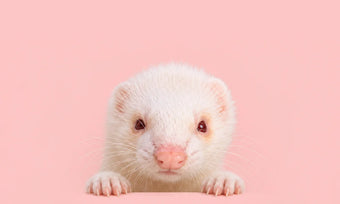
| Albino | White to cream all over | Ruby red eyes; pink nose |
| Dark-eyed white | White to cream all over | Burgundy eyes; pink nose |
VCA also names cinnamon and butterscotch, and the British Veterinary Nursing Association lists silver, sterling silver and black-eyed (onyx-eyed) white. In the UK you will hear older names more often. The RSPCA lists five main colours: fitch (sable), albino (also called the English ferret), silver, sandy and dew. "Polecat" is the usual UK word for a sable, because it looks like its wild ancestor.
Ferret patterns
Pattern describes how the colour is spread. Any of the colours above can come in any pattern, according to the American Ferret Association standard.
| Pattern | What it looks like |
|---|---|
| Standard | Lighter body with darker legs, tail and shoulders; full or T-bar mask |
| Solid | Colour so dense the body looks one shade from head to tail; T-bar or full mask |
| Siamese (colour point) | Pale body with clearly darker points; thin V-shaped mask; pink or beige nose |
| Mitt | White feet with a white bib under the neck; can go with most patterns |
| Blaze | White stripe 1.3 to 2 cm (0.5 to 0.75 in) wide from the top of the head down the back of the neck; white feet; no full mask |
| Panda | Almost completely white head, darker shoulders and hips, white feet; no mask |
| Roan | 40 to 60% white hairs sprinkled evenly through the coloured coat |
| Dark-eyed white pattern | At least 90% white hairs, with a sprinkle of colour, spots or a stripe |
Pet shops and breeders also use their own names, such as "silver mitt", "cinnamon" or "butterscotch". These are usually a colour and pattern pair under a friendlier name.
Do white-marked ferrets have health problems?
They are more likely to be deaf. In an American Ferret Association article, a breeder and judge reports a vet geneticist's warning that ferrets with heavy white markings, such as blazes, pandas and dark-eyed whites, more often carry genes linked to deafness (Waardenburg syndrome) and to cleft palates and head deformities in kits. The advice to breeders was to pair them, if at all, with ferrets that have no white marks.
A deaf ferret can live a full, happy life. It startles more easily, so approach where it can see you, wake it by touch rather than noise, and tell visitors. If you are choosing a blaze or panda kit, ask the breeder about deafness in the line, and test by clapping out of sight while the kit is awake.
Angora ferrets: what they are and where to find one
An angora is a ferret with a long, fluffy coat. VCA lists it as a coat variation, and it can come in any colour. Angoras are uncommon, so you are most likely to find one through a specialist breeder.
Long hair is not part of the American Ferret Association breed standard, which discourages breeding for traits not normally found in the species. We found no welfare charity or vet guide that sets out angora health in detail, so here is what follows from what we know:
- The long coat tangles and traps litter and food, so plan for regular combing
- Ask the breeder how long they have bred angoras and what health problems the line has had
- Ask to see the parents and check the kit is alert, with clear eyes and nose and a clean bottom
- Kits should stay with their mother until about 12 weeks, as the British Veterinary Nursing Association advises
We have not found a published price we could check, so we do not quote one. Our ferret cost guide covers what you will spend after you bring one home, and where to get a ferret explains how to judge a breeder.
Giant ferret breeds and bulldog ferrets
There is no giant ferret breed. Size depends mostly on sex, neutering and diet. The MSD Veterinary Manual gives adult weights of up to 2 kg (4.4 lb) for males (hobs) and up to 1.2 kg (2.5 lb) for females (jills), so a big hob can be almost twice the size of a jill.
Neutering age matters too. The American Ferret Association standard explains that ferrets neutered before maturity, and especially before 12 weeks, grow with less bone and muscle than ferrets neutered later or left entire. That is why an entire breeder ferret, or one neutered after it matured, can look much heavier than a ferret neutered as a young kit. It is not a separate breed.
"Bulldog" describes head shape, not a breed. The standard allows two head types:
| Head type | Shape |
|---|---|
| Bulldog | A rounded equal-sided triangle: as wide as it is long from nose to ears, with a deep skull |
| Standard | Slightly longer than wide, by up to 10% |
The standard says neither is preferred. A bulldog-headed ferret from a breeder is simply a stockier look within the same species.
European ferrets and polecat ferrets
The American Ferret Association says the domestic ferret was almost certainly domesticated from the European polecat, Mustela putorius. When people talk about "European" ferrets, they usually mean ferrets from UK or European working and show lines. Any extra size comes from sex, diet and neutering age, as above, not from a different kind of ferret. Polecat-coloured ferrets look like the wild animal, but they are still domestic ferrets.
Ferrets have been kept for more than 2,000 years, first for hunting rabbits and controlling pests, according to VCA. Our ferret facts page has more on their history.
How to find a good ferret breeder
Start with a rescue: many ferrets of every colour need homes. If you want a particular colour, coat or a young kit, look for a breeder who puts health first.
- Use a club list. In the US, the American Ferret Association publishes a list of breeder members and runs a registered ferretry name scheme so lines can be traced. In the UK, ask local ferret clubs and rescues who they trust.
- Visit and meet the parents. Look for alert, curious, calm adults in clean, roomy housing.
- Ask about health. Ask about deafness in white-marked lines, adrenal disease, insulinoma and any kits born with problems.
- Check age and vaccines. Kits should be about 12 weeks old and have had their first distemper vaccine.
- Ask what happens if it does not work out. A good breeder takes ferrets back at any age.
Once your ferret is home, our list of ferret names has ideas for every colour.
Ferret breeds and colours: questions
What is the most common ferret colour?
Sable, which UK keepers often call polecat or fitch. VCA describes it as the most common: a buff coat with black or dark brown on the face mask, feet and tail. Albino, white with pink or ruby eyes, is the next most familiar, and the RSPCA notes it is also known as the English ferret.
Are albino ferrets different from dark-eyed white ferrets?
Yes. In the American Ferret Association standard, an albino has ruby red eyes and a pink nose, while a dark-eyed white has a white to cream coat with burgundy eyes. Dark-eyed whites carry white-marking genes, so they belong with blazes and pandas in the group linked to deafness. Albino is a separate colour, not a white marking.
Do ferrets change colour?
Yes, with the seasons and with age. The MSD Veterinary Manual says the coat darkens and thickens in winter and lightens and sheds in summer. Many ferrets also look lighter after a moult or as they get older, so a kit's colour is not always the colour of the adult.
Are ferrets easy to take care of?
Easy to understand, but not low effort, whatever their colour. The American Ferret Association asks for at least 4 hours a day out of the cage, 2 of them with people. They need a meat diet, daily tray cleaning, neutering, a yearly vaccine and a vet who knows ferrets. Our ferret care guide covers it all.
Do you need 1 or 2 ferrets?
Two, in most cases. The RSPCA describes ferrets as sociable, and Woodgreen asks for at least a neutered pair. Colour and type make no difference to this. Keep groups to four or fewer, ideally littermates, and neuter all of them.
Is a polecat the same as a ferret?
Not quite. The American Ferret Association says the pet ferret was almost certainly domesticated from the European polecat, a wild animal. In the UK, polecat is also used as a colour name for sable ferrets, which look like their wild cousins. A pet ferret of any colour is still a domestic ferret.
Sources
- American Ferret Association: Ferret breed standard
- American Ferret Association: Expression of undesirable genes in ferrets
- American Ferret Association: Ferret breeding
- RSPCA: Ferrets
- VCA Animal Hospitals: Ferret facts
- British Veterinary Nursing Association: Ferrets, curious critters
- MSD Veterinary Manual: Description and physical characteristics of ferrets
- Woodgreen: Introduction to ferrets